


Food journalist Sona Bahadur journeyed to Goa, on a 'currython', while researching material for her book An Invitation To Feast, to understand the beauty of the quintessential Goan fish/seafood curry.
While in Goa she uncovered two special Konkan curry recipes.
We present Prawn And Bimbli Hooman from Chef Avinash Martins, who is the mastermind behind the typical Benaulim tavern, Cavatina in south Goa. His curry can be eaten with steamed rice or poi, Goan pav.
In an excerpt from An Invitation To Feast, read about Sona's curry adventures:
'Goa is awash in change and taking its culinary cues from the rest of the world...
Curry-rice, happily, is holding up supremely well amid this avalanche of change. Though some may trade it for the occasional salad, the quotidian staple continues to tether Goans to a place of familiarity, comfort, and tradition. Chef Vasquito Alavares (who currently helms a restaurant called Casa Lusitana) has refrained from tinkering with the icon thus far. 'The problem with Goan fish curry is that very few people want any new takes. They just prefer a dish made well.'
'I did manage to hunt out an out-of-the-box version of the classic at Chef Avinash Martins's restaurant Cavatina in Benaulim. The creative perfectionist is known for his 'local-heart, global-soul' renditions of Goan cuisine, and his updated seafood thali didn't disappoint.
Reimagined tapas-style, the common Prawn Hooman sparkled anew with its bevy of accompaniments and marine-themed plating. Beautifully creamy and subtly accented with turmeric and teftam, Avinash's poem of a curry was eclectically paired with crab xec xec goujon (deep fried strip of crab cooked in aromatic coconut sauce), kismur fritter (dry fish salad croquette), seeded recheado chonak (seed-crusted Asian sea bass spiked with a fiery red paste), cloud-light mini sannas, and sol kadi foam.
The bite-sized morsels, stunningly presented on sea shells, were elegant, innovative, and above all, respectful of produce.

Like others I met during my visit, Avinash believes that the future of Goan fish curry is inextricably entwined with the preservation of its ingredients. Strongly opposed to bull trawling, a method of commercial high-speed fishing with trawl boats, he mourned the disappearance of precious Goan marine life.
'I don't like this mega business of harvesting and harnessing anything from the sea at any given point of time,' he said.
It is the distinctive taste of local fish, the chef emphasised, which gives a defining edge to a Goan curry. For the dish to retain its magic, it is important to bring back disappearing species like shevto, or the striped gray mullet, which have been impacted severely by industrial fishing and the growing influence of foreign fish like tilapia.
'The sea is like our mother. It should be allowed to rest during the rains. It must be allowed to recover,' he said fervently.

My currython convinced me of Goan fish curry's exceptionality. It might appear to be the most unassuming of dishes, but greatness lurks beneath. Woven into the very warp and weft of Goa's fabric, it epitomises inclusivity.
In a state sharply cleaved along religious and geographical lines, it's a minor miracle that all of Goa's major communities -- Hindus, Christians, Muslims, and aboriginals -- eat this dish for lunch almost every single day.
The genius of the staple lies in its minimalism. It rocks the plate with a few inexpensive ingredients. Just two elements -- the kick of kokum or tamarind and the heat of red chillies -- are enough to add pizzazz to the humblest meal.
Cheap, nourishing, and easy to cook, the egalitarian staple honours the tables of all classes. The wealthiest with state-of-the-art kitchens make it, as do the less financially affluent, often on wood fire. It is daily fuel, a beloved culinary tradition, a rich cultural artifact, and above all, a simple pleasure to be enjoyed with loved ones.
Yet, for all its simplicity, the story of Goan fish curry is nuanced and complex, and has a sprawling sweep. It is striking how the same basic, rustic recipe is infinitely interpreted and adapted across the state -- as teflamche hooman (hooman is spicy, coconut-based fish curry) and kandyanche hooman, as soi-mirem and juice curry, as fish-head curry and kalchi koddi, and so many others.
At the end of my visit, Goa's most loved dish still brimmed with mystery. I would have to tease out its nuances slowly, over successive visits. Bit by bit, bite by bite, it would unravel its secrets to me. But even then, I would never know it all.

Chef Avinash Martins's Prawn And Bimbli Hooman
Serves: 4
Ingredients
- 15-20 prawns
- 5-6 bimbli, sliced
- 1 tbsp haldi or turmeric powder, for marination
- 1 tsp chilly powder
- ½ cup grated coconut
- ½ tsp haldi or turmeric powder - ½ tsp
- A marble-sized ball imli or tamarind
- 5 black peppercorns
- ½ tsp coriander seeds
- 2-3 byadagi chillies
- 1 tsp oil
- ½ chopped onion
- 1¼ cup water
- 1 tsp salt
Method
For marination:
- Shell the prawns and devein them by removing the thick black thread from the middle of each prawn's back.
In a bowl, apply the turmeric powder, chilly powder, salt to the prawns. - Keep aside to marinate for 15-20 minutes.
For the gravy:
- Grind together the grated coconut, turmeric powder, tamarind, black peppercorns, coriander seeds, red byadagi chillies with ½ cup of the water to make a thin smooth paste.
Keep aside. - In a saucepan or a kadhai, heat ½ cup of the water and the marinated prawns over medium heat and add 2 tbsp of the ground paste, and let it cook for 2-3 minutes.
Now add in the rest of the paste and the remaining ½ cup water along with the sliced bimbli and cook over medium heat for 5-8 minutes more.
Take off heat and keep aside. - Heat the oil in a small frying pan or tempering pan, add the chopped onions, and fry until slightly burnt.
Add the onions to the gravy and cover. - Add more salt if required.

Sona's Note: Instead of bimbli, you could use 1 tbsp tamarind paste or 1 tbsp vinegar as a souring agent in the gravy.
Editor's Note: Bimbli, whose scientific name is Averrhoa bilimbi, and is also called bilimbii and irumban puli, is a sour fruit native to Goa and other coastal regions of South India
Bimbli chutney or bimbli pickle is available online. You could wash pieces from the pickle and use it. Or substitute the bimbli with 1-2 tbsp bimbli chutney.
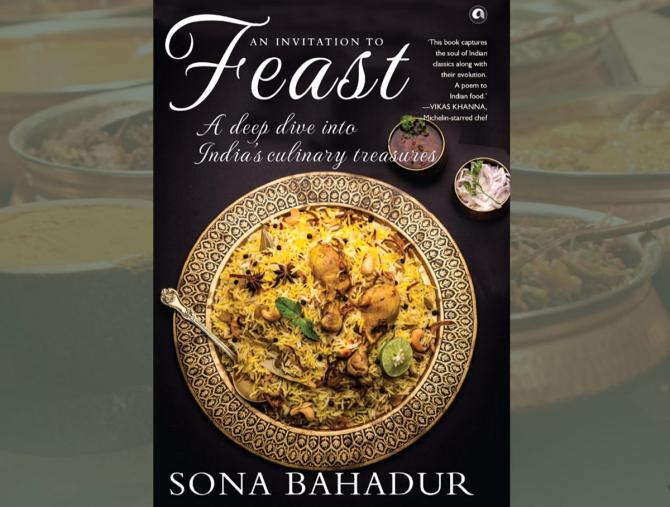
Excerpted and published from An Invitation To Feast, by Sona Bahadur, with the kind permission of the publishers, Aleph Book Company.
ALSO READ about Sona's voyages in South India looking for biryani: Have You Tasted Yummy Ambur Biryani?







 © 2026