

Despite similar tax treatment, debt MFs enjoy certain advantages over FDs.

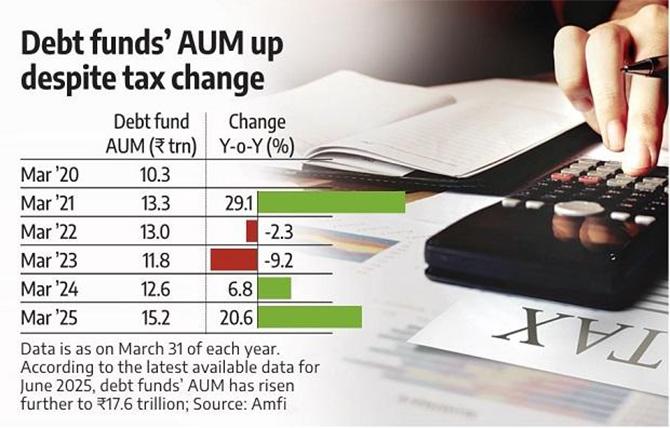
The Union Budget of 2023 removed the indexation benefit on capital gains from debt mutual funds (MFs).
This had a far-reaching impact not only on the category but also on investor behaviour.
How tax rules changed
Until March 31, 2023, gains from debt MFs held for over three years were treated as long-term capital gains (LTCG) and taxed at 20 per cent with indexation.
Gains from holdings up to three years attracted tax at slab rates.
From April 1, 2023, all gains are taxed at slab rates, regardless of holding period.
Initially, units purchased on or before March 31, 2023, were grandfathered: if held for over three years, they continued to qualify for LTCG treatment. The 2024 Budget revoked this.
For such units, the LTCG threshold was reduced to two years, and the tax rate revised to 12.5 per cent without indexation.
As a result, units bought before April 1, 2023, and redeemed on or after July 23, 2024, are taxed at 12.5 per cent if held over 24 months, or at slab rates otherwise.
Impact on flows
Debt fund assets under management (AUM) rose 48 per cent between March 2023 and June 2025.
"This is because whatever tax advantage debt funds enjoyed vis-à-vis bank FDs and other fixed-income instruments was taken away, and they were brought on a par with them.
"But it is not as if debt funds were placed at a disadvantage in terms of tax treatment," says Joydeep Sen, corporate trainer (debt markets) and author.
He adds that most investments in liquid, money market, or short-term funds anyway didn't stay invested long enough to benefit from indexation, hence the change had limited impact on these categories.
Between March 2023 and June 2025, AUMs of money market, longer-duration, ultra-short, and corporate bond funds registered highest growth, while floater, medium-duration, credit risk, and overnight funds' AUM declined.
Experts say this shift mostly reflects investor preference (except in the case of overnight funds).
Investors continue to flock to longer-duration categories.
"Despite the changed tax treatment, investors flock to these funds whenever there is a possibility of making capital gains due to a reduction in interest rates," says Vishal Dhawan, chief financial planner, Plan Ahead Wealth Advisors.
Not all investors were affected
The change adversely impacted investors in higher income tax brackets.
"But it is not such an adverse development for those who do not pay any tax, or fall in the 5 or 10 per cent tax bracket," says Deepesh Raghaw, a Sebi-registered investment advisor.
Senior citizens in lower tax brackets and non-resident Indians with no Indian income also remain largely unaffected, he adds.
Alternatives for affluent investors
Earlier, investors in higher tax brackets benefited from the tax arbitrage between debt MFs and fixed deposits.
With that advantage gone, their post-tax returns have come down, especially when inflation is also factored in.
"Many have moved to hybrid categories like arbitrage funds and equity savings funds, which offer equity-like tax treatment," says Dhawan.
Arbitrage funds: These funds allocate 65 per cent to arbitrage and 35 per cent to debt. They offer equity taxation along with low volatility.
"Investors must remember that arbitrage is a complex category. During black swan events, these funds could suffer losses," says Raghaw.
Sen recommends entering these funds with a minimum six-month holding period to allow for recovery from adverse movements.
Redemptions take slightly longer in these funds.
Equity savings funds: These funds, too, enjoy equity taxation.
Fund houses often maintain a low exposure to pure/unhedged equities to reduce volatility.
"While both are not perfect substitutes and can see some volatility, investors in higher tax brackets have shifted to them," says Raghaw.
Debt plus arbitrage fund-of-funds: This is a new category launched by the industry in response to the tax changes.
Holding them for two years qualifies investors for 12.5 per cent tax.
"Investors must understand the strategies of the underlying funds and also be mindful of expense ratio. They should also have a minimum two-year horizon," says Dhawan.
Debt MFs vs FDs
Despite similar tax treatment, debt MFs enjoy certain advantages over FDs.
"If the money is pulled out before the FD matures, investors get a lower return (the interest rate applicable to the actual holding period).
"They are also saddled with a penalty for premature withdrawal.
"In open-end debt funds, investors can stay invested for any length of time," says Dhawan.
FD interest is taxed annually and may also be subject to tax deducted at source (TDS).
In a debt MF, investors are taxed only on withdrawal, so compounding happens better here.
However, FDs provide the promised rate of return if held till maturity, while debt MF returns are market-linked and can fluctuate.
Additional tips
While investors willing to take some risk may diversify into some of the other categories mentioned above, they should continue to use debt funds in the fixed-income portion of their portfolios.
"Choose a debt fund category by matching the average maturity of the fund with your investment horizon," says Sen.
Senior citizens may use systematic withdrawal plans (SWPs) in debt funds to generate income for their monthly expenses, as stable funds are suited for such withdrawals.
Only the capital gains portion and not the entire sum withdrawn is taxed.
Avoid chasing past returns.
"The market rally driven by expectations of RBI rate cuts is over, so avoid duration bets," says Sen.
Dhawan advises focusing on credit quality and selecting funds with higher AUM and lower expense ratios.
Disclaimer: This article is meant for information purposes only. This article and information do not constitute a distribution, an endorsement, an investment advice, an offer to buy or sell or the solicitation of an offer to buy or sell any securities/schemes or any other financial products/investment products mentioned in this article to influence the opinion or behaviour of the investors/recipients.
Any use of the information/any investment and investment related decisions of the investors/recipients are at their sole discretion and risk. Any advice herein is made on a general basis and does not take into account the specific investment objectives of the specific person or group of persons. Opinions expressed herein are subject to change without notice.
Feature Presentation: Ashish Narsale/Rediff











 © 2026