

'Look at what kind of sites the child is visiting, what kind of games they are playing and then tell them about the pitfalls.'
'After the child sleeps, parents can check the history of sites visited and block sites that could be dangerous or inappropriate.'
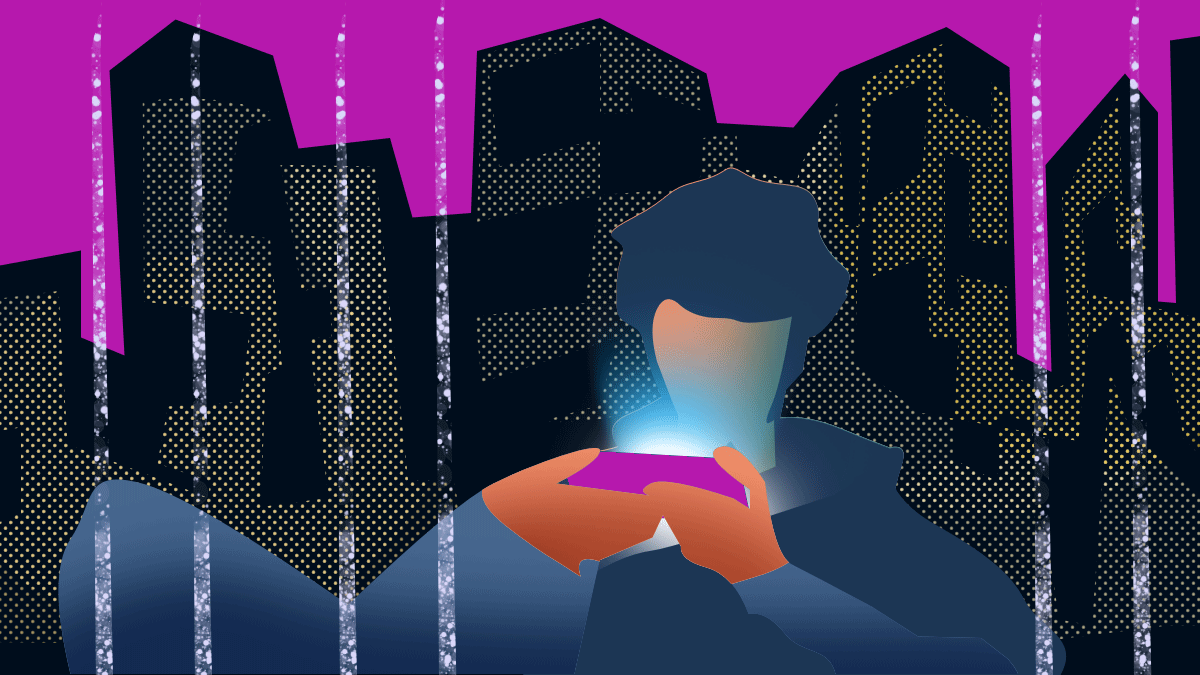
Shrinking social and recreational spaces for children is a major cause and worry and should be dealt with on a war footing if India has to deal with online gaming and digital virus addiction, asserts Dr Gulshan Rai.
Dr Rai was India's first national cyber security coordinator and is a former director general of CERT-In (Indian Computer Emergency Response Team).
"Parents need to be friends with their children, not prison wardens," Dr Rai tells Prasanna Zore/Rediff in a must-read interview.
Key Points
- 'Children spending more time on online gaming or social media are short of good social company and good social connections, both inside the house and outside.'
- 'As a parent, you need to be friends with your child. This is important because it helps you educate your child about gaming, about its pitfalls, how to use trusted gaming sites and platforms.'
- 'Schools can influence the child in the right direction. Every school must have some extracurricular period in their schedule where they teach children about the negative impact of online gaming, and give them dos and don'ts.'
- 'Teachers are more effective gurus than parents. Children can be better disciplined in school. We all learn discipline from schools. What we learn in school becomes part of our foundation as adults.'
As India grapples with a concerning surge in digital addiction among its youth, the Economic Survey 2025-2026 has brought the issue into sharp national focus.
The recent tragedy in Ghaziabad, where three young sisters took their lives allegedly influenced by online gaming culture, has intensified the debate around screen time and parental oversight.
The government's Online Gaming (Regulation) Act, 2025, which bans wagering-based games and has introduced stringent licensing requirements, represents a decisive regulatory intervention. With 85.5 per cent of Indian households owning smartphones and approximately 500 million citizens engaged in online gaming, the scale of potential harm is unprecedented.
500 million Indians hooked to online games
How serious is gaming and digital addiction among children in India today?
Online gaming has become an integral part of modern entertainment, captivating children and adults alike. There are approximately 500 million (50 crore) users in India alone -- that's one-third of our population -- hooked to online games regularly.
The industry generates more than Rs 30,000 crore (Rs 300 billion) per annum.
The mobile phone has become a tool for engaging yourself.
Originally, online gaming was designed to improve problem-solving skills and provide socialisation opportunities for children. But it has also come with potential risks. The addiction has become very large indeed.
What makes free gaming apps particularly dangerous?
There are broadly two types of games -- free and paid. Free apps are dangerous because one doesn't know where they are hosted. This creates concerns about the safety of children's information and the cybersecurity of your device.
Free apps are created for three main purposes.
- First, developers create them to expand their market and attract members.
- Second, hackers and cybercriminals create these apps to steal data or enter your system.
- Third, perpetrators use them to penetrate your system and access other systems from your mobile, infringing your cybersecurity.
Certified games -- like those advertised during IPL matches -- are more secure. They might offer free access for a limited time to increase their market presence but ultimately they are paid services, better secured from cybercriminals, cyberbullying and predators.
But largely, games in the market today are free. And free games aren't actually free -- there's a cost of hosting, maintaining, operations, the entire IT infrastructure.
How do they recover the money? Through nefarious activities like collecting data for financial crimes, cybercrimes or online fraud and cyberbullying.
There are more than 400 online gaming apps available today, hosted not only in India but elsewhere too.
At what point should parents worry that gaming is turning into addiction?
Children can be divided into three brackets: Up to 13, then up to 18 and 18 plus. Parents have better control over children up to 13 years. From 18 onwards, parental control becomes very weak.
Parents can guide children when they are younger and lay down a good foundation. If parents can create healthy controls during this period, it gives children better understanding of the pitfalls of online gaming; they become more mature.
And if the parent remains friendly with them, guiding them about online games does not become as difficult when they grow older.
The first early warning sign is if the child starts playing a game for more than 15 to 30 minutes every day and it's the same game -- that could signal addiction.
Children have to be given space to do what they feel like. But if the child is constantly hooked onto gaming while there are essential things to be done and is spending more than 30 minutes on nefarious kinds of games, then it becomes serious. That's where parents need to take stricter control.
'Children spending more time online don't have adequate social company'
Why do children get so deeply attached to online games and mobile screens?
There are multiple reasons. First, physical social gatherings -- like going down to play -- does not take place as often now.
In our time, we played so many games in the field. Today, people live in flats. Playgrounds are not there.
When playgrounds aren't available, what is the option for children?
Children need time and space to relax. So what do they do? They hook onto TV or online gaming.
About five years ago, children would watch TV. Today, TV has been replaced by online gaming.
The second factor is that both parents are working. The child is alone -- either at home or with grandparents. They have no company and hook onto online gaming because they learn it from school, from their peer group.
Third, TV media (and social media) and advertisements make children aware of so many gaming options. The media itself is promoting gaming.
Basically, one thing is very clear: Children spending more time on online gaming or social media are don't have adequate social connections, both inside the house and outside.
What mistakes do parents commonly make while dealing with gaming addiction?
Normally, parents force children to study. They become unreasonable in their control. That actually makes things more difficult. Children are friendly with their grandparents but have adverse relations with parents because parents try to control too much.
Parents need to become friends with the child, whatever the age, and slowly teach them about the pitfalls of gaming right from the time the child starts understanding things. Being friends with your child is important; it helps you educate your child about gaming, about its pitfalls, its negative impact and how to use trusted gaming sites and platforms.
I believe mothers have a more particular role to play because the child is usually closer to the mother -- they have a special bond.
Parents need to tell their children: 'You want to play a game? Play the game, no problem but protect your personal information.' Children should protect their name, address, school, financial details. They should recognise and report inappropriate behaviour in games.
How can parents set digital rules without damaging trust?
Parents have to be sympathetic. They have to spend more time with the children. They must give them space to play. These are the fundamental things.
Secondly, the devices are bought by the parents. They should buy all the connected software -- antivirus software, parental control apps so that if there's any virus in the system, it won't damage the device.
Parents will have to develop their own method of supervising the child in a manner that the child doesn't feel offended.
Look at what kind of sites the child is visiting, what kind of games they are playing and then tell them about the pitfalls.
After the child sleeps, parents can check the history of sites visited and block sites that could be dangerous or inappropriate.
If parents try to tell their children themselves, sometimes children don't take the advice positively. Children tend to believe whatever information is available on social media about the game much faster.
'Teachers are more effective gurus than parents'
What role should schools play in addressing digital addiction?
Schools can influence the child in the right direction. Every school must have extracurricular periods in their schedule where they teach children about online gaming, the pitfalls or bad impact and give them dos and don'ts.
Content can be downloaded from the internet -- case examples of exploitation using online gaming or social media, examples of fraud... all cases are available. There should be a period (in schools), maybe one weekly period, where teachers can educate students about these dangers.
Teachers are more effective gurus than parents. Children can be better disciplined in school. We all learn discipline from schools. What we learn in school becomes part of our foundation as adults. We remember what our teachers used to tell us.
Today, if you go to YouTube, there are many episodes available which tell you in a simple way about the bad impact of online gaming, cases of the pitfalls. One doesn't have to prepare anything -- just download those and show the children. That makes a deep impact on the mind and heart of the child.
Should the government make it mandatory for schools to teach digital hygiene?
Absolutely. The government has issued advisories telling schools to do that. It should be mandatory because I think it will play a huge role in containing this virus (digital gaming and digital addiction).
Children spend half the day in school -- six to eight hours every day, from Monday to Friday. They learn from their classmates there, from their peers.
When parents go for a parent-teacher meeting, they must ask the teacher: 'Please tell us who are the peers with whom our child is interacting.' Each teacher knows information about the child.
Parents should request in parent-teacher association (PTA) meetings that class teachers give feedback about the student, about their peers, about the company they keep. That will also help.
When should parents seek professional help for digital addiction?
This varies from child to child and from parent to parent.
As the first step, parents should try to deal with the child on their own.
Then, if needed, they should take the help of an outsider who is not a professional consultant. They should organise things in such a manner that the advice and counselling seem natural.
If the child becomes more aggressive, then they have to go to a psychologist. If the child isn't listening and becoming violent, then they must consult a psychologist who should be able to deal with such aggression.









 © 2026