

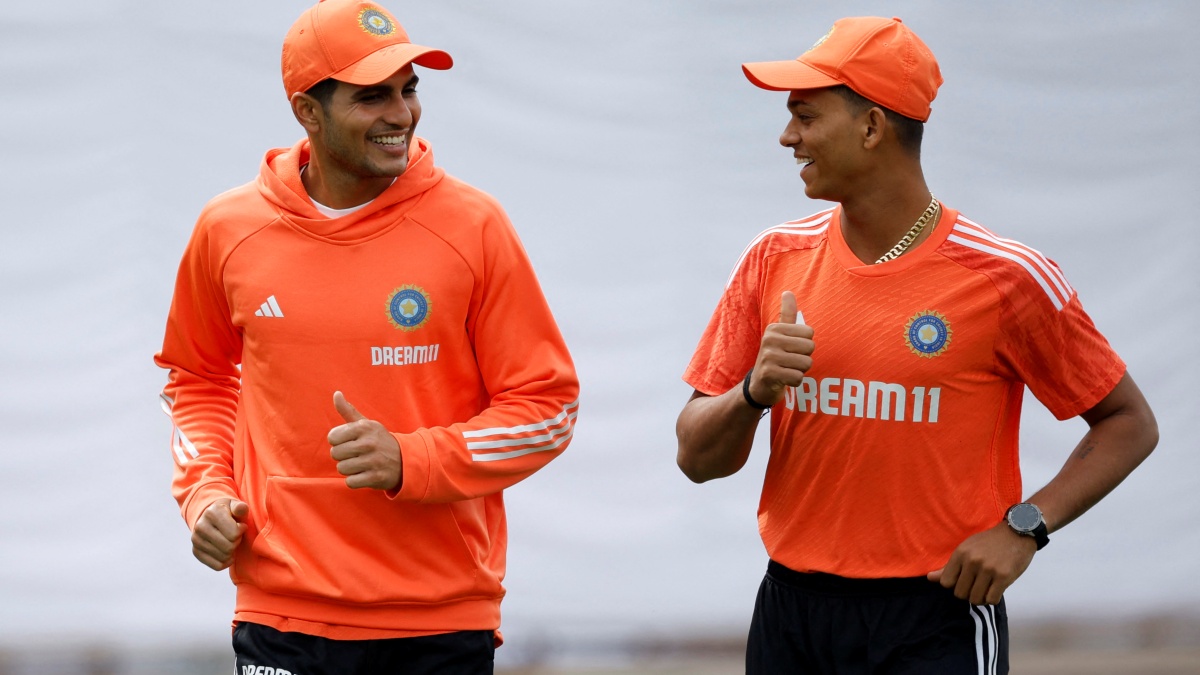
The newly-appointed Test skipper, Shubman Gill, rewrote a massive chunk of batting record books with a 754-run outing during the tour of England, which saw him score four centuries in five matches and walk away with the Player of the Series honours.
Already a force to be reckoned with in ODIs, having scored 2,775 runs and 22 fifty-plus scores in 55 matches, there have been temptations to play him in the upcoming T20 Asia Cup, starting on September 9.
India will kickstart their campaign on September 10 against the UAE. Media reports suggest that Gill could make his return to the T20I team, possibly as vice-captain. According to ESPNcricinfo, he could also be in line to take over the ODI leadership once current skipper Rohit Sharma calls it quits.
The question is: does Gill fit into India’s T20I plans? His most recent T20 outing came in the Indian Premier League (IPL) 2025, where he scored 650 runs at a strike rate of almost 156, with six fifties in 15 matches, finishing as the fourth-highest run-getter. He is also seen as one of the faces who could dominate all-format cricket for India in the coming decade.
But the selection process is still complex. The last time India played a full-strength T20I squad, Rohit Sharma and Virat Kohli were still part of the setup for the T20 World Cup 2024, with Gill travelling as a reserve outside the main 15. Since then, scheduling and injuries have influenced India’s T20I selections.
After the World Cup, Gill led a second-string Indian side to a series win in Zimbabwe, and July 2024 was the last time he played T20Is for India. He ended 2024 with 266 runs in eight matches at an average of 38.00 and a strike rate of 133, including two fifties from the Zimbabwe series. This improved his career T20I numbers to 578 runs in 21 innings at an average of 30.42 and a strike rate of over 139, with one century and three fifties—following an inconsistent start to his T20I career.
Gill was appointed as Suryakumar Yadav’s deputy for the July T20I series, but as Test cricket took priority, he was not picked for subsequent T20Is. In his place, Sanju Samson, Abhishek Sharma and Tilak Varma emerged as India’s new top three. Gill missed the T20Is against Bangladesh in October, the series in South Africa in November, and the home T20Is against England in January this year.
The January T20Is were scheduled soon after a disappointing Border-Gavaskar Trophy in Australia, and with the ICC Champions Trophy in March taking priority, Gill was picked for the England ODIs instead. During that T20I run, all-rounder Axar Patel was given the vice-captaincy.
The scheduling remains extremely tight: after the Asia Cup final on September 28, India’s home Tests against West Indies will begin on October 2. Selectors must choose their best Asia Cup squad with an eye on defending the T20 World Cup titles at home and in Sri Lanka next year. Since their T20 World Cup win, India have dominated bilateral series, winning 17 of 20.
In Gill’s absence, Abhishek Sharma cemented his spot with a 279-run series (at a strike rate of 220) against England, including a blistering 135 off 54 balls at Wankhede. While Sanju’s recent scores were low, he had earlier smashed three centuries in five innings during the home series against Bangladesh and the away series in South Africa.
Since the last T20 World Cup, Abhishek has been the top run-scorer among all top-order options, with 1,363 runs in 40 innings at an average of 34.94 and a strike rate of over 198, including four centuries and six fifties. His best score is 141.
Tilak Varma has also been prolific, scoring 1,200 runs in 32 innings at an average of 50.00 and a strike rate of 153.84, with three centuries and five fifties—two of those hundreds coming on the South Africa tour last year.
Samson has found a new lease of life as an opener alongside Abhishek, scoring 908 runs in 30 innings at an average of 33.62 and a strike rate of 157.09, with three centuries and three fifties.
Skipper Suryakumar Yadav has managed 1,107 runs since the T20 World Cup win, at an average of 36.90 and a strike rate of 161.13, with eight fifties, though his international form has dipped.
Gill, in this period, has scored 893 runs in 22 matches at an average of 47.00 and a strike rate of over 147, with eight fifties and a best of 93*.
With Abhishek, Samson and Tilak in form, and Surya still around, the top order is heavily crowded, leaving little space for Gill.
Like Gill, Yashasvi Jaiswal last played a T20I in July 2024, as India used his Test batting in the home season and away tours of Australia and England, where he scored 391 and 411 runs respectively in those series. Jaiswal was the back-up opener ahead of Gill for the 2024 T20 World Cup, when India preferred Rohit Sharma and Virat Kohli as the opening pair.
Having scored 723 runs in 23 T20Is at a strike rate of over 164, with a century and five fifties, Jaiswal’s 559-run season in 2025 (six fifties in 14 matches at a strike rate of almost 160) has revived his T20I prospects.
If the Samson-Abhishek combination at the top is not broken, it will be difficult to fit Gill or Jaiswal into the first-choice XI. With the Asia Cup squad likely capped at 15 players—as with the T20 World Cup—selectors will have to make tough calls, given the need for backups in other roles. Samson’s wicketkeeping gives him an edge.
Ultimately, it could boil down to a choice between Jaiswal and Gill for the Asia Cup, depending on who the selectors believe can make the bigger impact.











 © 2026