

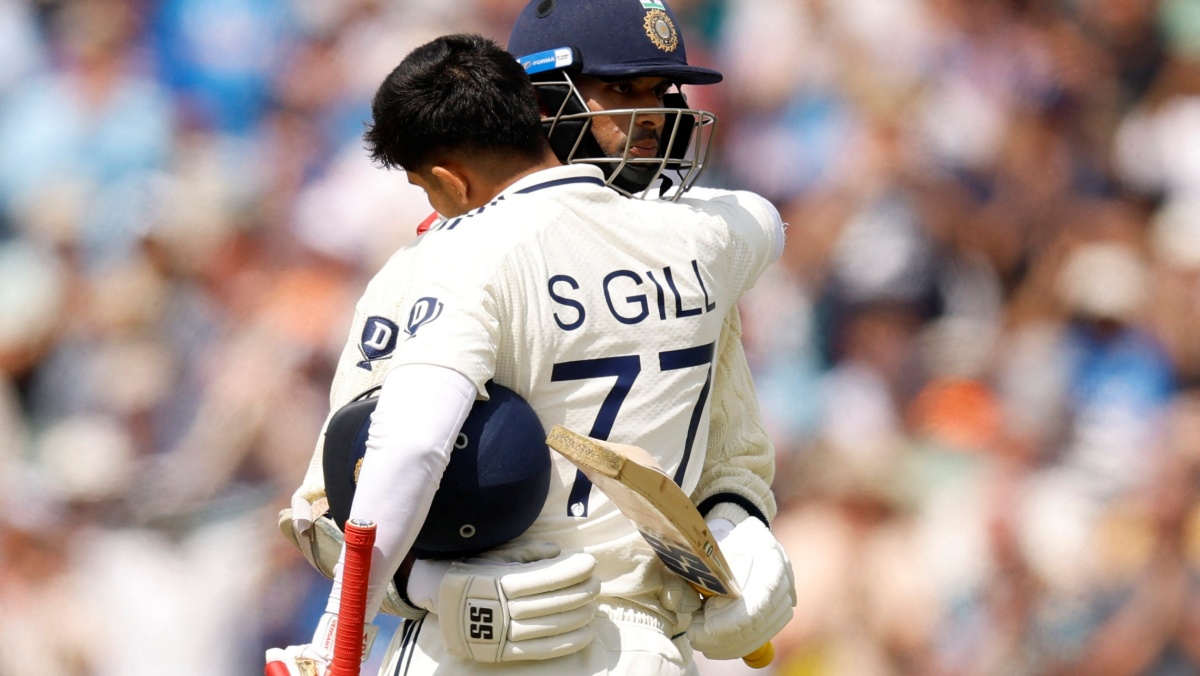
After a poor show by the lower-order batters in the first Leeds Test, Team India scripted a memorable comeback at Birmingham — one for the history books — as they registered the most runs in a Test innings after the fall of the fifth wicket.
India achieved this feat during the second Test at Birmingham. At one point on Day One, the visitors looked in trouble at 211/5, with Rishabh Pant and Nitish Kumar Reddy dismissed in quick succession.
However, skipper Shubman Gill, who went on to score a historic double century, stood firm and led the revival. Determined to prove himself as India’s best batter on tour, Gill ensured that the lower-order contributed meaningfully. He stitched together a 203-run stand for the sixth wicket with Ravindra Jadeja, followed by a 144-run stand for the seventh wicket with Washington Sundar.
Jadeja played a carefully constructed knock of 89 off 137 balls, including 10 fours and a six. Sundar provided further stability, scoring 42 off 103 balls with three fours and a six, allowing Gill to continue his record-breaking exploits.
Akash Deep (6), Mohammed Siraj (8), and Prasidh Krishna (5) chipped in with crucial runs, helping India add a total of 376 runs after the fall of the fifth wicket — their most in a Test innings. India were eventually bundled out for 587, a massive total that now stands as their fourth-highest in England. Their best remains 664 at The Oval in August 2007, a match that ended in a draw.
With this effort, India surpassed their previous best of 370 runs added after the fifth wicket, achieved against the West Indies at Kolkata in 2013. On that occasion, after being reduced to 83/5, debutant Rohit Sharma (177 off 301 balls, with 23 fours and a six), skipper MS Dhoni (42), and Ravichandran Ashwin (124 off 210 balls, with 11 fours) mounted a remarkable lower-order fightback to take India to 453 all out.
Rohit and Ashwin shared a memorable 280-run partnership for the seventh wicket in what turned out to be Sachin Tendulkar’s final international match.











 © 2026