
The National Pharmaceutical Pricing Authority will monitor how companies are increasing prices of non-scheduled drugs.

Recalling or relabelling medicines already in the supply chain before September 22 will not be mandatory, the finance ministry said on Tuesday, issuing a fresh set of frequently asked questions (FAQs) to address industry concerns following the announcement of goods and services tax (GST) revisions.
Leading pharmaceutical firms such as Cipla and Ranbaxy are among the firms pulled up by the drug price regulator National Pharmaceuticals Pricing Authority (NPPA) for overcharging.

The regulator is now probing 24 hospitals, including Max Hospital in New Delhi and Lilavati in Mumbai, for allegedly overcharging patients for stents

Drug major Novartis has been slapped with a Rs 300-crore penalty by drug regulator NPPA for overcharging consumers on sale of Voveran, its best-selling painkiller medicine.

In a move likely to influence future drug price regulation in the country, the National Pharmaceutical Pricing Authority (NPPA) has started a process to understand how other countries carry out this function.The authority has already studied the relevant regulatory systems in at least eight major countries. It has also finalised a round-table meeting on April 11 in New Delhi to sensitise stakeholders on the need to have an international outlook.

The government has been stringent with pricing changes. Prices of 651 essential medicines came down from April 1, 2023 by 6.73 per cent with the government capping ceiling prices of these drugs.

For the consumer, there would be practically no impact on prices of essential medicines this year.

The first-ever study conducted by the National Pharmaceutical Pricing Authority (NPPA) on cancer medicines has found huge price variations among different brands of same medicines sold in the country.
NPPA will begin analysing pricing trends of 74 bulk drugs that come under the government-notified price-controlled list every quarter.

Notwithstanding the fact that the country's pharmaceutical (pharma) pricing regulator has allowed a 12 per cent price increase for medicines listed under the National List of Essential Medicines (NLEM) in 2023, analysts and industry insiders predict that the overall domestic pharma industry will only witness a price hike of 5-6 per cent. This is attributed to higher competitive intensity in the market. Krishnakumar V, executive director and chief operating officer (CEO) of Eris Lifesciences, a domestic-focused pharma company, noted that the NLEM segment experienced growth suppression of around 150 basis points due to price reductions during the January to July period this year.

The top 300 pharmaceutical brands in the country will now bear a quick response (QR) code on their packaging to rein in spurious drugs and ensure better traceability.
As many as 34 new drugs were added to and 26 dropped from an updated list of essential medicines on Tuesday, with the government saying this will reduce "patients' out-of-pocket expenditure". The National List of Essential Medicines (NLEM 2022) has 384 drugs, up from 376 in 2015. "Drafting this list is a lengthy process, and around 350 experts from across India have held over 140 consultation meetings to draft the NLEM 2022," Union Health Minister Mansukh Mandaviya said.

The medical devices, which have been in high demand during the Covid-19 pandemic, will now see a drop in prices, as the earlier margins were up to 709 per cent for some of these products.
Novartis India is up in arms against a two-month old decision of the National Pharmaceutical Pricing Authority to reduce the price of its flagship brand Voveran on public interest grounds. The annual sales of Voveran, the brand name for pain reliever medicine diclofenac, exceed Rs 100 crore and account for one-fourth of the company's total sales turnover. The company has filed a review petition with the chemicals and fertilisers ministry against the authority's decision.
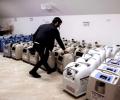
The government has capped the trade margin on oxygen concentrators at 70 per cent in order to keep in check the price of the much in demand critical life saving component amid the second wave of the coronavirus pandemic. The trade margin has been capped at 70 per cent on price to distributor level on oxygen concentrators. In an official release, the chemicals and fertilisers ministry said the decision has been taken in view of the extraordinary circumstances arising due to the pandemic which has resulted in volatility in Maximum Retail Prices (MRP) of oxygen concentrators.
The National Pharmaceutical Pricing Authority has revised prices of 440 medicines. Around 300 medicines have seen price cuts, while the others have seen a hike, sources said. The extent of the revisions is not known as yet.

The government has also given permission to 20 plants to produce the antiviral drug.
According to highly placed sources in NPPA, the reduction in prices following the latest exercise will range between six and 53 per cent.
The government said that "in exercise of extraordinary powers in public interest, conferred by paragraph 19 of the DPCO, 2013", the ceiling prices of 21 key formulations had been increased. These formulations include common medicines like BCG vaccines, penicillin, malaria and leprosy medicines (Dapsone), life-saving drugs like Furosemide (used to treat fluid build-up due to heart failure, liver scarring, or kidney disease), vitamin C, some common antibiotics, and anti-allergy medicines.

NPPA's decision would also benefit domestic stent makers.

The National Pharmaceutical Pricing Authority has decided to have one price for basic utility condoms and the other for pleasure condoms.

With these 18 drugs, the government now has brought in 467 medicines under the price control.
NPPA suggests expanding the list of essential medicines whose prices are controlled
The idea is to keep a close watch on real-time price movements, the maximum retail price of medicines and their availability.
NPPA seeks data from firms to revalidate existing prices.

Ties between India and the United States have been strained in recent years because of trade policies and patent disputes.

Face NPPA fine for overcharging on anti-asthma drug

Even as the Supreme Court had recently dismissed the industry's plea against prices fixed by the regulator and its timely implementation, the National Pharmaceutical Pricing Authority has asked companies to pay the overcharged dues with 15 per cent interest.
The intention of the government is to cap prices of drugs that are essential and which the public widely uses.
Govt has given the medicine price regulating body a freedom to control prices of medicines.
The prices of essential medicines may drop, as the National Pharmaceutical Pricing Authority (NPPA) has made significant changes in its norms to rationalise price approvals.

This import duty exemption would remain in force till October 31 this year.
Currently, the govt directly caps prices of 348 formulations at the average price of all medicines in a particular segment with at least 1% market share

The NPPA letter was issued to GSK on Wednesday.

The drug pricing regulator on Tuesday said it will fix the ceiling prices of over 300 medicines by the end of this month, a move that will come as a major relief to patients.

In a relief to pharma majors, the Delhi high court today held as "illegal and unsustainable" the Centre's decision to put a ceiling on the price of condoms, including the luxury variety.

These items will remain under essential commodities segment till June-end, a move aimed at ensuring availability at reasonable prices and cracking down on hoarders/black marketeers.

The government plans to rationalise trade margins for many other medical devices, besides stents and knee implants.

Aneesh Phadnis and Veena Mani find out what the manufacturers and the hospitals have to say.
 © 2026 Rediff.com - Advertise with us - Disclaimer - Privacy Policy - Sitemap - Feedback - About us - Terms of use - Grievances