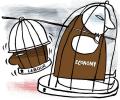
The new labour Codes, notified by the central government in November 2025, have pushed up employee costs for private-sector banks and insurance companies, with these firms reporting higher operating expenses in the October-December quarter (Q3FY26) due to the statutory impact of the new labour Codes.

Companies would have to recognise the increase in gratuity liability arising from new labour codes in their interim financial statements and results for the period ending December 31, the Institute of Chartered Accountants of India (ICAI) has said in its FAQs on the new labour codes.

For MSMEs the transition could mean higher wage bills and tougher compliance -- unless strong handholding follows reports Auhona Mukherjee.
SIS Ltd, a security and facility management services provider, aims to cross Rs 20,000 crore in revenue by FY27, driven by strong double-digit growth, expansion of its service network, and a simplified regulatory framework under new labour codes, said its Group Managing Director Rituraj Sinha.

IT services major Wipro on Friday reported a 7 per cent decline in consolidated net profit to Rs 3,119 crore in the third quarter of FY26, weighed by a one-time provisional impact of Rs 302.8 crore due to the implementation of new Labour Codes.
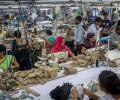
While the move may give a competitive edge over rivals like Bangladesh in the global market, several industry bodies raised concerns that many state governments may not implement it on the ground.

IT services firm HCLTech on Monday reported a 11.2 per cent decline in consolidated net profit to Rs 4,076 crore in the October-December quarter of FY26.
Infosys on Wednesday reported a one-time exceptional hit of Rs 1,289 crore on account of the impact of the implementation of new labour codes, as India's second-largest IT services firm announced its December quarter earnings.

'Workers are the people who create all the wealth in this country. How can you call them anti-national?'

India's largest airline IndiGo on Thursday reported a 78 per cent decline in December quarter net profit at Rs 549.1 crore as flight disruptions and implementation of the new labour code took a toll on its earnings. The airline reported a net profit of Rs 549.1 crore in the October-December quarter, compared with Rs 2,448.8 crore earnings in the year-ago period, according to a company statement.

'Workers are being pushed into 12- to 14-hour shifts under poor conditions. These largely leaderless protests are likely to continue.'

From appointment letters becoming mandatory to gig workers receiving social security to enhanced rights for women and contract labour, the changes reflect India's attempt to balance ease of doing business with stronger worker welfare.
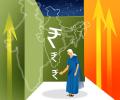
The World Bank has affirmed India's strong position to withstand the current global energy shock, citing high foreign exchange reserves, fiscal space, and low inflation as key buffers supporting continued growth despite international headwinds.

Hiring demand strongest in ecommerce, tech startups, healthcare, and energy sectors, with Bengaluru, Hyderabad, and Pune leading.

The Maharashtra government has initiated action against those involved in an alleged job fraud targeting fresh graduates with the promise of jobs at Hinjewadi IT Park in Pune. The government is also working on regulations to address forced resignations and layoffs in the IT sector.

Two of the three strikes are related to the gig economy, a centrepiece of the new labour Codes.

A nationwide strike called by central trade unions saw a mixed response across India, impacting various sectors and states differently, with some areas experiencing disruptions while others remained largely unaffected.

FMCG major Hindustan Unilever Ltd (HUL) on Thursday reported a two-fold jump in consolidated net profit to Rs 6,603 crore in the December quarter of FY'26, on a year-on-year basis, driven by a one-off positive impact from the demerger of its ice cream business.
Hindustan Unilever Limited's (HUL's) standalone revenue grew 4.4 per cent year-on-year (Y-o-Y), while volume rose 3.5 per cent during the third quarter of financial year 2026 (FY26).

Stocks of fast-moving consumer goods companies have taken it on the chin in calendar year 2026 (CY26) with the Nifty FMCG index falling over 6 per cent compared to the Nifty 50 dipping 0.8 per cent. Nifty FMCG is one of the worst-performing sectors on the NSE in CY26.

From the 30-Sensex firms, Bharat Electronics surged nearly 9 per cent post its December quarter earnings. Eternal, Bajaj Finance, Power Grid, Trent, Mahindra & Mahindra and UltraTech Cement were the other major gainers. Maruti, Sun Pharma, Infosys and Bharti Airtel were among the other laggards.

Maruti Suzuki sold more cars than ever before, earned more money, and saw many first-time buyers choosing small cars again.

Cigarette-to-soap conglomerate ITC on Thursday reported a consolidated net profit (attributable to owners) of Rs 4,931.19 crore for the third quarter (October-December/Q3) of 2025-26 (FY26), affected by a one-time provision related to the new labour codes and a base effect from an exceptional item in Q3 of 2024-25. In the year-ago period, net profit had stood at Rs 4,934.8 crore.

'In the last one year, we have added more than Rs 1.7 trillion, and we are on track.'
The country's largest IT services company TCS on Monday reported 13.91 per cent decline in December quarter net profit at Rs 10,657 crore. The Tata Group company had posted a net profit of Rs 12,380 crore in the October-December period of FY25 and Rs 12,075 crore in the preceding September quarter.

'The trade deficit in some sectors is huge and that is an area of opportunity to localise.'

From the 30-Sensex firms, Trent, Larsen & Toubro, Reliance Industries, InterGlobe Aviation, Maruti, ITC, Adani Ports and Bharat Electronics were among the biggest laggards. In contrast, Eternal, ICICI Bank, Tech Mahindra, State Bank of India and Tata Consultancy Services were among the gainers.

'Given that the population is almost evenly split, the Indian economy cannot grow without women participating in the workforce.' 'While women's participation has increased, it is still well below 40 per cent,' says Kartik Narayan, CEO of the professional networking and jobs platform, Apna.

India's real gross domestic product (GDP) is likely to grow at 7.5 per cent in FY26 and moderate to 7 per cent in the subsequent fiscal year, a domestic rating agency said on Wednesday.

'Raising the retrenchment, layoff and closure threshold to 300 workers for prior government permission enables hire-and-fire in more than 90 per cent of the Indian workplaces. More than 12,00,000 disputes are now pending for adjudication with an average disposal period ranging from 3 to five years for more than 75 per cent of the disputes.'

'It will increase the contribution to gratuity, which is something the employer has to give.'

India, the world's fourth largest economy, is set to maintain the 'goldilocks' phase with tailwinds of good growth, low inflation and robust banking performance as well as reform initiatives poised to sustain the economic pace witnessed during 2025.

'Companies will need to revisit compensation structures, contracts, staffing models, and human resources system.'

Trade unions have decided to launch a phased, consistent struggle to press for the withdrawal of the labour codes and go on a countrywide general strike in February next year, a statement said on Tuesday. The date of the strike will be announced on 22nd December 2025 in the next meeting of the joint forum of central trade unions, a statement said.

The Indian government has expressed its disagreement with the IMF staff's 'baseline' assumption that the 50 per cent US tariffs on its goods exports 'would remain in place indefinitely', based on which the staff pegged the country's GDP growth at 6.6 per cent this year, and pared its 2026-27 projection by 20 basis points to 6.2 per cent.
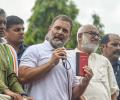
Congress leader Rahul Gandhi accused the BJP of rigging the Maharashtra assembly elections and expressed concerns about similar tactics being used in the upcoming Bihar polls. He alleged that the special intensive revision of electoral rolls in Bihar is an attempt to manipulate the election process.
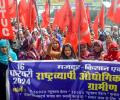
Over 25 crore workers across India are set to strike against new labour codes and privatisation, potentially disrupting banking, postal, and other essential services.
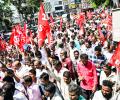
A nationwide strike called by trade unions to protest against the central government's labor policies had a mixed impact across India. While normal life remained largely unaffected in most parts of the country, some sectors like banking, transport, and insurance experienced disruptions. Sporadic incidents of violence were reported in West Bengal.

The resilience of the economy and strength of domestic demand will continue to make India an engine of growth amid the rapidly evolving global trade landscape as a result of US tariffs, Finance Minister Nirmala Sitharaman said in London on Tuesday.

The government on Wednesday said it would put in place a new labour law within the next six months, incorporating reforms in the sector, as part of measures to bring it in tune with the liberalised environment.
 © 2026 Rediff.com - Advertise with us - Disclaimer - Privacy Policy - Sitemap - Feedback - About us - Terms of use - Grievances