

'It will increase the contribution to gratuity, which is something the employer has to give.'
Days after the Centre notified the long-pending four labour Codes, the labour ministry is busy with preparatory work in finalising the rules.
In an interview at her office in New Delhi, Labour Secretary Vandana Gurnani tells Shiva Rajora and Asit Ranjan Mishra/Business Standard how the ministry plans to enforce worker protections without bureaucratic drags and how states are aligning their rules with the national framework.
Labour is a concurrent subject and states too need to notify the Labour Code rules.
How are the states gearing up? What kind of interaction are you having with the states?
Interaction is a continuous process. It is not that it is happening only now. We've had six regional consultations with the states and their rules are in sync with the national framework.
States have the flexibility to adapt the rules to their local context. We will continue to have this engagement and in areas where they need support.
Since states have the flexibility in rulemaking, don't you think rules may diverge drastically and in turn may create problems for both employees as well as employers?
The rules that states have made are in sync with whatever the national framework is. In the Codes, there are sections in which only the states have to make rules, so they will be making those rules.
So it's not as if there will be a huge divergence because the overall framework has been set by the Codes. We have not seen any such divergence [yet].
How do you ensure that worker-friendly provisions such as the minimum wage and universal social security are executed?
On minimum wage, there is no confusion regarding its application. It is universal now. Many a time legislation is not enforced easily because of grey areas [in interpretation].
Soon floor wage will also be declared, meaning that no state can set its minimum wage below the floor rate.
We want to make the inspection system web-based, using artificial intelligence and big data.
We would make sure that the energy of the labour machinery is focused on defaulting organisations and that it has better oversight over such organisations. Human interface is going to be reduced.
On safeguards for workers, grievance-redressing committees with tripartite representation are proposed in workplaces, apart from having trade unions.
In fact, trade unions get legal recognition under the Codes.
Tribunals, which are the legal recourse for workers, are also being broadbased. Each tribunal will have an administrative member, along with a judicial member.
This is being done with the expectation that a two-member tribunal will be able to dispose of cases faster. So these are the legal safeguards.
For social security to unorganised workers a tripartite national board will be set up, which will be able to oversee the rollout of the social security for the unorganised sector.
Similarly, a separate board has been proposed for gig and platform workers. All these will be tripartite in nature.
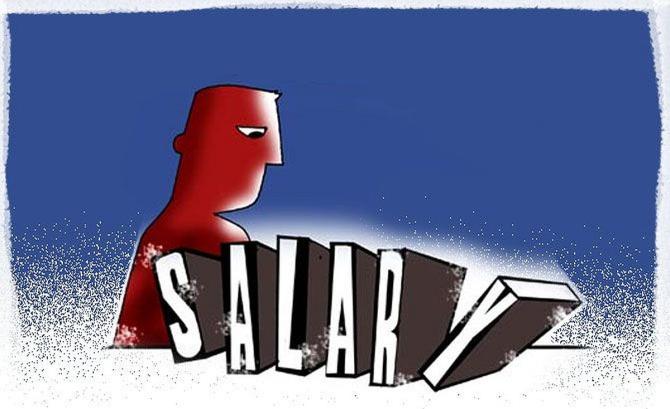
Due to change in the definition of wage, companies also have to change the wage structure.
Don't you think it will be unpopular with the employees because the take-home salary may come down?
This formula needs to be understood. It says that if the allowances are more than 50 per cent (of the total) -- in the past there was a tendency to depress the wage and to increase the allowances -- the difference gets added to the basic wage.
Now, what does it do? It will increase the contribution to gratuity, which is something the employer has to give.
It will increase the maternity benefit, which is linked to the wage and is, again, the employer's responsibility.
When it comes to provident fund [remember that] contribution is mandatory up to basic wage of Rs 15,000. It's a very small amount or a small proportion.
The vast majority is voluntary and is between employer and employee. Hence, the impact of this in terms on the number of people affected, as well as the amount of deduction, is going to be minuscule.
Therefore saying the take-home salary will drastically reduce is [not right].
The International Monetary Fund on November 26 said AI might disrupt the labour market in India significantly.
How do you see this in the context of the Codes? How prepared are we?
Most assessments have shown while AI will disrupt some jobs, it will also create jobs.
We in the labour ministry are trying our best to make sure that our national career service (NCS) portal, which we offer as a job-matching kind of a service, is upgraded.
It has been significantly upgraded. We are working on a pilot where we want to see how we can take NCS towards our digital public infrastructure, which can be used by various people in the ecosystem.
***
Govt to release compliance handbook for new labour codes: Labour secy
The Centre is set to release a compliance handbook to help businesses comply with the four new labour codes, Labour Secretary Vandana Gurnani said on Friday.
Speaking at an event organised by the PHD Chamber of Commerce and Industry, Gurnani said the government will work with the industry for smooth implementation of the codes and better understanding of the new system of compliances.
"We are also working on a compliance handbook, which will tell what the simplified compliances now are. We will disseminate it physically as well as electronically," Gurnani said.
The labour secretary further added that the government and the industry need to collaborate so they can together carry this message to the last mile where businesses also know what is now required from them.
Gurnani said both the Centre and state governments will help labour inspectors understand their new role of inspector-cum-facilitator and provide them with training.
She stated that both the central and state labour commissioners organise forums and meetings regularly to give clarifications on any concerns that businesses may have.
"We would be happy to deploy our machinery so that they can explain what is in the codes. This effort of taking the message of the codes down should be a joint effort between the government and the industry," she added.
Under the new codes, the inspector-cum-facilitator has to provide a 30-day notice to businesses before taking any action when an instance of non-compliance is found.
The draft rules of the new codes, which will be up for a 45-day public consultation with stakeholders, are yet to be notified by the labour ministry.
The central government notified the four labour codes last month, five years after they were passed by Parliament, reforming and consolidating the 29 existing labour laws.
The four labour codes -- the Code on Wages (2019), Industrial Relations Code (2020), Code on Social Security (2020), and Occupational Safety, Health and Working Conditions Code (2020) -- are intended to modernise labour regulations, enhancing workers' welfare and aligning the labour ecosystem with the evolving world of work.
-- Auhona Mukherjee
Feature Presentation: Aslam Hunani/Rediff











 © 2026