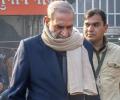
Sajjan Kumar is currently lodged in Tihar jail.
A Delhi court acquitted former Congress MP Sajjan Kumar in a case related to inciting violence in Janakpuri and Vikaspuri areas during the 1984 anti-Sikh riots.

The BJP has demanded the death penalty for former Congress MP Sajjan Kumar, who was sentenced to life imprisonment for his role in the 1984 anti-Sikh riots. The party's leaders have called for the CBI to appeal the verdict, saying it was not an ordinary murder case but a genocide. The BJP has also said that the "wheels of justice" are starting to turn and that other Congress leaders involved in the riots will soon face consequences.

A Delhi court sentenced former Congress MP Sajjan Kumar to life imprisonment for his role in the murder of two Sikhs during the 1984 anti-Sikh riots. The court cited Kumar's age and illness as mitigating factors in its decision to impose a lesser sentence than the death penalty. Kumar was convicted for being part of a mob that set fire to the victims' home and killed them. This is the second life imprisonment sentence for Kumar in connection with the 1984 riots. He is also facing other charges related to the riots.
Former Congress MP Sajjan Kumar now faces a maximum of death penalty and a minimum of life term in prison after being convicted on Wednesday by a Delhi court in a murder case stemming from 1984 anti-Sikh riots.

A Delhi court has convicted former Congress MP Sajjan Kumar of murder in a 1984 anti-Sikh riots case. The court found that Kumar was part of an unlawful assembly that killed the victims and is guilty of the murders of Jaswant Singh and Tarundeep Singh. Kumar now faces a maximum of the death penalty and a minimum of life in prison. The court rejected Kumar's argument that the statement of the complainant couldn't be trusted, as she named him belatedly and held at the time of the incident she was not aware of the identity of the accused as she was admittedly new to the area and had never seen him earlier. The court also found the other residents of the locality were reluctant to come forward to aid the victims at the time of the incident, leading to the conclusion that they would also not support the victims' version in court.
While the Congress party's popularity is on the wane, an aggressive Akali Dal is moving in quickly to encash on the hurt feelings of the Sikh community and pitch itself as the only party which works for its interests, says Anita Katyal

A Delhi court, hearing a 1984 anti-Sikh riots case involving senior Congress leader Sajjan Kumar, was Monday told by the Central Bureau of Investigation that there was a conspiracy of "terrifying proportion" between him and the police during riots.
The cases in which the chargesheets were filed against Kumar and others were registered in police stations -- Sultanpuri and Delhi Cantt-- following the killing of seven and five persons respectively in the riots that broke out after the assassination of the then Prime Minister Indira Gandhi.
A Delhi court on Thursday refused to grant bail to a co-accused of former Congress MP Sajjan Kumar in a 1984 anti-Sikh riots case, terming the charges relating to murder and arson against him as "direct and serious" in nature.

'1984 is important as it is the beginning of the State making war against its citizens in India.' 'Since then, we had the government of the day organising riots or genocide by attacking certain people.'

'No one talks about the Mumbai riots anymore, though like Delhi 1984, the guilty have not been punished. In Gujarat, many powerful leaders of the state's ruling party are in jail for their role in the riots... In Mumbai, only one politician of the Shiv Sena, a former MP, was convicted of hate speech, along with two other Shiv Sainiks, one of whom was a corporator and the other a junior functionary... So why the apathy? Could it be because despite these statistics and the widely-publicised findings of the Srikrishna Commission, what remained in public consciousness was the violence by the Muslims, thanks to a highly efficient Sena propaganda machine? There's no demand for it, but would an SIT probe into the closed cases of the Mumbai riots help today?' The fadeout of Mumbai's riots from public debate can be called a triumph of the communal State, argues Jyoti Punwani.
 © 2026 Rediff.com - Advertise with us - Disclaimer - Privacy Policy - Sitemap - Feedback - About us - Terms of use - Grievances