
The Bombay High Court has criticised the Foreigners Regional Registration Office (FRRO) for failing to process the exit permit of a US national facing religious conversion charges, despite a court order allowing him to travel.

"How can an officer be suspended for judicial orders which can be appealed against and rectified by the higher judiciary?" he asked.

Flouting a court's order was "inexcusable" and it would amount to a breakdown of law and order.
The Supreme Court has expressed serious concern over the rising cases of digital arrest cybercrime in India, where fraudsters extort money from victims by posing as law enforcement officials. The court has vowed to deal with such cases with an iron hand and has sought reports from the Ministry of Home Affairs and the CBI.

The Supreme Court has directed the CBI to conduct a pan-India investigation into digital arrest scams and questioned the RBI about its lack of AI usage in detecting and freezing accounts used by cybercriminals.

'Judges have transmitted a terrible message to citizens across the nation. All right-thinking individuals will be disturbed by what the Delhi high court judges have done.'
The Supreme Court has restrained lower courts from releasing the accused in a digital arrest fraud case where a 72-year-old lawyer was duped of Rs 3.29 crore. The court expressed concern over the growing cybercrime and the targeting of elderly citizens.

I learn that success isn't measured in metres gained but in how we handle the moment when plans dissolve. The mountain doesn't grade on completion -- only on presence and effort, discovers Manoj Mohanka.

'Even as the Supreme Court's anti-punitive demolition judgment nears its first anniversary, no formal contempt proceedings have been initiated either by the Supreme Court or any high court against officers or demolition squads who have acted in violation of it.'

The Supreme Court on Thursday held that the Governor can reserve a bill for consideration of the President even in the second instance, when the bill is again sent by the state assembly to him whether in its amended or unamended form.

'Non-compatible with Western Civilization' is about as vague and jingoistic as it gets and Trump saying this gives full license to his acolytes to go full throttle on making life as difficult and scary as possible for as many non-white people as possible,' notes Sree Sreenivasan.

The Supreme Court is considering entrusting the CBI with the investigation into digital arrest cases, citing the magnitude and pan-India spread of such crimes. The court has sought details of FIRs registered in different states and union territories and is monitoring the progress of the investigation.

'These children possess catastrophically low birth weights -- often 1.4 kgs or less. Such extremely low birth weight results in profoundly compromised neo-natal immunity.' 'The escalation to 97 deaths in three months precipitated contemporary attention precisely because this magnitude concentrates the humanitarian emergency, rendering it impossible for the administrative machinery to ignore.'
The Supreme Court has taken serious note of the digital arrest of a senior citizen couple in Haryana based on forged orders, highlighting the rising number of such cases and seeking responses from the Centre and CBI.

Vantara did not initiate or request the relocation of the elephant named Mahadevi from a monastery in Kolhapur to its facility in Jamnagar but served only as the 'court-appointed recipient facility', the NGO said in a statement.

The RSS-affiliated ABVP won the president's post and two other positions in the Delhi University Students' Union (DUSU) elections, restricting the NSUI to just one seat. The victory celebrations were muted due to court orders against disruptive festivities.
Calling itself the "custodian of the Constitution", the Supreme Court on Thursday asked if it could "sit idle" if a constitutional functionary like governor failed to discharge duties, as it reserved its verdict on the presidential reference on grant of assent to bills.

The Centre has argued before the Supreme Court that state governments cannot use writ jurisdiction to challenge the actions of the President and Governor regarding bills passed by state assemblies, particularly concerning fundamental rights violations. The President seeks the Supreme Court's opinion on whether states can file writ petitions under Article 32 and the scope of Article 361.
The Centre told the Supreme Court that governors are not indefinitely sitting on bills passed by state legislatures, and that barring a few exceptions, most have acted in a way which the apex court would have perhaps desired. Solicitor General Tushar Mehta argued that a Governor is "not a rubber stamp" and has a duty to preserve, protect, and defend the Constitution.
The Supreme Court has scheduled hearings starting August 19 for the Presidential Reference concerning constitutional issues related to timelines for handling bills passed by state assemblies. The court has directed the Centre and states to submit written arguments by August 12.
The Supreme Court is hearing arguments regarding a presidential reference on whether fixed timelines can be imposed on governors and the president for acting on bills passed by state legislatures. The court is considering objections to the maintainability of the reference under Article 143 of the Constitution.

BJP-ruled states argued in the Supreme Court that governors and the President have autonomy in assenting to bills passed by state assemblies, asserting that courts cannot mandate assent.

The Supreme Court has ruled that a Governor cannot send bills to the President for consideration if the state assembly has already cleared them for a second time. The court was questioning the Centre over the powers of the Governor when it comes to granting assent to bills.

The Supreme Court is examining the extent to which courts can intervene when governors delay or refuse to act on bills passed by state assemblies. The court questioned the Centre on whether judicial review is barred in cases of gubernatorial inaction, sparking debate on the balance of power between states and the central government.
The Centre has opposed the imposition of fixed timelines on governors and the President for decisions on bills passed by state legislatures, arguing that such constraints were intentionally omitted by the Constitution's framers.
A Constitution bench comprising Chief Justice B R Gavai and Justices Surya Kant, Vikram Nath, P S Narasimha and A S Chandurkar, would fix the timelines on July 29 and commence hearing on the presidential reference in mid-August.
The Centre has told the Supreme Court that imposing fixed timelines on governors and the president to act on bills passed by a state Assembly would amount to one organ of the government assuming powers not vested in it by the Constitution and lead to a "constitutional disorder".
The Tamil Nadu government has urged the Supreme Court to dismiss the Presidential reference concerning the Governor's powers to assent to bills, arguing it is an 'appeal in disguise' to overturn settled law.

The Supreme Court on Tuesday granted protection from coercive action to a cartoonist accused of sharing alleged objectionable cartoons of Prime Minister Narendra Modi and Rashtriya Swayamsevak Sangh workers on social media.
A five-judge Constitution bench of the Supreme Court is scheduled to consider the Presidential reference on whether timelines could be imposed by judicial orders for the exercise of discretion by the President while dealing with bills passed by state assemblies.

President Droupadi Murmu has exercised powers under Article 143(1) used in rarity to know from the Supreme Court whether timelines could be imposed by judicial orders for exercise of discretion by President while dealing with the bills passed by state assemblies.

The matter would be heard by Chief Justice B R Gavai and Justice Augustine George Masih.
The Supreme Court on Monday said the pleas challenging the Waqf (Amendment) Act's constitutional validity will now be taken up by a bench headed by Chief Justice of India-designate Justice B R Gavai on May 15 as the incumbent CJI will be demitting office on May 13.
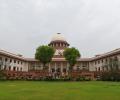
The Indian government has defended the Waqf (Amendment) Act, 2025 in the Supreme Court, arguing that there cannot be a blanket stay on the law as there is a presumption of its constitutionality. The Centre countered the pleas challenging the law's validity, asserting that the amendments were undertaken after a comprehensive study by a parliamentary panel. The government also highlighted the "reported misuse" of earlier provisions and the increase in waqf land, claiming that over 20 lakh hectares were added after 2013.

The Delhi high court has refused to accept the apology of TMC MP Saket Gokhale in a sealed cover over a plea of former diplomat Lakshmi Murdeshwar Puri and said he has "tarried and procrastinated" but not complied with its verdict.

The judge, however, ruled that there was a clear prima facie case under Section 354 of IPC for 'assault or criminal force to woman with intent to outrage her modesty".

A two-judge bench of the top court in 1981 questioned the correctness of the 1967 verdict holding Aligarh Muslim University not to be a minority institution since it was created by a central law and referred the issue to a larger bench for decision.
The Supreme Court on Monday suggested that Parliament should seriously consider bringing an amendment to the Protection of Children from Sexual Offences (POCSO) Act for substituting the term 'child pornography' with 'child sexual exploitative and abuse material' with a view to reflect more accurately the reality of such offences.

'Politicians can do symbolism by changing the names of places and museums.' 'Judges need not be seen to be craving for approval from the public.'
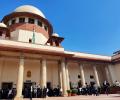
The top court took note of the submissions of Alvi that the high court had passed the order without assigning reasons and granted the interim stay.
 © 2026 Rediff.com - Advertise with us - Disclaimer - Privacy Policy - Sitemap - Feedback - About us - Terms of use - Grievances