

'Judges have transmitted a terrible message to citizens across the nation. All right-thinking individuals will be disturbed by what the Delhi high court judges have done.'
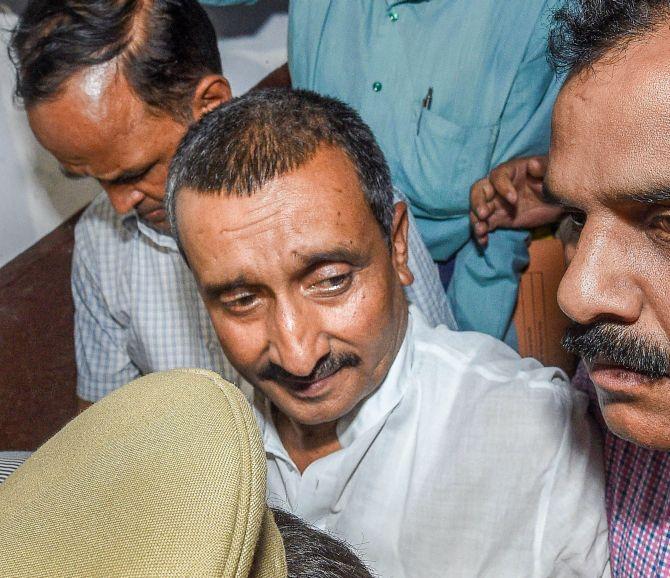
The Delhi high court's decision on December 23, 2025 to suspend the life sentence of convicted Uttar Pradesh MLA Kuldeep Singh Sengar in the Unnao rape case has triggered sharp criticism from the legal fraternity.
Senior Supreme Court Advocate Dushyant Dave, in an interview with Prasanna D Zore/Rediff, dissected what he terms an 'unconscionable judgment'. Dave argues that the Delhi high court's narrow interpretation of who qualifies as a 'public servant' establishes a dangerous precedent, potentially allowing powerful politicians accused of heinous crimes to escape stringent punishment.
What aspects of the Delhi high court order suspending Kuldeep Singh Sengar's life sentence do you find most legally troubling?
There are numerous concerns. First and foremost, the judgment is legally flawed because the judges have focused exclusively on one aspect -- the term 'public servant' -- while completely overlooking the opening provision of subsection 5(c) of the POCSO Act, which begins with 'person...who is in a position of trust and responsibility.'
(Section 5 of the POCSO Act, 2012, defines circumstances under which penetrative sexual assault of a child becomes 'aggravated penetrative sexual assault,' attracting enhanced punishment of 20 years to life imprisonment.)
There are several serious concerns. Chief among them is that the judgment is legally flawed, as the judges have confined their analysis to a single element -- the expression 'public servant' -- while entirely disregarding the opening words of subsection 5(c) of the POCSO Act, which refer to a 'person... who is in a position of trust and responsibility.'
(Section 5 of the POCSO Act, 2012, sets out the conditions under which penetrative sexual assault of a child is classified as 'aggravated penetrative sexual assault,' carrying enhanced punishment ranging from 20 years' imprisonment to life.)
The same phraseology -- 'trust and responsibility' -- appears in the latter portion of the section as well. Public servants, police officers, hospital staff, and educational institution personnel are merely illustrative examples.
The critical question one must examine is whether the child reposed trust in a particular individual. If the answer is affirmative, then one must interpret this section very broadly. The judges have interpreted the provision in an exceedingly narrow and pedantic manner.
This is social legislation designed to curb offences against children, enacted pursuant to India's obligations under the United Nations Convention on the Rights of the Child (an international treaty adopted by the UN General Assembly in 1989 to protect children's rights, to which India is a signatory).
When one considers paragraph 37 of the judgment, which concludes Sengar was not a public servant, it becomes apparent that this constitutes a grave disservice to legislative intent, to the circumstances that necessitated this law's enactment, to the prevailing situation in our country, and to the grossly gruesome facts of this particular case.
An MLA occupies an exceptionally powerful position in our democracy. Citizens place their trust in MLAs; these representatives bear responsibility for the welfare of their constituents. This child approached Sengar seeking employment -- a perfectly legitimate aspiration in today's challenging job market.
The MLA exploited that vulnerability. She approached him trusting that here was someone who might facilitate gainful employment for her.
MLAs wield considerable influence within their constituencies. In my considered opinion, an MLA functions as a trustee responsible for the welfare of all electors and residents in his area.
The Delhi high court has completely overlooked this crucial dimension. Furthermore, considering that the MLA utilised police force, that the victim's father died in police custody, and that the family's legal counsel died under suspicious circumstances, for the Delhi high court to adopt this view is nothing short of shocking. This is an unconscionable judgment.
How does this order affect not merely this survivor but all survivors confronting similar circumstances?
The Supreme Court has interpreted the term 'public servant' expansively in P V Narasimha Rao's case, holding that for purposes of the Prevention of Corruption Act (the Prevention of Corruption Act, 1988, is legislation designed to combat corruption amongst public officials, with Section 2(c) providing an extended definition of 'public servant'), MLAs and MPs are indeed public servants.
Therefore, the high court cannot conclude that in another piece of social legislation, an MLA does not qualify as a public servant. The Prevention of Corruption Act addresses serious offences, but sexual offences against children are far graver.
The Delhi high court ought to have exercised greater circumspection. Indeed, the Supreme Court in certain precedents has gone so far as to hold that a private bank officer also qualifies as a public servant because he holds custody of public trust and monies, and if he engages in misconduct, he may be prosecuted under the Prevention of Corruption Act.
This represents the appropriate level of judicial interpretation. All such legislation must ultimately be construed to subserve the purpose for which it was enacted.
When two interpretations are plausible, one must lean towards the stricter construction, not the liberal view the judges have adopted. This is a perverse judgment that opens a Pandora's Box.
At this rate, MPs, MLAs, and other public figures discharging public functions and duties will escape accountability if they behave as this MLA has behaved.
The court relied substantially on the duration Sengar has already spent in custody. Does this consideration outweigh the gravity of a rape conviction involving a minor?
If Section 5(c) applies (Section 5(c) of POCSO deals with aggravated penetrative sexual assault when committed by a public servant, carrying minimum punishment of 20 years and potentially life imprisonment), twenty years constitutes the minimum sentence.
Life imprisonment should be the appropriate punishment. He was indeed awarded life imprisonment. The judges cannot arbitrarily declare seven years sufficient.
This has become fashionable amongst certain judges. For instance -- and I state this on record -- when the minister's (Ajay Mishra Teni, the then Union minister of state for home) son (Ashish Teni, the key accused in the Lakhimpur Kheri violence case (2021), where farmers and a journalist were killed after being run over by a vehicle) was charged with killing several people by crushing them with his vehicle, and a journalist also perished, I was briefed by Mr Prashant Bhushan to oppose the bail application.
Judges of the Supreme Court, with Justice Surya Kant presiding, stated he had served one year in custody and should be released. I responded: By all means proceed, but then establish a legal principle that every person charged with murder is entitled to release after one year -- which was not done. That individual was released.
Meanwhile, countless individuals languish in prisons for years awaiting Supreme Court hearings. The Supreme Court lacks time to hear them. Whatever the merits, I am not commenting on those. I am addressing the manner in which matters proceed (in courts), which does not signal well for judicial independence.
Does suspending Sengar's life sentence dilute the gravity of rape conviction in law?

The appeal was admitted in 2020. What prevented the judges from hearing the appeal substantively? If they had time to deliver a 57-page judgment on bail, they might well have adjudicated the appeal itself.
What transpires through this approach is that if the appeal had been decided, an appeal would lie to the Supreme Court, and the Supreme Court would then consider the matter. Instead, the judges have taken a shortcut, which was truly unfortunate.
The appeal was admitted in 2020, yet it was never taken up for hearing on merits. If the court had the time to deliver a detailed 57-page order on the bail application, it could reasonably have considered hearing and disposing of the appeal itself.
The effect of this sequencing is significant. Had the appeal been finally decided, the aggrieved party would have had the opportunity to approach the Supreme Court, where the reasoning could have been examined in the normal appellate process.
Instead, the court issued an extensive bail order that had a substantial bearing on the case without a final adjudication.
Such an approach, particularly when the appeal had been pending for several years, is concerning from the perspective of judicial process and prioritisation. It highlights the need for greater consistency in how courts allocate time and decide matters of long-standing importance.
Suspension of sentence does not equate to acquittal, certainly. However, examining the Delhi high court's judgment reveals it has done considerable disservice to the findings recorded by the trial court (which convicted Kuldeep Singh Sengar in the Unnao rape case).
The trial court documented damning findings against the accused (Sengar). Therefore, the Delhi high court should have exercised greater circumspection before proceeding in the fashion it has adopted.
The court imposed conditions prohibiting contact with the survivor. In reality, can such conditions genuinely protect a rape survivor from fear or pressure?
These conditions are, frankly, rather naive. The Delhi high court appears naive in believing that by imposing these conditions, the victims will be protected. Victims are demonstrably not protected.
These conditions signify nothing, in my assessment, because when individuals lodge complaints regarding violated conditions, judges actually frown upon complainants. I believe judges impose these conditions to satisfy themselves and perhaps satisfy the public that they have passed judicious orders. According to my understanding, they mean precious little.
By suspending Sengar's sentence, doesn't the court place the burden of safety back upon the survivor?
Precisely my point. It proves exceedingly difficult for victims to return and establish that conditions have been violated. Not merely economic conditions, but social conditions and actual realities must be examined.
Wealthy and powerful individuals can escape accountability for virtually anything in this country. Those lacking resources -- like the victim here -- cannot possibly withstand the pressures these individuals can exert.
They pressure everyone in their orbit: Family members, relatives, friends, employers. There is nothing they will not do to apply pressure.
Judges are naive to believe pressure cannot be applied. Once he is released, he possesses sufficient resources and means to apply pressure.
From a survivor's rights perspective, should courts be required to consider emotional and psychological safety before suspending sentences in rape cases?
Not merely emotional and psychological considerations -- though those matter -- but I would emphatically state that the Delhi high court and Supreme Court serve as custodians of citizens' fundamental rights. Therefore, the Right to Life is absolutely crucial, as is the right to dignity.
When a young minor child has been raped repeatedly -- possibly subjected to gang rape -- judges should exercise extreme circumspection regarding rights. The judges have discussed the accused's rights. The accused's rights scarcely matter in such circumstances.
It is shocking that judges invoke the fundamental rights of an accused in this context. That constitutes mockery of justice -- mockery of the Constitution.
The proper approach is the inverse. In cases such as this, one is guided solely by the victim's rights and society's rights at large, because criminal offences constitute offences against society as a whole.
What also disturbs me is that in such cases, the CBI (Central Bureau of Investigation) fails to defend itself adequately. Why did the CBI not engage the services of Additional Solicitor General Chetan Sharma, who is an exceptionally capable and formidable advocate in the Delhi high court? These circumstances raise numerous questions. There are multiple wheels within wheels regarding how these matters transpire.
It proves deeply disappointing that the judiciary now adopts such approaches, which in my view do not augur well for its reputation or the respect it has commanded. I believe the judiciary is harming itself and bears responsibility for diminishing its own standing.
What message does the suspension of Kuldeep Singh Sengar's life sentence convey to women across India regarding how the justice system treats convicted rapists?
Women will certainly feel profoundly apprehensive and disturbed. After all, women constitute nearly half our population, and we remain a feudal nation in many respects. We must protect our women.
When judges fail to protect women and instead protect the accused -- someone guilty of a heinous crime -- this represents, according to my assessment, the rarest of rare cases.
This constitutes the rarest of rare cases. Judges have transmitted a terrible message to citizens across the nation. All right-thinking individuals will be disturbed by what the Delhi high court judges have done.







 © 2026