
The MCF subsequently issued commands to the satellite to make the earth viewing face to orient towards earth. The calibration of the gyros on board the satellite was also carried out.
Space scientists began the exercise at 8:17 am by commanding the satellite from Master Control Facility at Hassan in Karnataka
All systems on board the satellite were functioning normally.
INSAT-4CR is similar to INSAT-4C, which was lost during the unsuccessful launch last year.
With a mission life of ten years, INSAT-4CR will carry 12 high-power Ku-band transponders designed to provide Direct-to-Home television services, facilitating video picture transmission and digital satellite news gathering.
The launch of Ariane-5, which will carry India's indigenously-built 3,025 kg INSAT-4B geostationary satellite and Skynet 5A of EADS Astrium, is set for between 3.55 am and 4.28 am on Sunday.
Though it was originally intended to be the last launch for the INSAT 4B by Arianespace with the future satellites planned for launch from the Satish Dhawan Spaceport in Sriharikota, India is expected to launch INSAT 4G from an acquired launcher.

The Insat-4B communication satellite has been hit by a 'power supply anomaly' in one of its two solar panels, partially affecting some television and telecom services in the country.
The GSLV will put into orbit the INSAT-4CR, which carries 12 high-power Ku-band transponders for direct-to-home television services, video picture transmission and digital satellite news gathering.
The most advanced and powerful fourth generation communication satellite INSAT 4A was now closer to its space home in geostationary orbit.
The satellite has reached its final slot and will be fully operational by the month-end.
Industry experts say that even after the Insat-4B launch, there would be a requirement of over 25 more transponders from new players as well as older players looking for expansion.
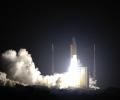
Indian space scientists have received signals of Indian National Satellite-4A.
INSAT-4A, India's most advanced and powerful communication satellite, has been successfully placed in near geo-synchronous orbit and its solar panels and two antennae have been deployed.
This is the first time ISRO was putting into orbit a two-tonne class satellite.\n\n
The anomaly was found in the 'water deluge system' that is intended to reduce the acoustics level for the safety of the launch-pad
A failure analysis committee has been set up to study the recent mishap.
Indian Space Research Organisation's immediate plan was the launch of two more PSLV flights this year and a GSLV launch early next year.

The launch of Polar Satellite Launch Vehicle (PSLV-C52) is scheduled at 05:59 hours on Monday from the First Launch Pad of Satish Dhawan Space Centre, Sriharikota, the Bengaluru-headquartered space agency said.
ISRO will build an identical GSLV and a satellite similar to INSAT-4C for a launch in June next year.
INSAT-4A ready for launch on December 22
The non-availability of transponders on satellites has hit the expansion plans of not only existing direct-to-home players such as DD Direct Plus and Dish TV but also new entrants such as Sun Direct, Reliance Bluemagic and the Bharti group.
The Indian Space Research Organisation is set to rake in a revenue of about Rs 1,250 crore (Rs 12.5 billion) with the launch of INSAT-4B satellite as transponders are fully booked on the back of booming demand for Direct-To-Home services.
The European space agency would be asked to launch the INSAT-4A and INSAT-4B spacecraft.

The 3,357-kg satellite is slated to blast off from the Ariane Launch Complex at Kourou, a French territory located along the northeastern coast of South America, at 02:35 hrs IST. "GSAT-30 is to serve as a replacement to INSAT-4A spacecraft services with enhanced coverage", ISRO said.
It is raining heavily at Sriharikota where the Satish Dhawan Space Centre is located
K Narayana, former director of SDSC-SHAR and currently senior advisor to the Centre, will chair the 15-member panel

GSAT-6, the country's latest communication satellite has been successfully positioned in its orbital slot, Indian Space Research Organisation said on Sunday.

A high power satellite, GSAT-15 is being inducted into the INSAT/GSAT system. GSAT-15 carries a total of 24 communication transponders in Ku-band as well as a GPS-Aided GEO Augmented Navigation (GAGAN) payload operating in L1 and L5 bands.
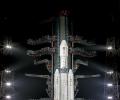
The Indian Space Research Organisation on Thursday launched its first experimental suborbital flight. Here are five things you need to know about the GSLV Mark III mission.

The 3,357-kg satellite, which was deployed from the lower passenger position of Ariane-5 launch vehicle (VA 251) into the geostationary transfer orbit, is configured on ISRO's enhanced I-3K Bus structure to provide communication services from Geostationary orbit in C and Ku bands.

The Mars Orbiter Mission (MOM) is among the most-tracked satellites in the world, according to N2YO, which provides a web-based real-time satellite mapping website.
The 'context' of the launch of GSAT-15 highlights that India has much ground to cover in the transponder arena while in satellite navigation arena ISRO's progress has been satisfactory, says Ajey Lele.

Besides Nair, others named in the charge sheet include the then K R Sridhar Murthy, Ramachandra Vishwanathan and M G Chandrasekhar.
 © 2026 Rediff.com - Advertise with us - Disclaimer - Privacy Policy - Sitemap - Feedback - About us - Terms of use - Grievances