US-based chip maker Intel has signed an agreement with Tata Group to manufacture and assemble semiconductors in India for the local market, the Indian conglomerate said on Monday.

Prime Minister Narendra Modi on Wednesday renewed his pitch for Make in India across sectors -- from mobiles to semiconductors and electronics, saying the government is accelerating the pace of reforms, offering the best investment opportunities.

The government plans to establish a fully indigenous manufacturing ecosystem with an annual production capacity of up to 6,000 tonnes. The scheme is expected to run for seven years, according to official documents.

Commerce and Industry Minister Piyush Goyal on Tuesday expressed hope that India will conclude the proposed bilateral trade agreement (BTA) with the US by the fall or November this year. He said that "a little bit" of geopolitical issues overtook the trade matters in the negotiations for the pact between the two countries.

The Foxconn move may have been prompted by the Chinese government's focus on strengthening its supply chain.
'I think that kind of change is coming. We should stay prepared for that change, whichever industry or sector we are in, we must be prepared.'

In 2023, the share of US electronics imports from India was a mere 1.9 per cent of the $520 billion they imported, while the total Indian electronics exports to the US was pegged at only $10 billion.

The Asia Pacific electronics industry continued to flourish despite the SARS outbreak, though the slowdown caused by the Iraq war did have an impact on the industry, according to Gartner.

History of electronics indicates that no company, nor any nation for that matter, has been able to cement pole position and maintain it through several cycles. he death of its iconic promoter, Lee Kun-hee, raises questions over how long the chaebol can maintain its gigantic footprint in the global electronics industry, says Devangshu Datta.

Any reduction in the customs duty on smartphone parts in the forthcoming budget will harm India's developing component ecosystem, discourage investment, increase imports, and make local firms uncompetitive, potentially resulting in job losses, think tank GTRI said on Tuesday. India's smartphone industry is a 'Make in India' success story, with 2023-24 production reaching $49.2 billion and exports at $15.6 billion, making smartphones the fourth-largest export after diesel, aviation fuel, and polished diamonds.
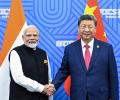
The Galwan clash occurred six months after the Doklam disengagement and two high-profile meetings. India should not be caught by surprise once again, asserts former foreign secretary Shyam Saran.

Bureau has registered just one product so far despite 1,500 applications.
Samsung India is willing to sign a long-term wage settlement and negotiate directly with its workers for an amicable resolution of the dispute, the company's lawyer said on Friday, terming the ongoing employees' strike at the Sriperumbudur plant "illegal". Lawyer Anand Gopalan, who is representing Samsung India in the high court of Chennai and the Kanchipuram District Court, said the company would only negotiate with its workers and not with any third-party leaders.

Of the total 29 major industry groups covered in the Annual Survey of Industries (ASI), 'manufacture of computer, electronic and optical products' has seen the highest growth in the number of people engaged between the pre-pandemic period (2019-20) and 2022-23. A Business Standard analysis of the latest ASI results has taken into consideration only industry groups having more than 1,000 operating factories. This industry group, which includes manufacture of electronic components, computer equipment, consumer electronics and optical instruments, among others, saw the total number of people engaged rise nearly 50 per cent to 425,000 from 283,000.

The average car price in India has increased rapidly in the last 5-6 years due to new emission regulations and demand for more spacious and comfortable cars loaded with advanced technology.

Due to the prevailing geopolitical situation, like-minded countries are collaborating with India to make it a major semiconductor manufacturing destination, a top Electronics and IT ministry official said on Sunday. In an interview with PTI, Ministry of Electronics and IT Secretary S Krishnan said pilot facilities of US storage semiconductor maker Micron and Tata Electronics have already rolled out chips, and their main plants in Gujarat will begin to produce made-in-India chips from the later part of 2025.

The Ministry of Electronics and Information Technology (Meity) is looking at a proposal to generate 1.5-2 direct jobs for every Rs 1 crore invested by companies under the proposed electronic components production-linked incentive (PLI) scheme. If this plan fructifies, a Rs 10,000 crore investment under the proposed PLI scheme would bring with it the expectation of creating 15,000-20,000 direct jobs in electronic components sector.

'In the new coalition government, India's reform agenda may prioritise job creation and factor market reforms.'

The three-day India Mobile Congress (IMC) will showcase the widening convergence of telecom with new domains, such as semiconductors and deep tech, P Ramakrishna, the forum's chief executive officer, said on Tuesday. With more than 250 global and domestic exhibitors, the seventh edition is expected to draw more than 100,000 visitors this year, he said. There will also be over 5,000 CXO-level delegates and more than 350 speakers.
'I was in the US, where I met top executives of HP and Dell, and they are very keen to come to India.' 'Acer and ASUS have also evinced interest.'

Tamil Nadu Governor R N Ravi stoked a fresh controversy on Thursday, remarking that the anti-Sterlite protests in the state in 2018 had been fuelled by foreign funds and was aimed at hindering progress. His comment instantaneously drew an outcry from the ruling Dravida Munnetra Kazhagam and its allies.

The global semiconductor shortage is turning into a headache for automotive (auto) and appliance manufacturers. But it is proving to be a boon for equity investors. Semiconductor stocks are among the best performers this year. The PHLX Semiconductor Index has gained more than 35 per cent year-to-date.

Apple's three vendors in the country have hit the milestone of creating 30,000 new direct jobs since the production-linked incentive (PLI) scheme for mobile devices kicked off in April 2021. Based on the government's estimate that one direct job in the electronics industry helps to generate three indirect ones, Apple's vendors, Foxconn Hon Hai, Wistron and Pegatron, are close to creating 100,000 direct and indirect jobs. The direct jobs that the vendors have created account for a fourth of Apple's commitment to generate 60 per cent of the new direct jobs out of the 200,000 jobs targeted by the government under the PLI scheme within five years.
According to the survey report, the government's move to earmark Rs 76,000 crore outlay for semiconductors and display manufacturing segment will aid their production in the country. The survey said that government intervention to boost semiconductors and display manufacturing ecosystem in the country has come at a time when the global economy is facing acute shortage of semiconductors due to severe disruptions in supply chains.

The industry is expecting double-digit growth on a year-on-year basis, helped by a possible price correction after softening of raw material inputs and factors such as positive sentiments, pent up demand and improving economic conditions. Besides, a shift in consumer behaviour from price consciousness towards technologically advanced premium products with quality, value proposition and safety aspects leading to a rise in demand for home automation products is making the industry upbeat. With the government's production linked incentive (PLI) scheme for white goods, which has witnessed a committed investment of Rs 4,614 crore, in place, many manufacturers are gearing up to make the most out of the opportunity as well as take steps towards reducing their dependency on imports and make products more affordable.
The Tata group is looking to make a foray into semiconductor (also known as chips) manufacturing and it has set up a business to seize the opportunity, Chairman N Chandrasekaran said on Monday. "At the Tata group, we have already pivoted into a number of new businesses like electronics manufacturing, 5G network equipment as well as semiconductors, in all probability," he said while speaking at the annual general meeting of the IMC Chamber of Commerce and Industry. Chandrasekaran said global supply chains, currently heavily dependent on China, would see a big change in a post-pandemic world with businesses shifting their reliance to other countries.

The task force, to be headed by Finance Minister Nirmala Sitharaman, will look at measures to limit economic hardship caused by the Covid-19 pandemic, he said in his address to the nation.
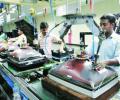
'The government expects demand for electronic products to reach $400 billion by 2023-24. This would be a huge foreign exchange outflow, which may further widen our trade deficit with other nations. Hence, the government plans to push local electronics manufacturing to cut down on their import bill.'
Even though India has major strengths in chip design and in making the software that actually commands the processors to execute specific tasks, chip-manufacturing has never been the country's strength.
The West Bengal government has decided to close down five ailing subsidiaries of West Bengal Electronics Industry Development Corporation Ltd, the nodal agency to promote electronics industry in the state.

Finance Minister P Chidambaram announced the Union Budget 2013-14 in Parliament on Thursday.

CEAMA will include the proposal in its pre-budget memorandum to the government.

Experts say it is difficult to determine country of origin where most products are manufactured and sold, as part of a complex global value chain.
Micromax has built a successful brand by harnessing the advantages China offered. Now it needs to change its strategies.
More than 100 products have been introduced at the Consumer Electronics Show at Las Vegas.
The tablet market will be an extremely competitive market place that is likely to see a flood of new entrants.
Japan's nuclear crisis and the devastations caused by last Friday's earthquake and tsunami are unlikely to trigger a global recession as happened in the aftermath of the collapse of the US investment bank Lehman Brothers three years ago, according to leading economists.

The company, however, expects the direct impact of the Japanese crisis to be minimal on its business in the short-term.
It appears that 2011 will be the year of 3D again for the consumer electronics industry. While 2010 CES "was certainly defined by 3D" (included 3D content, hardware and services), 2011 CES will again play home to the entire 3D ecosystem, according to Shawn Dubravac, CFA, chief economist and director of research, Consumer Electronics Association.
 © 2026 Rediff.com - Investor Information - Advertise with us - Disclaimer - Privacy Policy - Sitemap - Feedback - About us - Terms of use - Grievances