
'Geopolitically and diplomatically it's a very difficult situation for India.'
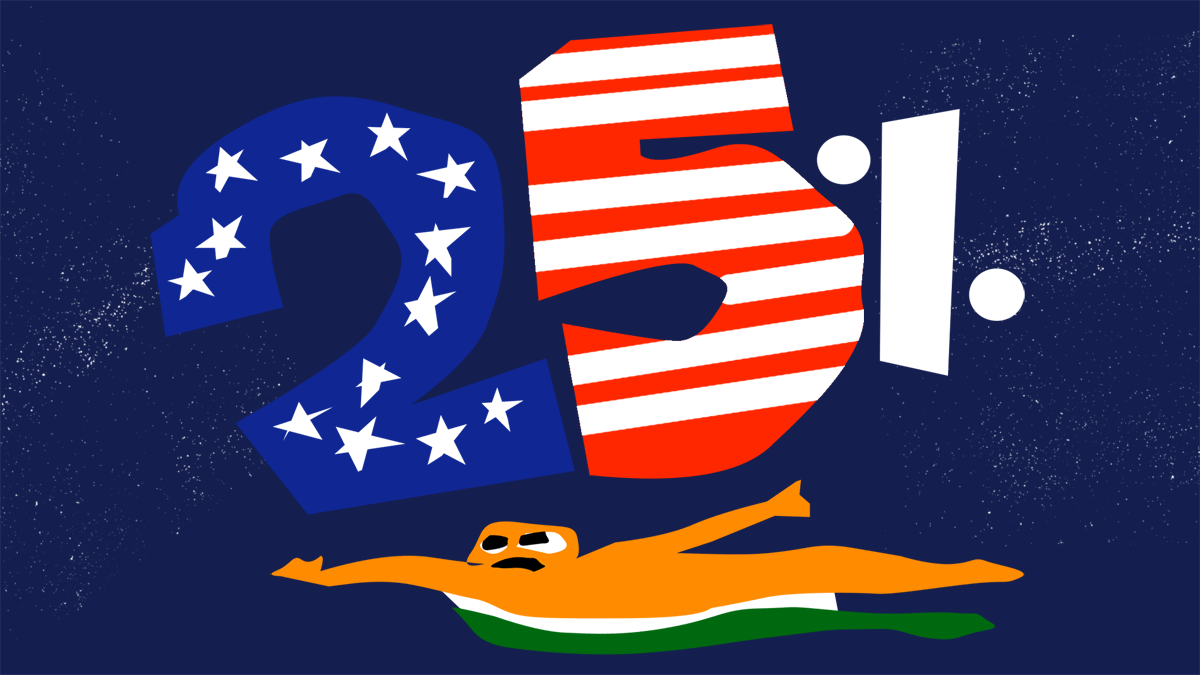
Not since the days of Richard Nixon and Henry Kissinger has India been berated by global statesmen in the way American President Donald Trump has done -- calling this country, the world's fastest-growing major economy, a 'dead economy' and 'tariff king'.
India is a country much different today from what it was in the 1960s and 1970s. Then it was forced to depend on the United States for food aid, some of which the US froze when India did not toe its line in the Vietnam war.
Today there's a surplus of food grains, which are not only exported but also processed into ethanol and used as fuel.
The statistics on India's rise as an economic power are equally revealing.
If India's economy sustains a 7 to 8 per cent annual growth rate in the decades to come, it will topple the US to become the world's largest economy, government officials say.
India's carbon dioxide emission from energy production jumped over 4 per cent in 2024 from a year earlier, much faster than China's 1.2 per cent and America's decline of 0.8 per cent, reflecting the pace of growth, according to the EI Statistical Review of World Energy.
And energy supply grew 4.3 per cent last year compared to 0.4 per cent for the US and 2.4 per cent for China -- pointing to India's huge energy needs.
Moreover, India will be the biggest contributor to global oil demand in the coming decade, international forecasters say.
It is this need for energy and a lack of it that Trump utilised when he announced a 25 per cent tariff on much of India's exports for sourcing discounted oil from Russia.
India's oldest ally accounts for nearly 40 per cent of its crude oil.
Together with a 25 per cent reciprocal tariff, imposed August 7, Indian exporters will pay a 50 per cent tax to gain access to the US market, the highest for any nation alongside Brazil.
'Importing lots of fossil fuel is creating geopolitical liabilities,' said Allan Bentley, associate professor of political science at Johns Hopkins University, at a Climate Trends webinar.
'So doubling down on clean energy goes towards creating economic sovereignty, given India has no strong diplomatic options globally.'
India imports nearly 90 per cent of its crude oil, half its natural gas, and over 60 per cent of liquefied petroleum gas.
Previous pushbacks
It is not that India had not stood up to US sanctions in the past.
When Indira Gandhi declined to back President Lyndon Johnson in the Vietnam war, he cut off the last instalments of the PL480 food aid to India, prompting the Indian prime minister to lay the foundations of the Green Revolution.
In May 1998, when Atal Bihari Vajpayee's coalition government conducted the nuclear tests, a few years after then finance minister Manmohan Singh opened up India's economy, President Bill Clinton, a Democrat, imposed trade and investment sanctions.
The stakes are higher now and so is the uncertainty.
"Essentially, the whole world has to deal with the politics of Donald Trump," says Arun Singh, a senior fellow at Carnegie India, a think-tank, and former ambassador to the US.
"It is not just high tariffs on India but also a 'tariff' on India-US relations."
Over the past two decades Washington had attempted to erase India's bitter memories of the US as an unreliable and coercive partner -- it supported India's position in the Kargil conflict in 1999, and did the civil nuclear cooperation agreement with India in 2008, Singh says.
Ajay Srivastava, founder of think-tank Global Trade Research Initiative and a former trade official, says a 50 per cent tariff exempts 28 per cent of India's $86 billion in goods exports to the US, its biggest market, but "the remaining 72 per cent will take a major hit".
He expects India's exports to the US, largely labour-intensive industries like textiles and gems and jewellery, to crash 70 to 90 per cent in a year.
'There will be a free fall in six months,' he said in the same webinar.
Aruna Sharma, former steel secretary, says, "It's (tariff) going to hit in a big way especially in textiles."
"When it was 25 per cent it was not concerning as competitors had similar tariffs. But 50 per cent is too big."
This trade war is not new. What began during Trump's first term when he imposed import taxes on steel and aluminium, targeting China and other Southeast Asian nations, has evolved in his second term into an attack on US allies like India and Brazil.
India will pay 50 per cent from August 27, and Brazil is also paying 50 per cent because it refuses to drop charges against former president Jair Bolsonaro, a Trump ally -- both unrelated to any direct trade issues.
China is paying 30 per cent. Neighbouring Pakistan, shunned by the Biden administration but entertained by Trump with a White House lunch (for its army chief) and billions of dollars in aid, will pay 19 per cent.
"Trump's policies are difficult to understand," says Julian Popov, senior fellow, Strategic Perspectives, a pan-European think-tank, and a former minister in Bulgaria.
Trump extended the deadline to reimpose tariffs on China, America's biggest rival, which runs a surplus of nearly $300 billion, by 90 days.
By contrast, India runs a $40 billion trade surplus with the US and Brazil a trade deficit.

The politics of Trump
Singh, who spent 37 years as a diplomat, says the politics of Trump has three elements.
First, he wants to project himself as a peacemaker (Trump has claimed to have resolved several conflicts in Africa, Southeast Asia, the Caucuses, and South Asia, in six months.)
But that runs into conflict with how India defines foreign policy in our neighbourhood and the emphasis on bilateralism. India cannot deviate from that.
Second, Trump wants to tell his MAGA (Make America Great Again) base, which brought him to power, that he has done more for US manufacturing than anyone before him.
He projects himself as someone who makes trade deals in which he gives nothing but secures unlimited market access and investment.
He has claimed that Indonesia and Vietnam, among others, have thrown open their markets to the US but have been still slapped with import taxes.
Japan, South Korea, and the European Union together have committed over $1.5 trillion in investment in the US but will still pay a 15 per cent import tariff.
The third aspect of Trump's politics is his relations with Russia, Singh says.
He wants to end the Ukraine war and so doesn't want to enhance sanctions on Russia.
But the US Congress has been breathing down Trump's neck to ratchet up pressure on the Kremlin, prompting him to use secondary tariffs as a weapon.
Further tariffs on China, the biggest importer of Russian oil and gas and the only buyer of cheap, sanctioned oil from Venezuela and Iran, have consequences for American consumers, industries and markets, prompting Trump to pick on India, Singh says.
Unlike China, Mexico, or Canada, India is not a big trade partner, Bentley says.
In the near term, India has been boxed into a corner. Srivastava says the elimination of the 25 per cent Russian oil tariff will bring back $25 billion in Indian exports, as against the $13 billion in savings from buying Russian oil.
"So we will be on the positive side."
A senior official in oil refining says there is no guarantee that Trump will remove the tariffs or will not impose them again on the pretext of India being a member of the BRICS grouping -- along with China, Brazil, Russia, and South Africa, among others.
Trump has threatened separate tariffs on BRICS members for trying to de-dollarise trade, though India has been reluctant to ditch the dollar, Sharma said.
But India's relations with Russia stretch decades.
Military equipment like Russian S-400 and Brahmos missile systems helped India overpower Pakistan in Operation Sindoor; Russian state-owned Rosneft paid around $13 billion for Nayara Energy in 2017, becoming the biggest investor in India's energy sector; Indian refiners have saved over $15 billion since early 2022 on Russian oil purchases; and Russian pressurised water reactors power India's largest nuclear power plant in Kudankulam, Tamil Nadu.
'Geopolitically and diplomatically it's a very difficult situation for India,' Bentley says.
'China is an easy winner from all this.'
"In a long-term framework there's a lot of convergence between the US and India," Singh says, adding, "just that the present moment is difficult".


Feature Presentation: Aslam Hunani/Rediff








 © 2025