
'The US slump could hit our hosiery market hard since 40 per cent of our exports go there.'
'Job losses could be severe if the government doesn't step in fast.'
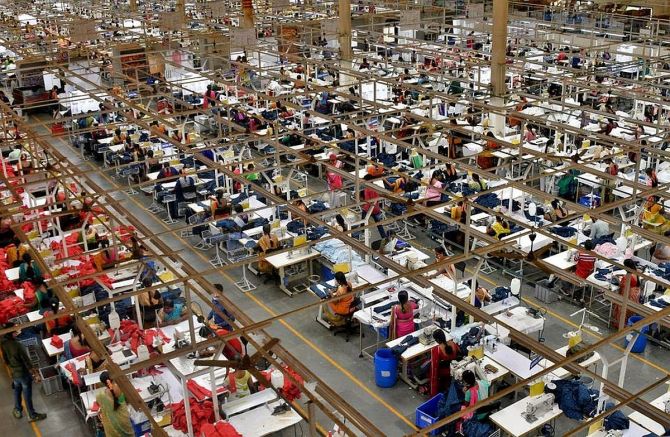
Tiruppur is known as India's knitwear capital, sometimes even called Dollar Town for its export-driven economy.
Tucked away in the heart of the city is the Khaderpet wholesale apparel market, a living stage that reflects the mood of this export hub, often jolted by global geopolitics.
Though catering largely to domestic trade, the market mirrors the state of export manufacturing in Tiruppur.
The narrow lanes of Khaderpet, once buzzing and splashed with coloured fabrics, surplus stock, and shop signs flaunting export connections, now look deserted.
An outsider would usually be greeted by lively chaos here, but the energy has dimmed -- a direct fallout of dwindling US export orders for the coming summer season.
The reasons: A likely Rs 2,000 crore (Rs 2 billion) hit to Tiruppur exporters this year, with the US accounting for more than Rs 15,000 crore (Rs 150 billion) of their total revenue; thinning export orders; deep discounts to American buyers that wipe out 20 to 25 per cent in some cases; job losses; and growing competition from other states.
Just 2.5 kilometres from this commercial hub is the Poppys Knitwear office, founded by A Sakthivel, one of Tiruppur's export pioneers and the force behind the Tiruppur Exporters and Manufacturers Association, set up in 1990.
Sakthivel compresses four decades into a snapshot: "In 1985, our exports were barely Rs 15 crore (Rs 150 million). By 1990, it had shot up to Rs 300 crore (Rs 3 billion). Come 2025, we're crossing Rs 44,000 crore (Rs 440 billion) annually (including nearby Coimbatore).
"We've faced worse crises -- the pandemic, container shortages, the closure of dyeing units in the early 2010s, demonetisation, and more. Still, this town held its ground in the global market because of its product quality."
He says this with calm assurance from his office, Sakthi, lined with idols of Lord Ganesha.
His confidence springs from the restart of bilateral trade talks between India and the US, the first since Donald Trump's 50 per cent tariffs.
He adds that exporters are still shipping to American buyers, choosing to absorb losses for the sake of long-term ties.
"Buyers are seeking heavy discounts -- 15 to 20 per cent to cover the penalties. On top of that, Bangladesh and Vietnam are tough rivals. Still, we're continuing with summer orders, as companies have already sunk big investments into the supply chain," says Sakthivel.
But on the ground, the picture isn't as hopeful. In Kongu Nagar, the Jharkhand government runs a migration support centre.
During a 30-minute chat, managers Madhu Dube and Rashmi Rekha Das referred to the labourers only as "bachche" (children), not "migrants" or "workers".
"Since the US crisis began, new hiring from Jharkhand has dropped 50 to 60 per cent each month. Some bachche are even facing wage cuts in companies tied to US orders," says Dube.
This comes despite the region's typically high attrition.
Nearly 300,000 migrant workers from states like Odisha, Uttar Pradesh, West Bengal, Jharkhand and Bihar form part of Tiruppur's textile workforce, out of 700,000 people directly dependent on the sector.
These State-run centres offer free housing and meals for new arrivals and help with wage negotiations.
Social media has been abuzz with reports of companies taking heavy hits.
Arun Ramaswamy, chief executive officer of New Man Exports, shares a similar struggle: "Purchase orders worth Rs 4 crore (Rs 40 million) are on hold. To save jobs, we're running our factory only three to four days a week."
He insists the setback is temporary, pointing to his foothold in other markets. "Of total revenue of Rs 44,747 crore (Rs 447.47 billion), about 35 per cent -- a little over Rs 15,000 crore -- comes from the US in three cycles a year."
"For the upcoming summer season, goods worth about Rs 6,000 crore (Rs 60 billion) are ready, but the industry expects a Rs 2,000 crore (Rs 20 billion) cash loss. Most buyers want the orders but at steeper discounts," explains K M Subramanian, Tiruppur Exporters' Association president and promoter of KM Knitwear.
He hopes the UK free trade agreement will ease some pressure.
"To reduce dependence on the US, we need to branch into more markets. West Asia, New Zealand and the European Union should be explored, along with the UK," Subramanian says.
At a meeting with the finance ministry, exporters sought targeted market schemes, subsidies, revival of the 5 per cent interest subvention, and an extension of the loan moratorium from 90 to 180 days.
From his unit, Esstee Exports India near Vigneshwara Nagar, promoter N Thirukkumaran voices cautious confidence: "The industry is lining up discounts and continuing orders. What we need now is government help through quick trade agreements and short-term fiscal support. Rival countries are reportedly playing aggressive discount games."
Still, not everyone is putting up a brave face.
"The US slump could hit our hosiery market hard since 40 per cent of our exports go there. Job losses could be severe if the government doesn't step in fast," warns S Balachandar, board member of the South India Hosiery Manufacturers' Association and vice-president of Priya Hosieries.
On the way to the bus stand near Avinashi Bypass, a cab driver summed it up best: "Tiruppur is like a phoenix. It's seen worse. It'll rise again." He added, with a grin, "Now, migrants from Bihar and Odisha are starting factories and employing Tamilians."
Perhaps Sakthivel put it most simply: "Yesterday's worker, today's factory owner, tomorrow's exporter."
A law of survival in this textile hub -- though one that badly needs a timely stitch if it's to keep weaving such stories.
Feature Presentation: Aslam Hunani/Rediff









 © 2025