

'The biggest point of contention is market access for US agricultural and dairy products.'

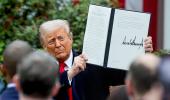
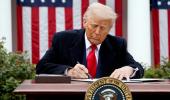
The 25% import duty on goods from India announced by US President Donald Trump on Wednesday may impact the margins of Indian exporters to a tune of 30% to 50%, said Anand Rathi Share and Stock Brokers Ltd.
Trump also announced levying a penalty on import of Indian goods for India buying Russian oil and defence equipment. He did not specify the penalty amount or the percentage.
'Around 30% to 50% of the tariff's impact is expected to be absorbed by Indian exporters, with the remainder falling on US importers and consumers; any rupee depreciation may cushion some of the pain for Indian exporters,' Anand Rathi said in a report on the impact of tariff announced by Trump.
Terming the 25% tariff as part of a broader US strategy of hard-nosed negotiations and not necessarily a final position, Anand Rathi said the episode underscores the need for India to diversify export markets and accelerate new trade agreements to reduce future vulnerabilities.
According to the Anand Rathi report, the development challenges India's policy of strategic autonomy -- prioritising national interest while balancing relations with the US, Russia, and others -- without succumbing to pressure.
The report pointed out India's carefully calibrated policy of strategic autonomy --prioritising national self-interest over ideological alignment.
'This has meant buying discounted Russian oil despite Western sanctions, continuing defence cooperation with Moscow, rejecting external mediation on its terms with Pakistan, and holding firm in trade negotiations with the US even under tariff threats.
'It has also meant embracing a leadership role in forums like BRICS, reshaping them into platforms for articulating the concerns of the Global South rather than echoing Western orthodoxy,' the report noted.
The announcement of a 25% US tariff on Indian exports marks a moment of reckoning for this posture.
The tariff decision by the US seems as much a negotiating ploy as a policy marker -- part punitive, part performative.
'There have been ample flip flops by the US on tariff issues relating to India. However, India is not alone here. The current US administration has done similar flip flops with most other major trade partners including Canada, China, EU and Mexico,' the Anand Rathi report noted.
"While Trump is talking tough, negotiations are still in progress. The biggest point of contention is market access for US agricultural and dairy products," said Aditi Raman, Associate Economist, Moody's Analytics.
India is concerned about the threat to livelihoods at home; agricultural workers make up 46% of the country's labour force.
Given that India opted not to join the Regional Comprehensive Economic Partnership in 2019 because it wanted to protect domestic industries, it is unlikely to now open the door to US competitors, Raman said.
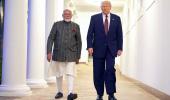
According to Raman, both the countries have historically had a strong relationship. The US has increasingly relied on India as a counterbalance to China in the Asia-Pacific region, and the two countries are also part of a security alliance.
"It remains to be seen if India can leverage those ties to pull off a better deal," Raman said.
Venkatachari Jagannathan can be reached at venkatacharijagannathan@gmail.com
Feature Presentation: Aslam Hunani/Rediff







 © 2026