
The Indian pharmaceutical industry is likely to benefit from a major wave of patent expiries in the US, as small-molecule drugs worth $63.7 billion are expected to go off-patent between 2025-29, a 65 per cent rise over the previous five years, according to a report by Antique stock broking limited.

With the interest rate cut cycle nearing its end, several debt fund managers are shifting their focus towards interest income rather than betting on duration in anticipation of capital gains.

US accounts for a large part of revenue for top Indian pharma companies like Gland Pharma (54 percent), Dr Reddy's (53 per cent), and Aurobindo Pharma (48 per cent).

Foreign investors continue to show confidence in the country's equity market, infusing Rs 14,167 crore so far this month, largely driven by favourable global cues and robust domestic fundamentals. Notably, this inflow has come despite the ongoing military tensions between India and Pakistan.

India and China have announced a series of measures aimed at improving their relationship, including maintaining peace along the border, reopening border trade, and resuming direct flights.

American sourcing firms and exporters in China are approaching Indian companies to supply goods to the US as high tariffs imposed by Washington are making it difficult for them to ship directly to America, apex exporters' body FIEO said on Monday. The US has imposed 145 per cent tariffs on Chinese goods entering the American market. For India, the duty is just 10 per cent.

'Investors who remain calm, consistent, and disciplined through short-term volatility are usually the ones who benefit most in the long run.'

The overall number of frauds, including those related to loan accounts and digital payments, jumped by three times in FY25, primarily due to reclassification of 122 cases as per a Supreme Court order, the Reserve Bank said on Thursday. The fraud value jumped to Rs 36,014 crore in FY25, up from Rs 12,230 crore in the previous fiscal year, while the number of fraud cases went down to 23,953 in FY25 from 36,060 in FY24.

There is need for buyers to understand cancellation rules before entering into a purchase agreement with a developer.

Domestic institutional investors (DIIs), mostly mutual funds and insurance companies, overtook foreign portfolio investors (FPIs) in ownership of NSE-listed companies in the March quarter of 2025. According to Prime Database, DIIs held a 17.62 per cent stake, up from 16.89 per cent in the December 2024 quarter.

They are not just underreporting income; they are reshaping what the income tax system perceives, says study.

With more than 1.2 million Indians stuck in green card backlogs, investor-driven EB-5 programme sees rising interest as a secure route for migration to the US.

It remains a mystery that when its scientists were accused of selling technologies which did not exist in ISRO, ISRO's leadership did not say to the public that they were searching in a dark room for a black cat which was not there, points out Ambassador T P Sreenivasan.

Education loan growth is set to halve this fiscal (FY26) because disbursements for the US decelerate following a raft of policy changes there.

The domestic stock market this week would monitor the geopolitical developments after India and Pakistan reached an understanding to stop military actions, analysts said. Moreover, macroeconomic data announcements, Q4 earnings, trading activity of foreign investors and global market trends are also likely to influence sentiments, traders said.

The top 20 fund houses held 6.8 per cent of their portfolios in cash as of May 31, down from a record high of 7.2 per cent in April 2025.

At a time when the finance ministry is focusing on addressing employee grievances, the number of employees in most public-sector banks (PSBs) has declined over the last three financial years.

Reserve Bank on Friday decided to cut Cash Reserve Ratio (CRR) by a huge 1 per cent, which will unlock Rs 2.5 lakh crore liquidity to the banking system for lending to productive sectors of the economy. With the reduction in four equal tranches ending November 29, 2025, the CRR would come down to 3 per cent.

India's merchandise exports in November dipped by 4.85 per cent to $32.11 billion against $33.75 billion a year ago, according to government data released on Monday. Imports increased by 27 per cent to $69.95 billion in November compared to $55.06 billion in the year-ago month.

Secretary of Commerce Howard Lutnick has said one should expect a trade deal between India and the US in the "not-too-distant future" as the two countries have found a place that works for them. "So the idea is when they put the right person and India put the right person on the other side of the table, and we've managed, I think, to be in a very, very good place," Lutnick said in his keynote address at the eighth edition of the US-India Strategic Partnership Forum (USISPF) Leadership Summit in Washington on Monday.
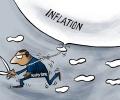
'Deposit and lending rates have started to fall considerably. It is likely to spur investment and consumption of durables.'

From the Sensex pack, Bajaj Finserv, Bajaj Finance, Sun Pharma, Zomato, Tata Steel and Nestle were the biggest gainers. UltraTech Cement, Tata Motors, Mahindra & Mahindra, Kotak Mahindra Bank, Tech Mahindra and State Bank of India were among the major laggards.

Global trends, tariff-related updates and trading activity of foreign investors would be the key drivers for the equity market movement this week, analysts said. Markets witnessed a strong rebound last week, with the benchmark indices surging over 4 per cent.

'This means that there will be more than 1,000 tech talent in India over the next 12-18 months.'

'All governments are scared of a negative image.' 'Somehow, this government has a tendency to create a narrative that things are improving.' 'When the real data gives a different picture, they are upset.'
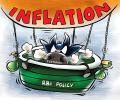
The Reserve Bank on Wednesday lowered the inflation projection for the current fiscal to 4 per cent from 4.2 per cent earlier, taking into account good agricultural output and falling crude prices.

Algorithmic management (AM) in India has led to a decline in job quality, with "clear" evidence of increased monitoring, surveillance and work intensity, noted International Labour Organisation (ILO) in its latest report.

rediffGURU T S Khurana answers readers' personal income tax queries.

These super-rich Indians intend to reside in their chosen host country permanently while retaining their Indian citizenship.

The Bombay High Court has ruled that a spouse threatening or attempting to commit suicide amounts to 'cruelty' and is a valid ground for divorce. The court upheld a family court's decision to dissolve a marriage where the husband alleged his wife threatened to send him and his family to jail by committing suicide. The court found that the husband's claim of cruelty was supported by evidence, including the wife's attempt to end her life.
rediffGURU T S Khurana answers readers' personal income tax queries

After the success of bringing businesses to WhatsApp, Meta - its parent - is now introducing ads and subscriptions to Status and Channels under the Updates tab of the messaging app, the company said on Monday. This move will further push its monetisation efforts on WhatsApp.

Borrowers should consider switching from an MCLR-linked to a repo rate-linked loan.

The time is up for the over three-decades-old business model with the advent of artificial intelligence, HCL Technologies' chief executive C Vijayakumar said on Monday. Speaking at industry lobby grouping Nasscom's annual NTLF event in Mumbai, Vijayakumar said companies need to be "paranoid", given the wide-ranging impact of AI and stressed that this attitude will help them to be relevant and grow. "I strongly believe that the business model is ripe for disruption.

From the 30 blue-chip stocks, Titan, Asian Paints, Nestle, Tech Mahindra, Reliance Industries, Zomato, Larsen & Toubro and Bajaj Finserv were among the laggards. Adani Ports, Mahindra & Mahindra, Maruti, Sun Pharma, Bharti Airtel and Tata Motors were among the gainers.

The Reserve Bank of India on Friday permitted banks to increase charges on ATM cash withdrawals beyond the mandatory free monthly usage by Rs 2 to Rs 23 per transaction from May 1.
The US Fed interest rate decision, global trends, tariff-related developments and trading activity of foreign investors will drive the equity market movement this week, analysts said. Among macroeconomic data announcement, WPI inflation for February is scheduled to be announced on Monday.

Reserve Bank of India (RBI) Deputy Governor Swaminathan J criticised some non-banking financial companies (NBFCs) for lax loan appraisal practices and charging excessive interest rates, even as he acknowledged the sector's rapid expansion over the past decade, especially in recent years. "Unfortunately, some NBFCs seem to believe they can operate with weak underwriting in the pursuit of fast growth while levying excessive and unsustainable interest rates - sometimes disguised as upfront or processing fees - followed by aggressive recovery methods in case of default," Swaminathan said at the conference of NBFCs in Chennai last month.

Until now, salaried individuals having income under the head LTCG were required to file Form ITR-2.
The global PC landscape is poised for a seismic shift as artificial intelligence (AI) PCs are projected to dominate the market, with 98 per cent of all PCs expected to feature AI capabilities by 2028, according to a senior Dell executive. Talking to PTI, senior director and general manager of Client Solutions Group at Dell Technologies India, Indrajit Belgundi said AI PC adoption is significantly growing across all age groups, industries, and categories.
