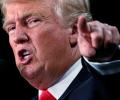
'If there is one certainty in this visit, it is that Trump does not follow a script. He is unpredictable,' highlights Ambassador B S Prakash.

"On behalf of the American people, I wish to extend my deepest condolences to the people of India on the passing of former Indian President Dr APJ Abdul Kalam," Obama said in a statement.

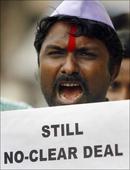
With the Indo-US civilian nuclear deal in a limbo in the wake of the Indian Parliament's nuclear liability law, the Barack Obama administration has asserted that complete implementation of the accord is imperative for the full transformation of the relationship.

A decision on this could be taken before Christmas, which might not necessarily result in a formal announcement as that could be delayed till the next year, people familiar with her thinking process said.
United States Senator Mark Warner, the democratic co-chair of the Senate India Caucus, said Prime Minister Dr Manmohan Singh and India's restraint in the face of continuing terrorist attacks is nothing short of remarkable and keeping with the best traditions of India.
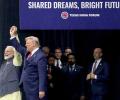
'The biggest takeaway is that the US-India relationship, which has sputtered a bit in recent months, enjoyed a big boost.'
Nirupama Rao, India's new ambassador to the United States, has defended India's stand on Libya and Syria, which stands in stark contrast to that of the US and its allies in the NATO. In the interaction that followed her keynote address at the third Brookings-FICCI Strategic Dialogue on US-India Relations, Rao said, "Let me say that we deeply value the consultations that we had with the United States on issues related to the Arab Spring and the upheavals that we have seen".
In an exclusive interview, Strobe Talbott, a key protagonist in resurrecting the United States-India relationship after India's nuclear tests in May 1998, talks about the US-India relations, Iran and the Pakistan situation to Rediff.com's Aziz Haniffa.
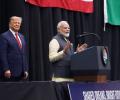
'Howdy Modi is an unforgettable celebration of the crowning of Modi as a world statesman,' says B S Raghavan, the distinguished civil servant.

With quintessential diplomatic astuteness, the Congress party's master trouble-shooter for decades, Finance Minister Pranab Mukherjee, shrugged off the irritants that loom large in US-India relations -- including the outsourcing controversy -- preceding the visit next month to India of President Barack Obama, saying all of these problems can be resolved through dialogue.
United States Senator and Texas Republican John Cornym, who is the founder and GOP co-chair of the Senate India Caucus, has lumped the Lashkar-e-Tayiba and China as the gravest security threats to India and the United States.
Prime Minister Manmohan Singh's Special Envoy on Afghanistan and Pakistan S K Lambah met with US Secretary of State Hillary Clinton and discussed a range of issues related to the bilateral ties, including plans for continuing the US-India Strategic Dialogue.
Taking part in an interaction following his speech to a conference of US-India Relations, Assistant Secretary of State for South Asian Affairs Robert Blake announced that US Homeland Security Secretary Janet Napolitano will make her first trip to New Delhi in the spring for meetings with her counterpart Home Minister P Chidambaram and other senior officials in the Ministry and intelligence agencies.
Richard Fontaine, senior fellow at the Centre for a New American Security and author of the Centre's recent report Natural Allies: A Blueprint for the Future of US-India Relations, believes that United States President Barack Obama's endorsement of India's candidacy for a permanent seat in the United Nations Security Council was 'a bold move'.
'Beijing is watching Obama's visit closely. While Chinese leaders have faced opposition from Japan and Vietnam, they view India's rise with caution.'
'We want to see a balance of power be preserved in Asia and as China grows in influence, a stronger India and a stronger India working together with an America that has a presence in Asia is to the good in maintaining that balance,' says Richard Fontaine, the key man behind the recent report, Natural Allies: A Blueprint for the Future of US-India Relations.
In the report titled Toward Realistic US-India relations, authored by George Perkovich of the Carnegie Endowment for International Peace, he cites an exchange between a senior White House official and an Indian businessman on Iran, which shows how poorly American officials understood India for all the talk of a strategic partnership.
Richard Fontaine, director of the Task Force convened by the Centre for New American Security, fears that India's abstentions of key votes at the United Nations Security Council and a divide on the issue of Iran when it does come up may dissipate Washington's enthusiasm to push for India's bid for a permanent seat.
United States Congressmen Ed Royce, California Republican, and Joe Crowley, New York Democrat, have been both unanimously selected to co-chair the Congressional Caucus on India and Indian Americans.
Ahead of United States President Barack Obama's visit to India, Pakistan insisted that its ties with Washington should not been seen through the prism of US-India relations.
Noting that the United States can only contribute marginally to India's success or failure, a report prepared by the Washington-based think- tank Carnegie Endowment for International Peace says it is in fact the actions of Indians at home and abroad that will determine which path India takes.
In an interaction that followed his keynote speech at a conference on US-India Relations, Barack Obama administration's point man for South Asia, Robert Blake was asked how he saw the Indo-US partnership playing out in the UN Security Council in the wake of the US endorsement.
'In the struggle India is going through, the US must be seen very clearly as being in India's corner. Pakistani-based terrorism is not a problem that India faces alone. It's part of a common problem that the US faces as well,' says India expert Ashley Tellis.
Richard Fontaine had an exclusive chat with rediff.com readers on Monday evening where he discussed the presidential visit and the way forward between the two countries, and their respective stands on a range of significant issues -- from the US foreign policy to rise in visa fees.
Former Under Secretary of State Nicholas Burns, who was the star diplomat in the Bush Administration who negotiated the Indo-US civilian nuclear deal, has rubbished Pakistan's request for a similar accord saying the A Q Khan network was the mother of all nuclear technology proliferators and said Pakistan's concerns over India's involvement in Afghanistan are over-rated.
Union Minister for Commerce and Industry Anand Sharma has shrugged off the recent irritants that have cropped up less than six weeks before US President Barack Obama makes his visit to India as 'transient negativity', and predicted they would 'get dissipated' soon.

Haley said Modi was aggressively pursuing reforms and changes in India.
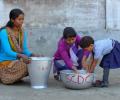
The NGO is said to be shutting down its India operations after allegations that the charity was engaging in religious conversion.
Former Assistant Secretary of State for South Asian Affairs, Karl F Inderfurth, has told the US Congress that Washington should publicly support India's bid for a permanent seat in the UN Security Council, arguing that the India's case has never been stronger.
In the last two years, foreign direct investment from India into the United States has grown more than the FDI from the US into India, excluding portfolio investments, Indian Ambassador to the US Meera Shankar said recently.

Congressman Ted Poe, chairman of the House Subcommittee on Terrorism, introduced the Pakistan State Sponsor of Terrorism Act in the US House of Representatives on Thursday.
'One thing I've learned about nuclear power is that these are not fast kind of time-lines.'
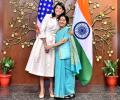
External Affairs Minister Sushma Swaraj and her American counterpart Mike Pompeo have agreed to reschedule the postponed '2+2 dialogue'.
The reason behind India retaining its lead as the top exporter of students to America for the sixth successive year is partly a reflection of that country's 'dynamic economy,' besides the blossoming US-India relations.
'Washington's silence about India's Article 370 move tells us all we need to know: It doesn't want to rock the boat of a relationship that has navigated some choppy waters but remains a highly important one.'
Bruce Riedel and Karl F Inderfurth, who were the point persons for South Asia in the Clinton administration and are expected to play key roles if a Democratic administration recaptures the White House, particularly a Hillary Clinton Administration, have bemoaned the unraveling of the Indo-US civilian nuclear agreement.
Burns said, "We'll continue to watch India's relations with Iran, and we'll obviously respond very respectfully to any concerns by members of our own Congress as we should do."

Friends of India in the US hope that New Delhi will receive a presidential waiver, given that Trump Administration has recognised India as a major defence partner and is in advance stage of selling billions of dollars' worth of equipment to India in the next few years.
'The relationship between India and the United States has always been one that seemed obvious -- that seemed like a no-brainer and seemed like it's something that should have happened a generation ago.'
USIBC officials attended the White House Signing Ceremony to witness President Bush's endorsement of the legislation passed by an overwhelming bipartisan majority of the US Congress on December 9, 2006.
 © 2026 Rediff.com - Advertise with us - Disclaimer - Privacy Policy - Sitemap - Feedback - About us - Terms of use - Grievances