
India's 500 MWe Prototype Fast Breeder Reactor (PFBR) at Kalpakkam in Chennai has achieved first criticality, marking a significant advancement in the country's nuclear energy capabilities and long-term energy security.

NITI Aayog member Gobardhan Das asserted that India possessed a rich scientific tradition that suffered setbacks during centuries of foreign domination, with its repository of knowledge systematically destroyed by invaders.

In many ways, this is only the beginning -- of a new chapter in India's nuclear story, and of a future where its vast thorium reserves could finally power its ambitions.

Construction major L&T is gearing up to expand its footprint in the global nuclear supply chain, a senior company official has said, while calling for amendments to key legislations on the domestic front to pave the way for the entry of private players and foreign capital necessary for capacity enhancement.

Fuel loading at India's first prototype fast-breeder reactor in Kalpakkam is expected to start next week, marking a significant step in the country's nuclear program.

"Whatever treaty or agreement we do, if it helps... well and good, but the thrust should be to be self-reliance in thorium fuel-based reactors," Kalam told PTI in an interview in London.
"We are looking at an investment of several million dollars or up to a billion in the coming years, depending on how India's government allows commercialisation of the nuclear power sector," said Dennis Hays, vice-president of Thorium Power. The investments and areas of operation can be in various technologies, manpower training, fuel processing, and operation & maintenance of power plants in the nuclear sector, he added.
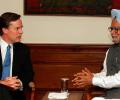
The India-US nuclear deal was aimed at ending India's nuclear isolation and nuclear apartheid, recalls Rup Narayan Das.

The PMK has now lent its voice to the protests against the mining of atomic minerals in Kanyakumari.
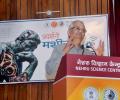
'Why should we disclose classified information to satisfy those who doubt our Hydrogen Bomb capability?'

Although the credit for acquiring the technological skill must be given to India's outstanding nuclear scientists, the decision to go nuclear was a political one that entailed clarity of vision, courage and resolve, points out Rup Narayan Das.
The JV will provide thorium fuel technology for light water reactors to come up in India, which predominantly generates nuclear power using LWRs. Thorium Power specialises in harnessing nuclear energy by using thorium, which is less radioactive than the conventional nuclear fuel -- uranium.
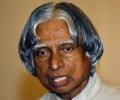
India plans to produce about 20,000 mega watt of nuclear power keeping safety features in mind, former President A P J Abdul Kalam on Friday said as he certified the Kudankulam atomic plant as safe.
Charles Stevens, CEO and chairman of Laser Power System, a small R&D start-up in Connecticut, said that his design uses just 8 gm of thorium to help a car run for years.
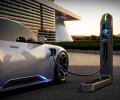
With a million-odd electric vehicles (EVs) - two-wheelers, e-rickshaws, buses and passenger cars - expected to hit the road this calendar year, the shift from gasoline-powered vehicles has become irreversible. Now the question is whether the supply chain is ready for this shift. Key components - the high-powered lithium-ion battery and the cells which go with it, the electric motor, and the electronics powered by chips - account for nearly 60 per cent of the cost of an EV.

'This is the beginning of a big campaign which may last a hundred years of trying to understand the human body in detail.'

'China is a friendly country and we welcome it for reconstruction and developing Afghanistan'
Keeping in view the ever-increasing energy requirement, India is all set to establish at least four nuclear reactors besides the world's first thorium-based reactor by 2020.

There is enough scope for India and China to cooperate on nuclear energy issues despite the lingering issues which not only includes the Sino-Pakistan nexus, but also the Sino-India border dispute over the LAC, says Debalina Ghoshal.

India has said it is committed to implementing the highest safety standards at its nuclear power plants as it seeks to harness the benefits of atomic energy to meet its growing energy requirements.
Google.org announces it will help find ways to tap the heat under the earth's surface.
Rock samples analysed in isotope laboratory of the University of Tuebingen in Germany have revealed uranium content to be as high as 5.36 per cent compared to around 0.1 per cent or less in ores present elsewhere in the country.

Immediate NSG membership will not help India realise its nuclear ambitions any faster. It could have easily left the process take its own course, instead of running a high-stakes campaign to get in, says B S Raghavan.
Chairman of Atomic Energy Commission Anil Kakodkar has said India's role in the global nuclear renaissance is going to be very crucial.
The thorium reactor does not require natural or enriched uranium which the country is finding difficult to import.
'There has definitely been a breakthrough in the nuclear logjam. It is good to see nuclear energy back on the rails,' says Dr Anil Kakodkar, former chairman, Atomic Energy Commission.
The Bharatiya Janata Party, if voted to power, will "revise" the country's nuclear doctrine to make it "relevant to challenges of current times", said the party manifesto while talking about maintaining the credible minimum deterrent in tune with the "changing geostatic realities".
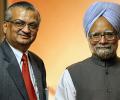
'Dr Singh, visibly relieved, said, 'Yesterday night I couldn't sleep. I stayed awake, praying throughout. You have saved the country'.' A fascinating excerpt from former atomic energy chief Dr Anil Kakodkar's memoir Fire And Fury: Transforming India's Strategic Identity.

Former President A P J Abdul Kalam kindly answered rediff.com's questions for an exclusive interview.

BJP, AIADMK oppose the project while DMK and CPI(M) support the Sethusamudram shipping project across the Palk Strait. T E Narasimhan reports

Swamy said Prime Minister Narendra Modi should convene a conference of "insiders" to draw up a new policy especially after the recent Lakhvi episode.

'In the last one year, it looks like there were bad things that didn't take place, and there were good things that didn't take place,' says Rajeev Srinivasan.

'The biggest lacuna in this agreement is it is called 'full civil nuclear cooperation agreement.' Actually, it is anything but full.'

Ravindra Shukla picks out his best option.
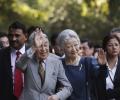
In the media frenzy over inconsequential issues, the visit of the Emperor of Japan to India has been pushed to the margins of public discourse. Colonel (retd) Anil Athale explains the great historical and political significance of the visit.

'China made it evident that neither the swing-ride at Ahmedabad nor the red carpet at New Delhi worked, by timing its muscle-flexing in Ladakh to coincide with Xi's visit.'
