
The aggressive Chinese dragon has taken the textile game away from competitors.
'The Congress is solely responsible for the situation that has arisen in Surat'
India and China would emerge winners in the post quota regime in the textile and garments sector, according to a study carried out by EXIM Bank.
The reintroduction of 4 per cent optional excise duty for cotton textile products is welcoming sign.
China on Friday announced a voluntary but drastic hike on export tariffs on 74 categories of textile products to douse a raging dispute with the United States and the European Union
With export orders going down, the textile industry in Surat has been feeling the heat of the global financial crunch.

In 2008, the textiles industry had attracted FDI worth Rs 869.6 crore (Rs 8.69 billion).
The rising rupee has pulled down textile exports, which have fallen short of the first quarter target by 36 per cent to $4.8 billion. The government had set the target of $7.5 billion for the first quarter ended June 30.
The wholesale price index-based inflation remained in the negative territory for the seventh straight month in October at (-) 0.52 per cent, on easing prices of food items. The WPI-based inflation rate has been in the negative zone since April and was at (-) 0.26 per cent in September, 2023. In October last year, WPI was at 8.67 per cent.
Fitch Ratings has said fundamentals of the Indian textiles industry are changing and the sector seems to be on a comeback trail aided by government policies and buoyant exports in 2002-03.
In order to modernise the Indian textile industry, the finance minister has increased the allocation to the Technology Upgradation Fund Scheme (TUFS) by 188 per cent to Rs 3,140 crore (Rs 31.40 billion) for 2009-10 as against Rs 1,090 crore (Rs 10.90 billion) for the corresponding period last year.
The government had reduced the duty drawback rates by 20-35 per cent on various textile products, the move which was proving detrimental to the growth of industry. Punjab's total yarn and textile export stands at Rs 2,223.38 crore (Rs 22.23 billion) as on March 31, 2008. 81420

'When the mill strike started, there was crisis in every mill worker household.' 'One entire generation went without education.' 'Hunger forced them to take to crime.'
The government on Sunday announced a package of Rs 1,400 crore (Rs 14 billion) under the Technology Upgradation Fund Scheme and 2 per cent interest subsidy up to March 31 next year. But the textile industry had demanded 4 per cent interest subsidy along with reintroduction of the duty drawback scheme.
The government will soon initiate action to restructure corporate debt in textile industry involving Rs 18,000 crore (Rs 180 billion) in ailing units.

'The package will help in realising the true potential of employment generation in the textile and apparel sector.'

...and say bye to the humanities-science divide, says Ajit Balakrishnan.

Designer Archana Jaju's brand is focused on bringing India's fine craftmanship into everyday clothing.
Jaybharat Textiles & Real Estate, a textile company that forayed into real estate three years back, today has a market capitalisation higher than Grasim Industries or Tata Motors.
Anu Raina is slowly becoming one of the most sought-after Canadian textile designers and artists.
In the face of testing global conditions, the Ministry of Textiles has stayed the course by introducing timely policy changes and innovative programmes aimed at spurring growth and development across the organised and unorganised sectors of the industry.
MFA is an agreement through which a particular country is restricted to export its textile products beyond a certain level to European and US markets.

Textile exports are expected to reach $50 billion by 2014-15 on the back of new markets.
Textiles: Slaps mandatory excise duty on RMG and apparels with 40% abatement on MRP

'Neither did I approach the BJP nor did they ask me to join them. It was a natural choice for both of us to make.' 'It was never for me to ask or for them to give.'

For someone who is such an indefatigable litigant, what is stopping Mr Saxena from using the law to depose Mr Kejriwal? Maybe we will get the answer after May 25, notes Aditi Phadnis.

The government has to cover a lot of ground if it wants to achieve the target of generating 10 million new jobs in the sector over the next three years, says Shyamal Majumdar.
Minister of State for Textiles, E V K S Elangovan said the government expects an increase in employment of 45.19 million persons in the textile industry by the terminal year of the Eleventh Plan. Consequently, the total employment in the textile sector including allied industries is projected to increase to 105.39 million persons in 2011-12 from the present level of 88.02 million persons, resulting in a net addition of 17.37 million persons.

It also asked why the data shared pertained to a period from April 2019 even though the scheme for anonymous political funding was introduced in 2017.
Many of the spinning mills in Tamil Nadu are facing closure and several mills have curtailed production as against the usual practice of working 24/7 round the year.
According to industry estimates, textiles exports have declined by 6.8 per cent during the April-May period of 2007-08, while cotton yarn has seen a negative growth of 9.9 per cent. India's textile exports amounted to $19 billion last year and the target for this fiscal was set at $25 billion.
Textile exports from India are expected to register a 25 per cent growth during this year, a senior textile ministry official said on Monday.

The corporate entities have decided to reach out to the employable womenfolk in hinterland to disseminate information about the employment opportunities and good working condition in the mills.
Under the scheme for integrated textile parks, the government provides up to 40 per cent of the cost of setting up a textile park with a ceiling of Rs 40 crore (Rs 400 million). Till now the ministry has contributed Rs 450 crore (Rs 4.5 billion). The industry has pitched in with nearly double this amount.

Saba Azad was joined by Karisma Kapoor and Kalki Kanmani for the Raw Mango show at LFW X FDCI.
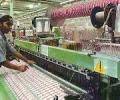
Industries in Punjab are facing an acute shortage of labourers, most of whom come from other states. In spite of revising the wages of labourers, be it unskilled, semi-skilled or highly skilled, they have found it difficult to solve the problem.
 © 2026 Rediff.com - Investor Information - Advertise with us - Disclaimer - Privacy Policy - Sitemap - Feedback - About us - Terms of use - Grievances