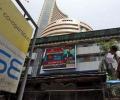
Among the Sensex constituents, as many as 16 stocks closed with losses with Nestle India, Kotak Mahindra Bank, IndusInd Bank, Bajaj Finserve, Titan and JSW Steel being the major laggards. Index major Reliance, Hindustan Unilever, Maruti and Tata Steel also declined due to selling pressure. In contrast, NTPC, TCS, Tech Mahindra, Bajaj Finance bucked the trend and ended the day in green. Axis Bank, Bharti Airtel, Mahindra & Mahindra and Tata Motors also defied the trend.
Shares of Avenue Supermarts (DMart) have rallied 15 per cent in the past month, even as the benchmark National Stock Exchange Nifty has remained flat. The stock has garnered favourable commentary from both fundamental and technical analysts after three years of poor performance. "DMart has reached its first 52-week high since October 2021, taking off from solid base formations.

The Reserve Bank of India's interest rate decision, macroeconomic data and global trends will drive investors' sentiment this week, with markets hoping to continue the positive momentum after ending FY24 on a buoyant note, analysts said. In addition, the trading activity of foreign investors, the rupee-dollar trend and the movement of global oil benchmark Brent crude would also influence trading in equity markets. The 30-share BSE Sensex climbed 14,659.83 points or 24.85 per cent in the 2023-24.

Stock markets would take cues from the biggest event of the week -- the US Fed interest rate decision, besides tracking the trends in global markets and trading activity of foreign investors, analysts said. Last week, a heavy decline in smallcap, midcap firms, foreign fund outflows and elevated crude oil prices in the international market dented investors' sentiments. Experts said equity markets may remain volatile in the near-term amid a host of global central bank's monetary policy decisions lined up during the week.

Nearly 90 per cent of the stocks comprising the National Stock Exchange Nifty 500 Index and 49 of the 50 stocks that make up the Nifty50 are trading above their respective 200-day moving averages (DMAs). The 200-DMA is considered one of the most relevant trend indicators by investors and traders. They believe that stocks and indices trading above this key level exhibit strength and are likely to rally, while those trading below this level are viewed as bearish, with the stock/index expected to see a selloff.

Stock markets will be driven by quarterly earnings by index majors, global trends and the RBI's interest rate decision this week after digesting news on budget proposals and US Federal policy outcome, say analysts. The trading activity of foreign investors and the movement of global oil benchmark Brent crude would also dictate trends in equities. "On the domestic front, the MPC (Monetary Policy Committee) meeting is scheduled from February 6-8.

Trading in stock markets this week will be majorly influenced by the upcoming quarterly earnings from IT majors TCS and Infosys, along with global trends, analysts said. Besides, global oil benchmark Brent crude, rupee-dollar trend and trading activity of foreign investors would also dictate the movement, they said. "On the domestic front, all eyes will be on the beginning of corporate performance for the third quarter of the current fiscal year.

Interim Budget, the US Federal policy decision and quarterly earnings will be the major drivers for stock markets which may also see some consolidation this week, say analysts. Besides, investors would also focus on the trading activity of foreign investors and global trends for further cues. From the macroeconomic front, the PMI (Purchasing Managers' Index) data for the manufacturing sector is scheduled to be announced on Thursday.
Among Sensex shares, Bajaj Finserve, ICICI Bank, Bharti Airtel, Bajaj Finance, Sun Pharma, Maruti Suzuki, ITC, and Nestle were the lead gainers. On the other hand, L&T Wipro, IndusInd Bank and TCS and Tata Motors were the lead losers.

Technical analysis can help you understand market trends so that you can make informed investment decisions, says Rupak De, senior technical analyst at LKP Securities.

The US Federal Reserve's interest rate decision, quarterly earnings of corporates and domestic macroeconomic data will influence trading in the equity market in a holiday-shortened week ahead, analysts said. Foreign funds' trading activity, monthly automobile sales data and global trends would also guide market movement this week, they added. Markets would remain closed on Monday on account of 'Maharashtra Day'.

'Some risks to this market rally include inflation, erratic weather conditions, rising crude prices, slowing global growth and the resultant impact on domestic exports, escalation in geopolitical tensions.'

Global trends, trading activity of foreign investors, outcome of state elections and RBI's interest rate decision are the major factors that will drive the movement in the domestic equity markets this week, analysts said. "Global markets are currently in a fabulous mood. The US 10-year bond yield and the dollar index are also cooling off, which gives strength to the market. These factors will be closely monitored, as they have the potential to influence market sentiment," said Pravesh Gour, senior technical analyst, Swastika Investmart Ltd. On the political front, the results of assembly elections in five states are eagerly anticipated, Gour said.

Quarterly earnings from IT majors Tata Consultancy Services (TCS), Infosys, macroeconomic data announcements, global trends and trading activity of foreign investors would guide the movement in the equity market this week, analysts said. Movement of global oil benchmark Brent crude and the rupee will also influence trading in the markets. "All eyes will be on the beginning of corporate performance for the second quarter of the current fiscal year. TCS is slated to unveil its Q2 results on October 11, with HCL Technologies and Infosys following suit on October 12.
Domestic equity markets will be driven mainly by quarterly earnings, global trends, and the movement in crude oil prices in this holiday-shortened week, analysts said. Investors would also keep an eye on the Middle East amid the ongoing Hamas-Israel conflict and the trading activity of foreign investors. Markets will remain closed on Tuesday for Dussehra.

The benchmark National Stock Exchange Nifty has rallied 4 per cent, or 750 points, from this month's low to end at 19,732 on week ending November 17. Technical analysts say the market could consolidate around the current levels as it is nearing the resistance zone. "The near-term uptrend status of the market remains intact, but there is a possibility of some more consolidation or minor weakness for the Nifty in the next one to two sessions.
RBI's interest rate decision, macroeconomic data, global trends and trading activity of foreign investors are the crucial factors to drive equity markets in a holiday-shortened week ahead, analysts said. Markets would remain closed on Monday for Gandhi Jayanti. "While global cues will continue to dictate trends in local markets, focus will shift to RBI's monetary policy announcement on Friday. "Although the market is expecting a status quo on interest rates, global concerns like rising US dollar index and bond yields coupled with surging crude oil prices continue to weigh on investors' minds.
The US Federal Reserve's interest rate decision, global market trends and trading activity of foreign investors are the major factors that would dictate terms in the equity markets in a holiday-shortened week ahead, analysts said. Equity markets will remain closed on Tuesday on account of Ganesh Chaturthi. From the global front, interest rate decisions from the Bank of England and Bank of Japan would also influence market trends.
With the first quarter earnings season coming to an end, the domestic equity markets would be driven by global trends and trading activity of foreign investors this week, analysts said. The movement of global oil benchmark Brent crude and the rupee against the dollar would also drive trends in the market. "Macroeconomic indicators, trends in global stock markets and FII activities will be pivotal in shaping market trends in the coming days," Pravesh Gour, senior technical analyst at Swastika Investmart Ltd, said.

Domestic equity markets, which are at record high levels, will be driven by quarterly earnings, global trends and foreign fund movement, analysts said. The movement of rupee and global oil benchmark Brent crude will also be tracked by investors. "The direction of global stock markets, fluctuations in the rupee-to-dollar exchange rate, and movement in crude oil prices will all play a crucial role in influencing the overall market trend.
The RBI interest rate decision, industrial production data for June and the ongoing quarterly earnings from corporates would largely drive the stock markets this week, analysts said. Other major factors such as global market trends, the movement of oil prices and the trading activity of foreign investors would also influence trading, they added. "The market will have an eye on the RBI Monetary Policy Committee (MPC) meeting, which will be announced on August 10, 2023. We are heading towards the last batch of Q2 earnings of key companies such as Adani Ports, Coal India, Hero MotoCorp, Hindalco and ONGC, among others, which will lead to stock-specific movement," said Pravesh Gour, senior technical analyst, Swastika Investmart Ltd.

Equity markets this week will be largely guided by trends in global stocks, foreign funds' trading activity and progress of monsoon, analysts said. Investors will also track the movement of rupee against the US dollar and crude oil prices. Benchmark indices Sensex and Nifty closed at fresh lifetime highs on Friday.
Macroeconomic data announcements, global trends and trading activity of foreign investors would guide momentum in the equity market this week, analysts said. Markets ended a five-week losing streak and gained nearly a per cent last week, helped by a sharp rebound on Friday. Last week, the BSE benchmark jumped 500.65 points or 0.77 per cent and the Nifty gained 169.5 points or 0.87 per cent.

Domestic macroeconomic data announcements, global trends, quarterly earnings and foreign fund trading activity would dictate terms in the equity markets this week, analysts said. Besides, movement of rupee against the US dollar and global oil benchmark Brent crude price would also guide the trading pattern in the equity markets. "From a macroeconomic perspective, market participants will be closely observing key events like the upcoming release of the US manufacturing PMI data, US services PMI data and US non-farm payrolls scheduled between August 1 and August 4.

tailwinds of a remarkable year and handsome investor returns, Indian equities are set for an eventful journey in 2024, with a slew of local and global cues -- varying from interest rates to Lok Sabha polls to geopolitical happenings. Analysts are of the view that the bull run in the domestic equity market will continue, and over the next 3-6 months, the benchmark indices -- Sensex and Nifty -- could climb up to 7 per cent. In 2023, the 30-share BSE Sensex jumped 11,399.52 points or 18.73 per cent, and the NSE Nifty climbed 3,626.1 points or 20 per cent.

Domestic quarterly earnings, global trends and foreign fund trading activity would dictate the movement in equity markets, which may face volatility amid the scheduled monthly derivatives expiry this week, analysts said. Equity markets took a breather last week. The BSE Sensex declined 298.22 points or 0.48 per cent and the Nifty dipped 111.4 points or 0.60 per cent.
The Reserve Bank of India's interest rate decision, domestic macroeconomic data and global trends will dictate terms in the equity markets this week, analysts said. Trading activity of Foreign Portfolio Investors (FPIs) will also influence markets, they added. "The Indian market will be closely monitoring the Reserve Bank of India's Monetary Policy Committee (MPC) meeting scheduled for June 6-8, 2023. Aside from that, market participants will be keeping an eye on the progress of monsoon," said Pravesh Gour, Senior Technical Analyst, Swastika Investmart Ltd.
RBI's interest rate decision, macroeconomic data and global trends would dictate terms in the equity market in a holiday-shortened week, analysts said. Besides, the focus will also be on foreign portfolio investors' trading activity, they added. Equity markets will remain closed on Tuesday for 'Mahavir Jayanti' and on Friday on account of 'Good Friday'.
Equity markets would be mainly driven by global trends and foreign fund trading activity in the holiday-shortened week, analysts said. The BSE and the National Stock Exchange have listed March 7 (Tuesday) as a holiday on account of Holi. However, stock brokers' association ANMI has urged the government, exchanges and Sebi to shift the holiday to March 8 from March 7.

The domestic equity market, which is on a record-breaking spree, will focus on macroeconomic data announcements, movement in global stocks and the US Fed minutes to get further direction, analysts said. Trading activity of Foreign Institutional Investors (FIIs) will also innfluence investors.From the domestic macroeconomic front, Purchasing Managers' Index (PMI) data for the manufacturing sector will be released on Monday, and that o,f the services sector on Wednesday. Investors, this week, will keenly watch major global market events, icluding the outcome of the Federal Open Market Committee (FOMC) minutes, scheduled to be out on Wednesday.

'An eerie similarity with 2019 inflation trajectory could now mean that the RBI and market inflation estimates could go awry.'
Macroeconomic data announcements, the Covid situation in China and global market cues would guide Dalal Street in the first week of trading in the New Year, analysts said. Markets would also keep a track on rupee movement, Brent crude oil prices and foreign fund investment trends. "As market players attempt to understand the Fed's stance, Indian markets may respond in lockstep with their international counterparts when the Federal Open Market Committee (FOMC) minutes are made public later this week.
With the markets scaling new highs, as many as 43 stocks from the Nifty50 index and 27 of the 30 scrips that are part of the S&P BSE Sensex are trading above their respective 200-day moving average (DMA). The 200-DMA is seen as one of the most relevant trend indicators by investors and traders, who believe that stocks and indices trading above this level possess strength and are likely to rally in the short to medium term, while the ones trading below this level are viewed as bearish and expected to see a sell-off. Wipro, UPL, Kotak Mahindra Bank, Hindalco, Infosys, Cipla, and Adani Enterprises are the only stocks from the Nifty50 pack that are still below their respective 200-DMA, the exchange data suggests.

With no major domestic market-moving event scheduled this week, stock market investors would largely focus on global trends and foreign fund movement, and may face volatility amid monthly derivatives expiry, analysts said. This week Federal Open Market Committee (FOMC) meeting minutes are due for release which would provide further cues to the market, Siddhartha Khemka, Head - Retail Research, Motilal Oswal Financial Services Ltd, said. "With all major events behind us, participants will take cues from global markets, crude and currency market movement.

The domestic benchmark indices - the S&P BSE Sensex and the National Stock Exchange Nifty50 - had lost close to 1.5 per cent in three days recently before gaining slightly. Notwithstanding weakness and volatility, the Nifty50 has managed to hold on to the 18,000 mark, while the Sensex has managed to stay above the 61,000 level. The performance of the stocks that comprise these front-line indices remains polarised.

'We are not entirely out of the woods.' 'The broader trajectory remains tentative.' 'However, we may expect some near-term bounce.'
Historically, March has been a volatile month for Indian equity markets. To begin with, it marks the end of a financial year, wherein there is some compulsive portfolio rebalancing trade by large funds - domestic and foreign. Retail investors, too, prefer to 'cash in' on their gains and losses before the financial year runs out.

Mixed earnings and not so encouraging macroeconomic data dented sentiment, Ajit Mishra, VP - Research, Religare Broking Ltd said. In twin blows to Indian economic revival, higher food prices drove retail inflation to a five-month high of 7.4 per cent, while factory output fell for the first time in 18 months. The second consecutive month of rise in consumer price index (CPI)-based inflation will add to the pressure on the Reserve Bank of India (RBI) to again raise interest rates to tame high prices. In the broader market, BSE Midcap declined 0.73 per cent while smallcap dropped 0.45 per cent.

'New record for the Nifty50 is only a question of when.'
The sharp correction in equity markets has taken a toll on mid-and-small cap stocks that have underperformed their large-cap peers. Thus far in calendar year 2022 (CY22), the mid-and-small cap indexes on the BSE have slipped over 8 per cent and 7 per cent respectively, as compared to a fall of around 6 per cent in the S&P BSE Sensex. While investors dumped mid-and small-cap stocks as the markets remained choppy over the past few weeks, analysts still expect these two segments to see good investor interest from a medium-to-long term perspective.
 © 2026 Rediff.com - Investor Information - Advertise with us - Disclaimer - Privacy Policy - Sitemap - Feedback - About us - Terms of use - Grievances