'Though I welcome the reduction of tax rates for corporates, I wonder why the benefits have been restricted to corporates and not to other business entities such as limited liability partnerships and partnership firms. This needs consideration', says Dinesh Kanabar.

The coronavirus pandemic has not impacted India's long-term growth trajectory although it has delayed it and in this decade, the country will lead the global growth rates, Tata group chairman N Chandrasekaran said on Tuesday. Speaking at tech giant Microsoft's annual flagship event, Future Ready, he said it should be a national priority to enable access to healthcare and education using digital infrastructure for all in the country, considering how the acceleration of digital adoption during the pandemic has created a divide as many people, who do not have the means and access, have been left behind. "There are many things going for India. I think as the economy fully opens up post the pandemic, I believe that our growth will continue to get stronger.

The calculator, with a comparative table to compare taxes in the old and the new tax regime, for resident individuals (financial year 2020-21) has been hosted on the official e-filing website of the department -- https://www.incometaxindiaefiling.gov.in.

Companies making larger profits are now paying a lower rate of effective tax because of concessions

'Tenants who pay rent above the threshold limit must be extra cautious about TDS fillings.'

From 0% to 28%, here's the breakup of what attracts how much GST.

Prime Minister Narendra Modi on Saturday hard sold his government's reforms spanning from manufacturing to taxation to labour, saying they have changed the world perception about the country from 'why India' to 'why not India' and went on to quote record foreign investment during the pandemic as a testimony to that. Speaking at industry association Assocham's Foundation Week event, Modi also said agriculture reforms brought by his government six months back have started benefiting farmers. The reforms in the last six years have influenced in changing the sentiment of the industry from 'why India' to 'why not India' in investing.

In the midst of third wave of COVID-19, Finance Minister Nirmala Sitharaman has come up with an impactful Budget which is balanced, fiscally prudent and growth-oriented, the USA India Chamber of Commerce has said. President of the Boston-based USA India Chamber of Commerce (USAIC) Karun Rishi, however, said it is a matter of concern that the budget lacks tangible measures to increase revenue generation. "Opting to keep the fiscal deficit at 6.9 per cent and increase capital expenditure by 35 per cent is a masterstroke. "The annual budget estimates the effective capital expenditure of Rs 10.68 lakh crore in 2022-23, making up about 4.1 per cent of the GDP," he said. "A phenomenal increase in the government's capital expenditure is likely to facilitate the expenditures on infrastructure and create jobs.
The broad trends of GST collections will make you wonder if indeed the biggest indirect tax reform in the country has led to a real improvement in revenues, notes A K Bhattacharya.

Increase in surcharge will adversely impact fund managers planning to shift to India. As a matter of fact several fund professionals based in India could also relocate to other jurisdictions, resulting in a brain drain.

GST on 17 items used by middle class viz Paints, Refrigerators, washing machines, vacuum cleaners, storage water heaters, TVs up to 68 cm was reduced from 28 to 18 per cent.

After years of disappointing growth, the economy and the markets are poised for a breakout, notes Akash Prakash.
.jpg)
Taxpayer will also have to forego deduction under 80CCC (contribution towards certain pension fund), Section 80D (health insurance), 80E (interest on loan for higher education), 80EE (interest on loan taken for residential property), 80EEB (purchase of electric vehicle), 80G (donation to charitable institutions), and 80G (rent paid).

The focus of the Union Budget is on providing basic amenities to the poor, middle class and youth, Prime Minister Narendra Modi said on Wednesday, and asserted that it is imperative that India becomes self-reliant.

Party leader Rahul Gandhi dubbed the Union Budget as a 'zero-sum budget', saying it has nothing for the salaried, middle class and the poor.

Ninety-nine companies, which also include some unlisted ones, have more than Rs 100 crore each of minimum alternate tax credit on their books, cumulatively adding up to Rs 75,000 crore. By utilising MAT credit, many companies will be able to bring down their effective tax cost.

The government has created a comprehensive budget with sharp focus on sustaining economic activity and investment but more clarity is needed on areas like taxation framework for adopting remote working on a long-term basis, IT body Nasscom said on Monday. The industry association noted that the IT/ITeS (Information Technology-enabled Services) industry has been a key driver of growth and jobs in 2020 and there is an opportunity to significantly accelerate it further. "For the IT sector, one of the biggest needs ahead of us is the development of future business models, with hybrid working becoming a reality. "We look forward for the government to provide clarity on providing a framework in direct taxes and indirect taxes for the industry to adopt WFH/remote working on a long-term basis," Nasscom said in a statement.
Prime Minister Narendra Modi on Wednesday underscored tax reforms of the past six years to say India has moved from tax terrorism to tax transparency. Speaking at the inauguration of an office-cum-residential complex of the Income Tax Appellate Tribunal at Cuttack, Modi highlighted the reduction in the corporate tax rate, simplified rate structure for individual taxpayers, faceless appeals and quick refunds.
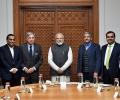
Further stimulus measures are expected in the upcoming Budget where the focus is likely to be on reforms, including some structural measures such as reducing red tape and boosting foreign direct investment. The meeting with industrialists is in the series of discussions that Modi has had during the last couple of weeks to seek suggestions to revive growth.

ITC was the top laggard in the Sensex pack, shedding around 3 per cent, followed by Reliance Industries, Bajaj Finance, Axis Bank, HUL and HCL Tech. On the other hand, PowerGrid, Bharti Airtel, ONGC and UltraTech Cement were among the gainers. NSE Nifty fell 53.25 points to 14,146.25.

The proposed move to withdraw the DDT would help encourage investments by addressing multiple taxation of income and bringing down the effective tax rate on companies, which is among the highest in the world.
The government should have mentioned clearly the specific structural reforms that were responsible for the deviation from the fiscal deficit target by half a percentage point, says A K Bhattacharya.
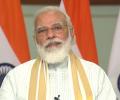
"The emphasis is on making every rule, law, policy people-centric, and public-friendly. This is the use of the new governance model and the country is getting its results," Prime Minister Modi said while speaking at the launch of a platform for 'Transparent Taxation -- Honoring the Honest'.

Tata Starbucks had hiked the base price of one its coffee variant after the GST Council cut tax rates on restaurants from 18 per cent to 5 per cent with effect from November 15, 2017.

The government is expected to dole out some populist policies, especially for the rural / farm sector while presenting the interim budget, given that the country is heading towards general elections over the next few months.

Sitharaman further said that to mitigate genuine difficulties of start-ups and their investors, government has decided to withdraw angel tax provisions for them.

In the last two years, winter sessions have been convened on November 21 and ended in the first week of January.

Anil Rego, CEO, Right Horizons, answers your personal income tax queries.

A hike in cess on luxury cars will not only hinder Jaguar Land Rover's network expansion but also prevent it from introducing new technologies in India, JLR India managing director Rohit Suri tells Shubham Parashar in an interview.

Maruti was the top gainer in the Sensex pack, rising around 6 per cent, followed by Tech Mahindra, Infosys, UltraTech Cement, PowerGrid and NTPC. On the other hand, IndusInd Bank, Bharti Airtel, SBI, ITC and HDFC were the laggards.

Clarity on the roadmap necessary to assess its likely impact on near-term fiscal health and investment.

'The government is trying to kickstart the investment cycle in India and while the corporate investments are yet to gather momentum, there are early signs of the same.'

In fact, no other recent Union Budget has held so much significance for the Indian economy as the one to be presented in about six weeks from now, notes A K Bhattacharya.

During the pre-budget consultation with Union finance minister, some states made a case for fiscal expansion by boosting consumption to tide over the sluggishness in the economy.

Pulse oximeters, hand sanitisers, temperature check equipment and ambulances too will attract lower 5 per cent tax.

This is a part of the exercise to bring down corporate tax rate in a phased manner.

The Congress will respond comprehensively only after specificity emerges in the proposals, reports Amit Agnihotri.

The cess levied on top of the maximum 28 per cent tax rate on petrol vehicles with capacity to carry 10-13 persons has been reduced to 1 per cent and the same for diesel vehicles has been cut to 3 per cent.

It proposes to bring down the corporate tax from the current 35 per cent to 15 per cent, significantly lower individual tax rates, and eliminate several tax rates like the death tax.
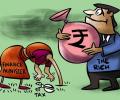
While the tax-to-GDP ratio of 9.88 per cent has been assumed for FY21, the same as last year, when it touched a decadal low, for FY22 a ratio of 10.7 per cent has been assumed, an average of the last five years.
 © 2026 Rediff.com - Investor Information - Advertise with us - Disclaimer - Privacy Policy - Sitemap - Feedback - About us - Terms of use - Grievances