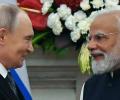
United States representative Sydney Kamlager-Dove while talking about the famous car selfie of Prime Minister Narendra Modi with Russian President Vladimir Putin said that it spoke a thousand words.
India is well-positioned to deal with the negative effects of US tariffs and global trade disruptions as domestic growth drivers and low dependence on exports anchor the economy, Moody's Ratings said on Wednesday.
The US Representative criticised the administration's new USD 100,000 fee on H-1B visas, observing that Indians hold 70 per cent of these visas and saying the change directly harms workers who have long supported US innovation across technology, science and medicine.
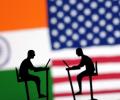
India's proposal to impose retaliatory import duty on certain US products in response to American tariffs on steel and aluminium could cast a shadow over ongoing negotiations for a trade agreement between the two countries, think tank GTRI said on Tuesday. The Global Trade Research Initiative (GTRI) said that if the US engages in consultations with India on the matter or withdraws tariffs, a resolution may be reached.

Foreign portfolio investors (FPIs) infused Rs 22,615 crore into Indian equities in February, marking the highest monthly inflow in 17 months, driven by factors such as the interim India-US trade deal, correction in domestic market valuations, and strong corporate earnings.

Bitcoin has fallen from its peak of $1,26,251.3 on October 6, 2025, to $65,405.5, a decline of 48.2 per cent. Investors must recognise that sharp volatility is inherent to Bitcoin and avoid kneejerk reactions.
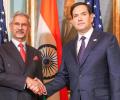
This will be the first face-to-face meeting between Rubio and Jaishankar following President Donald Trump's imposition of an additional 25 per cent tariff on India for Delhi's purchases of Russian oil, taking the total levies imposed on India by the Trump White House to 50 per cent.

The commerce ministry is working on different scenarios to assess the possible fallout of reciprocal tariffs to be imposed by the US administration on April 2 on its key trading partners including India, sources said. US President Donald Trump has said that April 2 will be 'Liberation Day' as he plans to announce tariffs or import duties to bring down America's trade deficit, and promote the country's manufacturing.
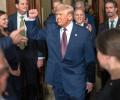
The White House has said India imposes a 100% tariff on American agricultural products and the high levies charged by other countries make it "virtually impossible" for US products to be exported to those nations. President Donald Trump has repeatedly criticised the high tariffs charged by India and other countries on American goods. He plans to roll out a set of reciprocal tariffs on April 2, which he says will be "Liberation Day" for the US.
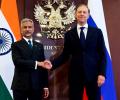
External Affairs Minister S Jaishankar has called for India and Russia to adopt a creative and innovative approach to address complex geopolitical challenges, emphasizing diversification and expansion of cooperation.
I'...additional concessions, such as opening government procurement, reducing agricultural subsidies, weakening patent protections, and allowing unrestricted data flows -- demands India has resisted for decades.'
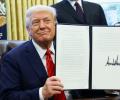
The Trump trade shock is a chance to push long-overdue reforms, rather than tinker with tariffs to appease the US, suggests M Govinda Rao.
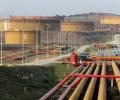
In a significant change to regulations, oil and gas regulator PNGRB has proposed a new policy of how tariffs for pipelines carrying gas to users will be determined, and proposed charging city gas entities selling CNG and piped cooking gas to households at the lowest rates.

The US did not accept India's request for consultations under an agreement of the World Trade Organisation (WTO) concerning American tariffs on steel, aluminium, and related derivative products, Parliament was informed on Tuesday. The US has maintained that these measures were introduced on the grounds of national security, Minister of State for Commerce and Industry Jitin Prasada said in a written reply to the Lok Sabha.

Analysts predict a surge in gold and silver prices as investors seek safe-haven assets due to escalating tensions in the Middle East. The impact on domestic prices will depend on the conflict's duration, with geopolitical factors and macroeconomic data also playing a role.
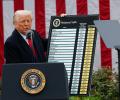
US President Donald Trump announced a 26 per cent "discounted reciprocal tariff" on India, half of the 52 per cent levies imposed by India on American goods, as he described India as "very, very tough."
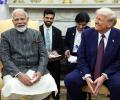
"Their Prime Minister just visited -- he's a great friend -- but I told him, 'You're not treating us right. You charge us 52%, while for years, decades even, we've c'harged you next to nothing. It wasn't until seven years ago, when I took office, that we started pushing back, beginning with China.'"
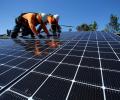
The United States has announced a preliminary countervailing duty of 125.87 per cent on imports of certain Indian solar goods, alleging unfair subsidisation. This move could impact India's renewable energy sector and its efforts to boost domestic solar manufacturing.

From the Sensex firms, Hindustan Unilever, Kotak Mahindra Bank, Trent, Reliance Industries, Asian Paints and ITC were among the gainers. However, Bharat Electronics Ltd, Tech Mahindra, UltraTech Cement, Maruti and Eternal were among the laggards.

Many fans hadn't even bothered to change their Team India jerseys with which they watched the match. A few wanted to carry on the stadium atmosphere into the train singing songs like Chak De India and Vande Mataram. They played them so loudly and ensured no one got a wink of sleep. Of course, the main topic of discussion was Sanju Samson.

India on Thursday said the issue of trade did not come up at all in talks between Indian and American leaders during its military clashes with Pakistan, virtually rejecting Washington's repeated claims that its offer of trade stopped the confrontation.

'Economic activity appears to have peaked in the second quarter of FY26, with industrial output, exports, and business confidence all softening from October 2025.'
American President Donald Trump has announced imposing reciprocal tariffs on its major trading partners including China that levy higher import duties on goods shipped from the United States. He has already announced a 25 per cent duty on steel and aluminium imports, which will come into effect from March 12.

ICICI Bank, Eternal, Titan, Adani Ports, Tata Consultancy Services and UltraTech Cement were also among the laggards. However, InterGlobe Aviation, Tech Mahindra, Hindustan Unilever and Bajaj Finance were among the gainers.
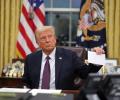
US President Donald Trump has said that tariff negotiations with India are "coming along great," and he thinks the two countries will strike a trade deal.
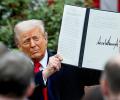
India is already negotiating a bilateral trade agreement with the US. The two countries are aiming to finalise the first phase of the pact by fall (September-October) of this year.
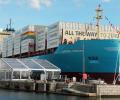
After US President Donald Trump announced a 90-day tariff pause for several nations, including India, global manufacturers are in a rush to ensure that bulk of their goods reach the US during this window. "The 90-day suspension of tariffs will be welcomed by shippers, but it should not be a cause for celebration.
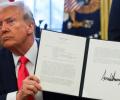
The sweeping tariffs proposed across sectors by US President Donald Trump are scheduled to be imposed starting April 2, with most analysts worried about their impact on companies, and in turn the financial markets. Recently, the US administration signaled that it will impose sectoral tariffs on energy, pharmaceuticals, semiconductors, agriculture, copper, and lumber.

Prime Minister Narendra Modi stayed calm, avoided public confrontation, and focused on India's long-term interests to steady ties with the United States.

A bewildered world is at a loss to find bilateral and multilateral measures to stop President Trump from pursuing his vision of a world unabashedly dominated by the United States, points out T P Sreenivasan.
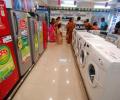
Consumer durable companies in India have begun early-stage talks with US importers at a time when the tariffs levied on Indian products are lower than those on competitors such as China. While the discussions started some time ago, many believe that the Donald Trump administration's tariff measures will help Indian companies expand their presence in the US market.
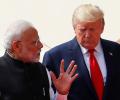
'While criticising India's high tariffs, Mr Trump stated he would impose reciprocal taxes on Indian products if re-elected.' 'However, since India's tariffs follow WTO rules, Mr Trump's actions would violate these rules,' Ajay Srivastava points out.

Uncertainties over the impact of the United States' (US') tariffs on India, along with the ongoing transmission of past rate cuts, prompted the members of the Reserve Bank of India's Monetary Policy Committee (MPC) to maintain the status quo during the August meeting, the minutes showed. While some of the external members highlighted their concern over growth, the internal members cited the one-year headline inflation rate overshooting the 4 per cent target.
Benchmark equity indices Sensex and Nifty rebounded on Thursday after three sessions of losses, tracking gains in global markets after US President Donald Trump struck a conciliatory tone on Greenland. In a volatile session, the 30-share BSE Sensex climbed 397.74 points, or 0.49 per cent, to close at 82,307.37.
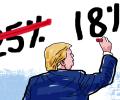
Several farmer organisations in India are protesting the proposed India-US trade deal, expressing concerns about its impact on the agriculture sector and demanding the resignation of the Commerce Minister.

In the 15 Union Budget presentation days of the Narendra Modi government since it came to power in 2014, the BSE benchmark Sensex has ended in negative territory eight times.
Equity benchmark indices Sensex and Nifty ended lower on Thursday after US President Donald Trump announced the imposition of a 25 per cent tariff on all goods coming from India starting August 1 and an unspecified penalty for buying Russian crude oil and military equipment.

From the 30-Sensex firms, Maruti, Power Grid, Tata Motors Passenger Vehicles, HDFC Bank, Asian Paints and Tata Steel were among the biggest laggards. However, Titan, HCL Tech, Tech Mahindra, Infosys and Tata Consultancy Services were among the gainers.

Gor also announced that India will be a member of the Pax Silica alliance.

Rahul Gandhi said that had an INDIA Bloc government negotiated the trade agreement with the US, it would have told US President Donald Trump that he should treat India as an equal.
