
Former finance secretary Subhash Chandra Garg went on to say that the 2020-21 fiscal will go down in the history of India as the year when India got way-laid from its story of three decadal outstanding growth.

Observing that India's worsening COVID-19 situation and the strict measures to contain it have hit the economy hard, the rating agency said productive capacity has been severely disrupted since the start of the pandemic.

Former Reserve Bank of India (RBI) Governor Raghuram Rajan says the government should take advantage of the peaks in the Indian equity markets right now and sell stakes in PSUs while prioritising spending to get the economy back on track. The upcoming Budget for the fiscal year beginning April 1 should look to provide "relief to the poorer households and small and medium enterprises," he said. And then move on to getting the economy back on track.

'It won't help being complacent about the momentum and valuations of equities that currently exist.'

The Cabinet Committee on Economic Affairs (CCEA) on Wednesday approved a five-year-long reform-based result-linked power distribution scheme worth Rs 3.03 lakh crore, for strengthening system of utilities to improve efficiency. Briefing after the CCEA meet here, Power and New & Renewable Energy Minister R K Singh said, "We have done a lot for power distribution reforms. It needs to be strengthened. Today, the Cabinet has approved the new scheme worth Rs 3.03 lakh crore, including Rs 97,000 crore central outlay." He said the funds would be given to power distribution companies (discoms) to strengthen their system.

To help revive the economy battered by COVID-19, Finance Minister Nirmala Sitharaman on Monday announced a slew of measures, including Rs 1.1 lakh crore credit guarantee scheme for improving health infrastructure, and enhancing the limit under the ECLGS by 50 per cent to Rs 4.5 lakh crore for the MSME sector facing liquidity crunch. Sharing the details of stimulus package, the finance minister said this comprises eight relief measures and other eight measures to support the economic growth. She announced Rs 1.1 lakh crore loan guarantee scheme for COVID-affected sectors, including health sector, which includes guarantee cover for expansion or for new projects. Besides, she said, additional Rs 1.5 lakh crore limit enhancement done for Emergency Credit Line Guarantee Scheme (ECLGS) scheme.

Overseas investors have pumped in $6.3 billion in Indian equity markets in three months ended September on attractive valuations, opening-up of the economy and resumption in business activities, says a Morningstar report. This comes following a net inflow of $3.9 billion in June quarter and a net withdrawal of $6.38 billion in March quarter. Apart from inflow, the value of FPI investments in Indian equities swelled further during the quarter under review largely on the back of robust net inflows, coupled with a strong performance of the Indian equity markets.

Indian economy is likely to rebound with an 8.9 per cent growth in the fiscal year beginning April 2021 after economic activity showed significant improvement in the last quarter, IHS Markit said on Friday. The National Statistical Organisation (NSO) on Thursday predicted that the economy will contract 7.7 per cent in the current financial year ending in March, the worst performance in four decades.
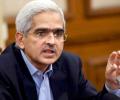
The rising COVID-19 infections across the country are a matter of concern, but it may not impact the ongoing economic revival as one does not foresee lockdowns, Reserve Bank Governor Shaktikanta Das said on Thursday. The economic revival will continue "unabated", Das said, asserting that there is no need for a downward revision of RBI's 10.5 per cent GDP growth forecast for FY22. Speaking at Times Network's India Economic Conclave, Das said, "We have 'insurance' to protect economic revival like a fast-paced vaccination drive, greater ability among people to follow COVID protocols", and one does not see lockdowns as well.

Krishnamurthy Subramanian listed land, labour, law, and liquidity as the key areas of big reforms.

FY22 will be the year to rebuild with the IMF projecting output growth at 11.5 per cent, economic survey at 11.0 per cent and the RBI's Monetary Policy Committee at 10.5 per cent.

Experts disagree with the idea and the Reserve Bank of India (RBI), which has the sole right to print money, is not comfortable with it as well.

With an increasing number of people from the Indian-American community playing a significant role in US elections, Congressman Raja Krishnamoorthi said there is a realisation among them that "if you don't have a seat at the table, you're on the menu -- that is why they are voting and running for office in large numbers".

The markets have been unable to sustain at higher levels as a rise in bond yields globally, especially in the US have dented sentiment. Surging commodity prices, especially crude oil that have now hit $70 a barrel (Brent) coupled with inflation woes and fear of sporadic lockdown across major economic hubs back home as Covid cases rise have chased the bulls away. In the short-term, analysts expect the markets to remain volatile as they react to news flow - both from overseas and developments back home. Investors, they say, need to keep a tab on how the US treasury yields move, which in turn will have a ripple effect on how big money moves across developed (DMs) and emerging markets (EMs), including India.

The Congress leader said a 'storm' was brewing on the economic front that will cause damage and hurt many.

ONGC was the top gainer in the Sensex pack, rallying around 18 per cent, followed by HUL, UltraTech Cement, RIL, TCS, HDFC, ITC and Asian Paints. Only HDFC Bank and IndusInd Bank settled in the red. NSE Nifty zoomed 482 points, or 5.83 per cent, to close at 8,745.45.

Top gainers in the Sensex pack included Vedanta, ICICI Bank, ONGC, Kotak Bank, Axis Bank, SBI, M&M, Infosys, PowerGrid, HCL Tech, NTPC, Bajaj Finance and Reliance Industries, rising up to 2.72 per cent.

IndusInd Bank was the top loser in the Sensex pack, plummeting over 23 per cent. PowerGrid, Kotak Bank, Bajaj Finance, HDFC Bank and NTPC also finished significantly lower. ONGC and ITC were the only stocks in the index that ended with gains. US President Donald Trump has proposed an economic package which could approach $1 trillion, a rescue initiative not seen since the great recession of 2008.

Markets cheer European bank stimulus. Sensex gains 273 points.

While gold added Rs 310 to hit the record level, silver rose by Rs 800 to Rs 62,000 per kilogram.

Among the lot, Rallis India, Escorts, Jubilant Life Sciences, and Crisil added half of the total gains made in the ace stock-picker's portfolio.
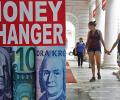
The Indian rupee tumbled in line with its Asian peers due to persistent risk-off sentiment on the back of broad dollar strength.

Asserting that the self reliant India programme will help revive the global economy, Prime Minister Narendra Modi on Thursday told global business community that his government aims to transform the country through access, inclusion and empowerment while also ensuring complete data security. Addressing the World Economic Forum's online Davos Agenda Summit, where he also interacted with global business leaders, Modi also said India offers a predictable and friendly environment from tax regime to FDI norms. He said Aatmanirbhar Bharat movement is committed to global good and global supply chain while the country's digital profile has been completely transformed.

As India emerges from the COVID-19 crisis, the ninth budget under the Modi government, including an interim one, is widely expected to focus on boosting spending on job creation and rural development, generous allocations for development schemes, putting more money in the hands of the average taxpayer and easing rules to attract foreign investments.

'Unless we get the health and economic situations right at the same time, we will not recover.'
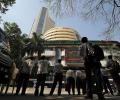
In the past four months, more than 4 million new accounts have been opened, taking the total to 44.3 million.

Despite the large economic impact of the Covid-19 pandemic, the markets have recovered sharply even though the performance among individual stocks has been quite polarised.

Global liquidity expected to continue amid ECB stimulus

A strengthening dollar, rising interest rates, tightening liquidity and a surge in oil prices - all are combining to create a toxic atmosphere for EM assets, says Akash Prakash.

Talking about dealing with the border issue faced by India, Jaishankar, without naming any country or going into details, said, "You know again we did what we had to do. There was a very active debate which still continues to this day. It is natural for people to offer advice, often on matters which they may not have particular knowledge of, that are a human trait. But again if there was what came through it was that we were resolute, we were strong about protecting our interests."

Modi first mentioned about his vision for an 'Atmanirbhar Bharat' (self-reliant India) in his address to the nation on May 12 while announcing a Rs 20 lakh-crore stimulus package to boost the economy hit by the coronavirus pandemic. Since then, various ministries and departments have announced a series of measures.

To make possible discretionary spending including capex and that on welfare, the government decided to borrow more than planned in FY21 -- Rs 12.7 trillion.

'You cannot fight a disease as complex as COVID-19 without a carefully calibrated, localised response.'

Tata Steel delivered one of its best financial performances ever in the third quarter of the current financial year, and surpassed its deleveraging target of $1 billion. In an interview, Koushik Chatterjee, executive director and chief financial officer, Tata Steel, tells Ishita Ayan Dutt that the company will continue to focus on deleveraging but profitable and value-added growth will be equally important.

Outlay for infra is also expected to see a significant increase in view of the government's Rs 111-trillion investment plan under the national infrastructure pipeline to develop social and economic infrastructure over five years.

'It will be only in fiscal year 2023 when the size of the Indian economy will be bigger than what it was in 2020, you will see demand and employment rising.'

Planning Commission member Abhijit Sen on Wednesday said growth in the next fiscal may reach seven per cent due to the stimulus packages already introduced. On deflation he said, "I personally do not see any threat of generalised deflation, though it (might happen) in some sectors."
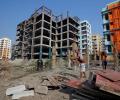
Housing sales fell 37 per cent year-on-year during the 2020 calendar year while gross office space leasing declined 35 per cent on low demand because of the coronavirus pandemic, but demand improved significantly in the last quarter to cross pre-COVID level, property consultant Knight Frank India said on Wednesday. In its 'India Real Estate - Residential and Office Update H2 2020' report released on Wednesday, the consultant reported that sales of residential properties fell 37 per cent to 154,534 units in 2020 across eight cities as compared with 245,861 units in the previous year.

Stock markets squandered early gains but managed to end in the green on Friday, propped up by heavyweight Reliance Industries which announced another stake sale deal for its digital platform. A strengthening rupee and firm global cues also supported the domestic bourses, traders said.
 © 2026 Rediff.com - Advertise with us - Disclaimer - Privacy Policy - Sitemap - Feedback - About us - Terms of use - Grievances