
Private equity fund Texas Pacific Group and global financial services major Citigroup have put in their bids to acquire nearly 40 per cent stake held by the promoters in Sharekhan

The bias for the BSE benchmark index, technical charts suggest, is likely to remain bullish as long as the index holds above 75,600 levels for the rest of the year.
Citigroup's private equity arm Citigroup Venture Capital International has acquired 85 per cent stake in retail brokerage Sharekhan for about Rs 470-480 crore (Rs 4.7 to Rs 4.8 billion).

'Those betting against PSUs will likely be punished in this upswing.'

The Nifty IT index, data shows, has outperformed the markets in each of the last four election years post the result. announcement.

The Reserve Bank of India's (RBI's) record surplus transfer to the government has raised hopes among bond traders that the government might reduce its gross borrowing for the current financial year (2024-25/FY25) by up to Rs 1 trillion. The RBI approved a dividend of Rs 2.11 trillion for the central government for 2023-24, marking an increase of roughly 141 per cent from 2022-23 (FY23). In addition, the contingency risk buffer has been raised to 6.5 per cent from the previous 6 per cent.

Traction for its specialty portfolio, a strong showing in the domestic market, and better regulatory compliance are positives for the country's largest pharmaceutical (pharma) company, Sun Pharmaceutical Industries. Given the triggers, some brokerages have increased their earnings per share estimates and target price for 2024-25 (FY25). This should sustain the momentum for the stock, which has been one of the major pharma gainers in 2023-24 (FY24), rising 57 per cent. It is currently trading at Rs 1,547 per share.

Build a portfolio diversified across market caps, investment styles, and geographies.

The top 100 companies have accounted for 63% of the gains (Rs 51 trillion out of Rs 81 trillion), while firms beyond the top 100 have contributed 37 per cent (Rs 30 trillion).

IT services major LTIMindtree reported a net profit of Rs 1,100 crore for the fourth quarter of financial year 2023-24 (FY24), down 1.2 per cent year-on-year (Y-o-Y) from Rs 1,141 crore in the same quarter last financial year. Revenue grew 2.3 per cent Y-o-Y for the fourth quarter to Rs 8,892.9 crore. Sequentially, revenue was down 1.4 per cent.

Gold prices have been on an uptrend in the last few months, rising nearly 28 per cent to $2387 per ounce now. This rise in gold price, according to Christopher Wood, global head of equity strategy at Jefferies, is attributed to the demand from China amid lack of investor euphoria as regards the yellow metal. "Recent developments show a distinct lack of investor euphoria as regards gold, the question remains what is driving the current rally.

https://www.rediff.com/business/report/quality-control-orders-what-does-this-mean-for-domestic-industry/20240425.htm

As Mumbai's real estate and electric vehicle penetration grows, two of the city's private power distribution companies, Adani Electricity and Tata Power, are eyeing a bigger business pie, particularly betting on high-value customers. Adani Electricity Mumbai (AEML), the subsidiary which houses Adani Energy Solutions' Mumbai distribution business, recorded a six per cent growth in total units sold in the financial year 2023-24 (FY24), the company's presentation shows. This gain came at over 13 per cent growth in the year-ago period.

The bottom lines of several private sector banks have taken a hit following the recent guidelines released by the Reserve Bank of India (RBI) on alternate investment fund (AIF) investments. Last month, the RBI announced that regulated entities, such as banks, non-bank lenders, and home financiers, cannot invest in AIFs that have directly or indirectly invested in companies that have borrowed money from the lenders. In case an entity had already made such an investment, they must liquidate the investment or make 100 per cent provision, RBI had said.

Large Indian IT services companies are expected to report "muted" sequential show in a traditionally strong second quarter, as macroeconomic challenges continue to weigh on global discretionary spending, say market watchers. The big earnings week for tech heavyweights is up ahead, with Tata Consultancy Services (TCS) scheduled to announce its results on October 11, and both Infosys and HCL Technologies on October 12. Wipro is slated to declare its Q2FY24 results next week, on October 18.

IT service company Wipro on Friday reported 7.8 per cent year-on-year decline in its consolidated net profit for the March quarter to about Rs 2834.6 crore, and cautioned that the macroeconomic environment remains "uncertain". The Bengaluru-headquartered company, which recently saw a change of guard with Srinivas Pallia taking over at the helm as the new chief executive officer, has given an IT Services revenue growth guidance in the (-)1.5 per cent to +0.5 per cent band for June quarter on a constant currency basis.

With sentiment for the automotive (auto) sector turning positive, stocks of two-wheeler auto majors have been hitting their 52-week highs. Hero MotoCorp, Bajaj Auto, TVS Motor Company, and Eicher Motors recently reached their yearly highs on strong sales in the festival season and the expectation of faster growth rates ahead. Since the start of this month, listed two-wheeler majors have delivered returns in the 12-17 per cent range, compared to the 7 per cent gains for the S&P BSE Auto Index and 3 per cent for the benchmark S&P BSE Sensex.

The benchmark National Stock Exchange Nifty has rallied 4 per cent, or 750 points, from this month's low to end at 19,732 on week ending November 17. Technical analysts say the market could consolidate around the current levels as it is nearing the resistance zone. "The near-term uptrend status of the market remains intact, but there is a possibility of some more consolidation or minor weakness for the Nifty in the next one to two sessions.

Abbott India outperformed the Indian pharmaceutical market (IPM) with a year-on-year (YoY) growth of 23 per cent in February. The domestic market grew at a robust 20 per cent on a low base, primarily led by volume growth and price hikes. Abbott continued to outperform the sector in the anti-diabetic space with a growth of 20 per cent and key brands such as Thyronorm (hypothyroidism), biliary agent Udiliv, insulin Ryzodeg posted robust growth.

Bajaj Auto's market capitalisation (market cap) hit Rs 2 trillion mark for the first time. The stock of the two and three-wheeler major rallied 6 per cent to hit a new high of Rs 7,420 on the BSE in Tuesday's (January 9) intraday trade after its board approved Rs 4,000 crore share buyback at Rs 10,000 per share. The stock ended the day at Rs 7,093.75, up 1.55 per cent and its market cap a shade above Rs 2 trillion.

Investors may have to wait a little longer for Unified Payments Interface (UPI)-based block mechanism in the secondary market even as the market regulator has set the effective launch date as January 1, 2024. Several brokerage firms said they may take a few months more to implement it. Investors will be able to register for this facility only if the stock broker has opted for the UPI block facility.

Swift gains on Dalal Street this year have also led to a sharp surge in shares of equity market intermediaries like depositories, exchanges, and registrar and transfer Agents (RTAs). The stock prices of BSE, CDSL, CAMS, and KFin Technologies are up 24-283 per cent so far in 2023 when compared to a 9 per cent rise in the benchmark Nifty index. With the market buoyancy expected to keep up the pace, analysts believe these stocks are a good long-term bet despite the sharp rally, which can trigger an intermittent correction.

Despite multiple headwinds at the start of 2023, the Indian markets delivered a strong performance, posting 19-20 per cent growth for the year. Even as new records were set, investor sentiment remains strong going into 2024, given the lower inflation, expectations of steady to lower interest rates, higher economic growth, and strong inflows. However, the overriding concern for most brokerages is valuations.

The global turmoil in the banking sector has made analysts cautious, who advise that investors stay away from stocks of this sector till the overall sentiment improves. The recent trouble for the banking sector started with the collapse of US-based Silicon Valley Bank (SVB), Silvergate Capital and Signature Bank. On its part, Moody's Investors Service has also cut its outlook for the US banking system to 'negative' from 'stable', citing the run on deposits at these three banks that led to the collapse of these banking majors in less than a week.

A likely turnaround in profitability margins in the March quarter (Q4FY23) will not be enough to lift the outlook for paint stocks due to volatile crude oil prices and rising competition in the sector, analysts say. Hence, they advise investors to avoid the sector over the short-to-medium term despite the heavy correction in the stocks since last year. Shares of Asian Paints, Berger Paints, Indigo Paints, Nerolac and Pidilite have shed 6-32 per cent over the last 6 months versus a 3 per cent rise in the benchmark Sensex.

The rupee depreciated by 9 paise and settled at its all-time low level of 83.13 against the US dollar on Wednesday, weighed down by a surge in crude oil prices and strong American currency. Forex traders said the Indian rupee depreciated as the US dollar rose to the highest levels in six months. Moreover, elevated crude oil prices also weighed on rupee.

'Some risks to this market rally include inflation, erratic weather conditions, rising crude prices, slowing global growth and the resultant impact on domestic exports, escalation in geopolitical tensions.'

The recent equity market weakness has sobered up investor mood, but the coming festive season is keeping analysts upbeat on stocks related to the consumption basket. Among the lot, fast-moving consumer goods (FMCG), retail, and consumer electronics segments are expected to do well over the next few months, and investors should thus selectively take bets in these pockets, analysts suggest. "We expect good volume growth for the FMCG sector during the festive season with some improvement in rural demand.

BSE's fresh shot at cracking the derivatives market is off to a promising start. However, Asia's oldest bourse is facing resistance from brokerages with nearly 10 large brokers yet to offer the relaunched Sensex and Bankex derivatives on their platforms. Many brokers maintain that they are working on the back end to enable BSE derivatives on their apps and websites. Some said while volumes are picking up, they are still miniscule compared to bigger rival NSE, which is the most-preferred venue for derivatives trading. Only a few brokers responded to formal queries sent by Business Standard on the issue of allowing BSE derivatives on their platform.

Among the Sensex firms, Tech Mahindra, Tata Motors, Bharti Airtel, Wipro, Bajaj Finserv, HCL Technologies, Bajaj Finance, Larsen & Toubro, Mahindra & Mahindra and UltraTech Cement were the biggest laggards. IndusInd Bank, Power Grid, HDFC Bank, ICICI Bank, NTPC, Reliance Industries, HDFC and Tata Steel were the prominent winners.

Auto industry volumes have grown by 2.5 per cent overall, led by domestic sales of three-wheelers, two-wheelers and passenger vehicles (PVs) in the first quarter of this financial year. Analysts predict an 18 per cent growth in revenues for automotive original equipment manufacturers (OEMs) and profit growth of 69 per cent year-on-year (YoY). However, on a sequential basis, a decline in revenues as well as earnings before interest, taxes, depreciation, and amortisation (Ebitda) margins is expected.

The equity cult has grown at a rapid pace in India in the last few years, with retail investors latching on to the stock markets like never before. At 126.6 million, the number of dematerialised (demat) accounts, where investors hold their securities in electronic form for trading purposes, are at record high levels. The growth rate, on an annualised basis, stood at 27 per cent in 2022-2023, up from barely 6 per cent a decade ago.

Stocks of gold jewellery retailers have been able to retain their sheen in 2023 despite volatile gold prices. Kalyan Jewellers, Titan, PC Jewellers, Thangamayil Jewellery, and Tribhovandas Bhimji Zaveri (TBZ) have rallied 21-72 per cent so far since April as compared to a 13 per cent gain in the benchmark Sensex index. The rally gained steam on the back of gold's 6 per cen

The stock of auto component major Bosch was up 2.5 per cent on Wednesday and in the process hit its 52-week high. Expectations of higher volumes of medium and heavy commercial vehicles' (M&HCV), rise in content supplies on account of BS VI stage 2 implementation from April, and improved profitability are some of the positives for the stock. In addition to this, the company appointed a new managing director and joint managing director last week, which will come into effect from July 1.

The headline for corporate profit growth has been very encouraging in the July-September quarter (Q2) of 2023-24 (FY24), with the combined net profit of listed companies up by 38 per cent year-on-year. However, the earnings distribution has been very lopsided, with most of the growth coming from public-sector oil-marketing companies (OMCs), banks, non-bank lenders, automobile (auto) companies, and cement producers. By comparison, companies from information technology services, fast-moving consumer goods (FMCG), retail, and consumer durables were disappointed, experiencing a sharp slowdown in net sales growth and a relatively muted increase in reported net profit.

10 non-bank and non-finance stocks from the BSE500 Index universe that offer an optimal blend of low valuation, reasonably robust revenue and earnings growth in recent quarters, a strong balance sheet, and most importantly, positive cash flow from their operations.

Logistic players have seen a sharp correction at the bourses over the past six months as intense competition from new-age-tech startups, higher freight rates, and weak macros dented listed players' growth outlook. Analysts warn that the emergence of tech-based startups could weigh on organised players' profit-pool, and can potentially erode their market share. Thus, a stock-specific strategy would be prudent at this juncture with focus on companies that are rapidly innovating and investing in technology.

HDFC Bank Q4 review: HDFC Bank's January-March quarter (Q4) results, for financial year 2022-23 (FY23), brought no cheer to investors as elevated costs, and merger-related uncertainties continue to dent the sentiment. Moreover, analysts fear that merger-related costs may put pressure on margins and cost to income ratio in the near-term, while the return on equity could moderate owing to low leverage of the parent. Analysts, therefore, opine that the stock's re-rating may be some time away. "While the risk of a de-rating on a standalone basis appears to be quite low given that the business performance is holding up well, we believe a re-rating in the stock would happen as and when more clarity emerges on the smooth transition (merger)," said a report by Sharekhan.
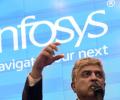
Strong Q3 brings Infosys comfort amid macro risks.

Seek advice from Sebi-registered investment advisors whose names are available on Sebi's Web site.
 © 2026 Rediff.com - Investor Information - Advertise with us - Disclaimer - Privacy Policy - Sitemap - Feedback - About us - Terms of use - Grievances