
The Allahabad High Court has ruled that a husband's obligation to pay maintenance to his estranged wife is not negated by her parents' financial support. The court overturned a family court's decision, emphasising that parental income cannot substitute a husband's legal duty and enhanced maintenance for both the wife and children.

The Uttarakhand High Court has ruled that a father cannot avoid his responsibility to provide maintenance for his minor child by claiming the mother's income or his own financial obligations.

The Allahabad High Court has ruled that a divorce under Mohammedan Law is effective from the date 'talaq' is pronounced, with a court decree simply confirming the divorce.
The Allahabad High Court has ruled that a daughter-in-law is not legally obligated to maintain her parents-in-law under Section 125 of the CrPC, now Section 144 of the BNSS, clarifying the scope of maintenance laws in India.
The Allahabad High Court has ordered the immediate release of a man sentenced to 22 months in civil prison for failing to pay maintenance to his wife, highlighting legal interpretations of maintenance enforcement.

In a judgment of far-reaching implications, the Supreme Court on Wednesday ruled that a Muslim woman can seek maintenance from her husband under Section 125 of the CrPC and said the "religion neutral" provision is applicable to all married women irrespective of their religion.
The Allahabad High Court has ruled that a wife cannot be denied maintenance under Section 125 of CrPC merely because she is highly qualified or possesses vocational skills.

A 25-year-old man in Uttar Pradesh, India, completed a 9km 'dandvat yatra' (prostration pilgrimage) to a local temple after his request for a divorce was granted, fulfilling a vow he made during marital difficulties.

The Supreme Court has ruled that no cognisable offence was committed by BJP leaders Anurag Thakur and Parvesh Verma regarding alleged hate speeches during the 2020 anti-CAA protests in Delhi. The court upheld a previous decision by the Delhi High Court, stating that the speeches did not incite violence or target a specific community.

Siddiqa Begum, daughter and legal heir of Shah Bano, has served a legal notice on the makers "for immediate restraint on the publication, screening, promotion, or release of the upcoming film."
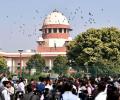
The Supreme Court of India has ruled that a wife is entitled to maintenance from her husband even if she refuses to cohabit with him after a decree for restitution of conjugal rights, provided she has valid and sufficient reasons for refusing to live with him. The court stated that the circumstances of each case must be considered individually and a decree for restitution of conjugal rights does not automatically disqualify a wife from receiving maintenance. This landmark ruling clarifies the legal interpretation of Section 125(4) of the Criminal Procedure Code (CrPC) regarding maintenance and emphasizes the importance of considering individual circumstances when determining a wife's right to maintenance.

'Who has seen what Sharia is? Who knows what actual Sharia is?'

The Supreme Court of India has dismissed a public interest litigation (PIL) seeking to make dowry harassment and maintenance provisions "gender neutral." The court stated that it cannot legislate law and it is the responsibility of Parliament to look into such matters. The PIL, filed by an NGO, argued that these provisions are often misused to harass husbands and their families. The court, however, emphasized that every case must be judged on its own merits, and that the provisions are intended to protect women and children. The court also noted that the allegation of misuse was vague and that such claims should be examined on a case-by-case basis.
The Supreme Court on Friday held that an adulterous relationship may become matrimonial by consent and referred to a larger bench the question as to whether a woman in a live-in relationship was entitled to maintenance from her man.
But the provision was made inapplicable to Muslim women after enactment of the said Muslim Women Act by the then Rajiv Gandhi Goverment in 1986.

The Delhi High Court has ruled that qualified women with an earning capacity should not claim interim maintenance from their husbands, stating that the law does not promote idleness. The court dismissed a woman's plea for maintenance from her estranged husband, highlighting her education and potential to earn. The court encouraged her to actively seek employment, stating she had the capability to become self-sufficient.
After a meeting of its working committee in New Delhi, the board adopted a resolution which stated that the recent judgment of the Supreme Court on the maintenance of Muslim divorcee women is "against the Islamic law (Shariah)".

An Ahmedabad court on Monday held that though Narendra Modi had committed an offence under RP Act by not disclosing his marital status while contesting the assembly polls in 2012, a petition seeking registration of a first information report against him cannot be entertained due to a time-bar prescribed for such cases.

A five-judge Constitution bench said the SC is empowered under Article 142 of the Constitution to do complete justice.

'Nearly 13,000 individuals have been charged for sedition since 2010.' 'If the Supreme Court stay ever gets vacated, arrests will follow immediately.'

Metropolitan Magistrate Akash Jain took cognisance of the complaint and fixed the matter for recording of pre-summoning evidence on August 28.

Crucial reforms in Muslim personal law, especially laws related to inheritance and adoption, need to be initiated forthwith; historically speaking, without the State's backing, hardly has any reform taken place or allowed to prevail, asserts Mohammad Sajjad.

The situation could worsen if weather predictions of more rain in the capital and upper catchment areas come true.

The water level of the Yamuna in Delhi on Tuesday followed a downward trend and dropped below the danger mark of 205.33 metres by 8 pm, the Central Water Commission's data showed.

The Punjab and Haryana high court on Wednesday quashed two separate FIRs registered against former AAP leader Kumar Vishwas and BJP's Tajinder Pal Singh Bagga by the Punjab police over their statements against AAP convenor Arvind Kejriwal.
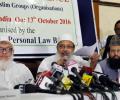
When the Muslim Personal Law Board promises 'advisories' and nikahnamas to the Supreme Court, one has to remember not only its recent campaign against any change in Muslim personal law, but also its past record of inaction on the question of triple talaq, says Jyoti Punwani.

The CBI said the interrogation was needed to reconstruct the scene of crime, to unearth conspiracy, if any, and to collect any other evidence related to the case.
