
Amid expectations that the Reserve Bank may keep its monetary stance unchanged, the central bank will come out with its second quarter review of the credit policy for the current fiscal on October 27.

RBI wants to introduce these as an alternative to gold.

The policy guidance marks a clear shift in RBI's monetary policy stance towards addressing growth risks while not de-emphasising the objective of containing inflation
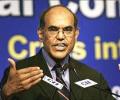
A revival in investment activity, which is key to stimulating growth, depends particularly on the recent policy announcements by the government being translated into effective actions, Subbarao said while announcing the second quarterly review of the monetary policy.
At close, the Sensex ended up 359 points at 20,929 and the Nifty ended up 120 points at 6,221.
Despite a higher CAD in the first quarter, capital inflows were broadly adequate to finance the current account gap, requiring only a marginal drawdown of foreign exchange reserves.

Announced at the second-quarter review of monetary policy, the move would make transactions at automated teller machines and point of sale terminals (PoS or merchant terminals) more secure.

The finance ministry will have to rely on the weapons in its arsenal, since monetary policy is not providing the support.
RBI Governor Duvvuri Subbarao on Tuesday defended the bank's decision to keep the key policy rate unchanged saying inflation could rise to above 8 per cent in the near-term.
Sensex gained 359 points to close at 20,929 and the Nifty added 120 points to end at 6,221.

High inflation continues to be an obstacle in lowering policy rates as of now.

Five of the six external members had suggested that the central bank should reduce the policy rate.

The central bank increased provisioning to 2.75 per cent from the present 2 per cent because CDR cases are on rise. This rise will hit bottom lines of banks by around 4 per cent.

Speaking at the Business Standard Banking Round Table in Mumbai on Monday, five of the six bank chiefs said 'no' when asked whether RBI should raise rates in the second quarter review of the monetary policy on October 25.

The Reserve Bank indicated that it would continue with its accommodative policy stance as managing growth and inflation poses a big challenge for the central bank.
With interest rates rising there are doubts if teaser rate home loans offered by banks will come to an abrupt halt.

The RBI, however, kept other key rates and ratios like repo, reverse repo and cash reserve ratio unchanged.
Professional forecasters have added to Reserve Bank of India Governor Duvvurri Subbarao's dilemma on timing the exit from an accommodative monetary policy stance.

The central bank raised statutory liquidity ratio, the portion of deposits that banks are required to keep in government securities, by 100 basis points to 25 per cent. Other key rates were unchanged.

RBI governor D Subbarao, in the second quarterly review of the monetary policy in October, had said there is need to increase provisioning against bad assets to not less than 70 per cent by September 2010.

RBI Governor D Subbarao explains the rationale for the moves announced in the second quarter review of the monetary policy in an interview with Sidhartha. Excerpts:
Bankers and the markets on Monday read signals that the Reserve Bank of India was likely to continue its tight money policy in Governor YV Reddy's statement that India is vulnerable to oil and foodgrain price shocks.
The interest rates on deposits continue to be high despite ample liquidity due to monetary policy uncertainty and expectations that liquidity would tighten later this year. Banks are still offering peak interest rates of 9 to 9.5 per cent on deposits
A fresh round of selling in late noon trades saw the index tumble to a low of 19,695 -- down 543 points from the peak. The Sensex finally ended with a loss of 194 points at 19,784. The NSE Nifty ended at 5,869, down 37 points.

The RBI has hiked repo or short-term lending rate up by 0.25 pc to 7.75 pc.
Reserve Bank-sponsored professional forecasters on Monday scaled down India's growth projection to 4.8 per cent for the current fiscal from 5.7 per cent estimated earlier.

Other members of the high-level advisory committee are former RBI Deputy Governor Usha Thorat, former Securities and Exchange Board of India Chairman C B Bhave, and Nachiket M Mor, Director of the Central Board of Directors of RBI, Governor Raghuram Rajan said.

Retail inflation measured by the consumer price index has risen sharply across food and non-food constituents, including services, keeping inflation expectations high, the Reserve Bank of India said in its Second Quarter Review of Monetary Policy 2013-14.

The RBI is working to nudge large foreign banks with 30 or more branches in India to get incorporated locally.

Disagreeing with Reserve Bank's projection on the price situation, former RBI Governor and PM's Economic Advisory Council chairman C Rangarajan said WPI and CPI may not be as high as being projected by the central bank.
Currently, foreign lenders are present in India only through branches or representative offices.
 © 2026 Rediff.com - Investor Information - Advertise with us - Disclaimer - Privacy Policy - Sitemap - Feedback - About us - Terms of use - Grievances