
* Repo rate reduced by 25bps to 5.25 pc; * 4th rate cut, totalling 125 bps, since February 2025; * MPC also decided to continue with neutral stance; * GDP growth forecast for FY26 raised to 7.3 pc from 6.8 pc;

Inflows into foreign currency non-resident (bank), or FCNR (B), deposits have significantly underperformed market expectations, leading to a more than 1 per cent depreciation of the rupee against the dollar this week. Analysts point to fading RBI support measures, tepid interest due to rising global bond yields, and narrowing interest rate spreads compared to 2013 as key challenges.

Commercial banks in India recorded their highest credit growth in two years, accelerating to 18.6 per cent year-on-year by June 27, while also mobilising nearly 7 trillion in deposits, marking the third-highest fortnightly deposit growth in 29 years.

The Reserve Bank of India's proposal to allow non-banking financial companies (NBFCs) access to the term money market is projected to significantly increase market volumes by 40-60 per cent in the first year, potentially doubling turnover within two to three years, according to treasury executives.

India's wholesale price inflation (WPI) increased to 9.87 per cent in June, up from 9.68 per cent in May, primarily due to significant price increases in non-food and food products, with food inflation alone rising to 5.49 per cent.

India has significantly improved its position as a global foreign direct investment (FDI) destination, climbing two places to 11th in 2025, with inflows surging by nearly 44 per cent to $38.89 billion, according to the United Nations Conference on Trade and Development (Unctad) World Investment Report 2026.

...and 3 lakh for harassment.

The Reserve Bank of India has imposed a penalty of Rs 41.8 lakh on Canara Bank for non-compliance with KYC norms and incorrect account classification, and Rs 3.1 lakh on Puran Associates Pvt Ltd for asset classification violations.

S&P Global Ratings projects India's economic growth to slow to 6.6 per cent in FY27, down from 7.7 per cent in FY26, citing energy stress and a potential sub-par monsoon.
India's net foreign direct investment (FDI) surged more than fourfold to $6.58 billion in April 2026, driven by a significant increase in equity inflows and reduced repatriation by foreign investors, according to the Reserve Bank of India (RBI).

Kerala Police chief Ravada Chandrasekhar highlighted cyber fraud as a serious social challenge, particularly targeting youth, during the inauguration of 'RBI Reelathon 2026'. This multi-phase awareness campaign by the Reserve Bank of India aims to engage college students in combating cyber financial frauds through creative content creation and timely reporting.

Indian companies' overseas expansion plans are holding strong despite geopolitical tensions in West Asia, driven by structural factors like supply-chain diversification, free trade agreements, and market expansion, according to Ajay Sharma, managing director and head of banking at HSBC India.

Bharti Airtel is strategically shifting its focus towards data centres, cloud services, and financial services as key drivers for its next phase of growth, leveraging significant past investments in digital infrastructure, as outlined by Chairman Sunil Mittal in the company's Annual Report for 2025-26.

Market participants are keenly awaiting regular, preferably weekly, updates from the Reserve Bank of India (RBI) on Foreign Currency Non-Resident (Bank), or FCNR (B), deposits, following the central bank's directive for banks to submit daily data on these inflows.

The Asian Development Bank (ADB) has revised down India's GDP growth forecast for fiscal year 2026-27 (FY27) to 6.6 per cent from an earlier 6.9 per cent, primarily attributing the change to elevated energy prices stemming from the Middle East conflict. Despite this moderation, India is still expected to remain the world's fastest-growing major economy.

The Reserve Bank of India (RBI) has debunked reports of gold sales, stating that its physical stock of gold remains unchanged at 880.52 tonnes, countering claims of selling approximately USD 12 billion to protect foreign-currency reserves.

Unified Payments Interface (UPI) transactions moderated slightly in June from a record high in May, reaching Rs 28.9 lakh crore. Despite a month-on-month decrease in volume, the daily average transactions hit a new high, indicating UPI's strong adoption for low-value payments. The platform also demonstrated significant annual growth and expanding international presence.

Domestic institutional investors (DIIs), driven by the popularity of mutual funds, have emerged as significant stabilising forces for Indian capital markets amidst global volatility and foreign portfolio investment (FPI) outflows, according to Sebi whole-time member Amarjeet Singh.
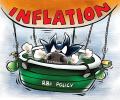
The Reserve Bank of India has increased its retail inflation projection for 2026-27 to 5.1 per cent, up from an earlier estimate of 4.6 per cent. This revision is primarily attributed to mounting input costs, driven by the pass-through of higher global energy prices to domestic petrol and diesel rates, which have seen significant increases since May.

India's wholesale price index (WPI) inflation surged to 9.68 per cent in May, up from 8.26 per cent in April, primarily due to significant increases in the prices of fuel and power, manufactured goods, and food items.

"With the leverage available, I believe the scheme remains reasonably attractive," said P D Singh, India and South Asia Chief Executive Officer, Standard Chartered Bank, regarding the Foreign Currency Non-Resident (Bank) or FCNR (B) deposits.

Reserve Bank Governor Sanjay Malhotra announced that India's foreign exchange reserves stand at a healthy $682.3 billion as of May 29, 2026, providing approximately 11 months of import cover and strong protection against external shocks.

The Reserve Bank of India (RBI) has declared a record Rs 2.87 lakh crore dividend to the government for the 2025-26 financial year, offering significant financial flexibility amidst global economic uncertainties.

...exceeding their 49,340 crore equity selloff.

Most members of the Reserve Bank of India's Monetary Policy Committee (MPC) expressed concerns about inflation becoming generalised and highlighted uncertainties surrounding both inflation and growth prospects due to the West Asia conflict, according to the recently released minutes.

It is because dealing with a regulatory system that is largely headed by retired IAS officers then becomes relatively easy, points out A K Bhattacharya.
Despite the Reserve Bank of India's (RBI) and the government's recent initiatives to attract foreign capital, which are expected to alleviate pressure on long-duration bonds, most debt fund managers are maintaining a cautious stance, favouring shorter-duration papers due to global uncertainties and potential future rate hikes.

India's foreign exchange reserves increased by USD 938 million to USD 682.321 billion during the week ended May 28, according to the Reserve Bank of India, following a previous week's drop.

Non-banking financial companies (NBFCs) reported encouraging results for Q4FY26 with improved asset quality and earnings, but analysts maintain a cautious near-term outlook due to geopolitical tensions, monsoon risks, and specific portfolio concerns.
The RBI seems to be acknowledging that all deposits are not equal -- a deposit with a lower run-off assumption is inherently more valuable than one that could disappear overnight, points out Tamal Bandyopadhyay.

India's remittance inflows have remained robust despite the West Asia conflict, driven by precautionary transfers and diversification of remittance sources, with bankers expecting continued stability for the year.

India's finance ministry anticipates inflation will remain relatively contained in the coming months, supported by a correction in crude oil prices and softening input costs following the cessation of the West Asia conflict, despite earlier spikes in wholesale and retail inflation.

Indian stock market benchmarks, Sensex and Nifty, saw gains in early trading, driven by anticipation surrounding the Reserve Bank of India's monetary policy decision, despite mixed global cues and significant FII outflows.

India's foreign exchange reserves decreased by $711 million to $681.61 billion for the week ending June 5, primarily driven by a significant reduction in foreign currency assets, according to the Reserve Bank of India (RBI).

Amitabh Jhunjhunwala, former Managing Director of the Anil Dhirubhai Ambani Group, has been remanded in CBI custody in an alleged bank fraud case involving Reliance Commercial Finance Limited (RCFL) worth Rs 9,280 crore. The CBI alleges misappropriation of loan funds and violations of RBI guidelines, while Jhunjhunwala's lawyers claim he is a scapegoat.
Outward remittances under the Reserve Bank of India's Liberalised Remittance Scheme (LRS) saw a 7.85 per cent year-on-year contraction in April 2026, primarily driven by reduced international travel spending due to global uncertainty stemming from the US-Iran conflict.

An Home Loan Protection Plan repays the outstanding loan if the borrower dies or suffers a covered disability.

Indian benchmark indices, Sensex and Nifty, closed almost flat in choppy trade as investors remained cautious due to ongoing uncertainty in West Asia, relentless foreign fund outflows, and anticipation of the RBI's monetary policy decision.

State-owned enterprises in India are projected to significantly increase their overseas borrowings, potentially exceeding $15 billion in FY27, driven by the Reserve Bank of India's new concessional forex swap facility which offers a 3 per cent funding-cost advantage.

Recognising the growing use of AI/ML models by regulated entities across business and decision-making processes, the RBI said weaknesses in governance, oversight, risk management, and controls could expose institutions to financial, operational, compliance, and reputational risks.
