
A London-based surgeon of Indian origin has made medical history by successfully completing the UK's first remote robotic surgeries on patients in Gibraltar, approximately 2,400 km away.
The Union Ministry of Health and Family Welfare has launched indigenous robotic technologies, Project Vimana and Project Operion, designed to perform life-saving surgeries on the battlefield, potentially revolutionising emergency care for injured security personnel.

Dr Tejas Patel from Akshardham in Gandhinagar showed the world how it is done.

According to the Department of Pharmaceuticals' annual report for 2024-25, India imported medical devices worth $8.1 billion, while exports stood at $3.7 billion in the financial year 2023-24 (FY24)
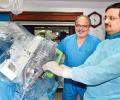
The procedure, however, would cost around Rs 75,000-100,000 more than conventional angioplasty.
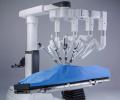
Doctors say robots reduce fatigue and give them greater precision.

In the not too distant future, you could see 5G technology being used for functions such as remotely-performed robotic surgeries, mine equipment operated remotely or cars driven by someone sitting hundreds of miles away. While these ideas will certainly find application globally, the urgent need for them in India could spur swifter adoption here than elsewhere.

The move comes against the backdrop of the US and some of its allies banning the purchase of Chinese telecom gear over security concerns and pressuring other countries to follow suit.

Pricing is a vital part of strategy to take high speed broadband to 265 million homes

The papers noted that the 5G network is built on easily accessible and open Internet protocols and it inherits all the vulnerabilities of previous generations which make it vulnerable to cyber-attacks and compromising the security of the entire system.

The Big Two telecom companies have accelerated their moves towards this next-gen technology, though they have chosen very different routes to getting there.

The merits and demerits of the telcos' 5G strategy however is clearly dependent on the financial muscle of players, reports Surajeet Das Gupta.
Several factors have held India back. One is DoT policy somersaults and lack of clarity on whether to or not to ban Chinese gear makers.

Reliance Jio's decision to acquire 700 MHz in combination with the possible use of an advanced standalone (SA) 5G network could give it an edge over its rivals, according to most analysts. The dissenters argue that the stiff price tag touching Rs 40,000 crore to grab 10 MHz of spectrum in 700 to provide coverage for its SA 5G network which offers ultra-low latency (unlike non-standalone or NSA), has a long way to go in India in terms of finding use cases that can be monetised. Globally, 700 MHz is a pivotal band which provides huge coverage, indoor penetration (especially useful in India where walls are thick) and is already considered by the European Union to be the 'pioneer band' for 5G, with 3.5 GHz and 26 GHz, both of which were auctioned in India recently.
It came as a surprise to all stakeholders - competing telecom companies (telcos), most analysts and even the government's internal projections on revenues from the 5G auctions. Reliance Jio disrupted all calculations by paying a stiff Rs 40,000 crore to buy 10 MHz of spectrum in the 700-MHz band, globally considered a key band for efficient 5G service coverage, along with the default 3.5 GHz band and the ultra-high speed and low-latency millimetre band of 26 GHz band. So what made Jio pay almost 45 per cent of its total spend in this auction for the 700 MHz band - much more than what it rustled up even for the 3.5 GHz band?

Describing neonatal and maternal mortality rates as a matter of grave concern, Prime Minister Narendra Modi on Saturday said his government wanted to effectively use its 'Make in India' and 'Digital India' campaigns to reach healthcare to the country's poorest of the poor.
 © 2026 Rediff.com - Advertise with us - Disclaimer - Privacy Policy - Sitemap - Feedback - About us - Terms of use - Grievances