Earlier, the administration had announced a 24-hour curfew on May 2 and 3 and asked Khargone residents to celebrate the Eid-al-Fitr and Akshaya Tritiya festivals at home.

If the corruption issue doesn't claim Mr Baghel, the Congress's chances in the assembly election later this year are good, observes Aditi Phadnis.

Prime Minister Modi last week called for optimal grain storage, fire audits and mock drills in hospitals as preparations for the harsh summer forecast by the meteorological department.

Why did Karnataka's economic prosperity fail to influence the nature of electoral promises made by political parties in the run-up to the assembly elections? asks A K Bhattacharya.

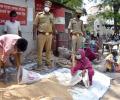
People can make purchases for the festivals on Sunday, when the curfew has been relaxed from 8 am to 5 pm, they said.

The protesting farmers celebrated Holi at the borders and maintained that their agitation will continue till the farm laws are repealed and a separate law on minimum support price is enacted, it said in a statement.

'He is exposing the failings of the BJP, which is rankling the party.'
The top court had on January 18 said the Centre will have a role in drafting the model community kitchens scheme and, particularly, exploring the possibility of providing additional food grains for it.
A bench of Justices MR Shah and Hima Kohli directed the Centre to submit a fresh chart with the number of migrant and unorganised sector workers registered on eShram portal.

Since the first Aadhaar number was issued in September 2010, more than 1.33 billion Aadhaar cards have been generated till June 2022. With the Aadhaar enrolment of adult Indians nearing 100 per cent, the main objective of the Unique Identity Authority of India (UIDAI), which was to give Unique Identification numbers (UID) to all residents of India, is almost achieved, said a senior government official. "Enrolment will now be much more update-based, because people keep updating their mobile numbers and addresses.

Chhattisgarh proves no cash transfer or UID is needed to make PDS work.
'The corruption charges in FCI are not the first and won't be the last.'
After Odisha and Tripura, West Bengal has now opposed the Centre's direct cash transfer to bank accounts of beneficiaries, claiming it would lead to a breakdown of the existing public distribution system and closure of the Food Corporation of India.

The finance minister has stayed true to her commitment to fiscal consolidation, even though the pace of the decline in the deficit could have been faster, notes A K Bhattacharya.
Both prime ministers believed in crafting schemes to help the common man. Modi used quite effectively the instruments Dr Singh introduced. In assessing Modi's success with many schemes, Dr Singh's fundamental work should not be ignored, points out A K Bhattacharya.
The free food scheme is driven by electoral considerations, but its long-term fiscal risks outweigh the short-term gains, cautions A K Bhattacharya.
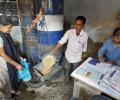
In the three months leading up to the Assembly elections, Chief Minister Yogi Adityanath's government distributed over 1.4 million tonnes (MT) of wheat, 0.95 MT of rice, 0.10 MT of chana (gram), 101.9 million litres of soybean oil and 100,000 tonnes of salt as free ration. This was part of the Covid relief package, officials said.
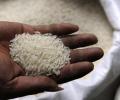
A 6-7 million tonnes shortfall in rice production due to a fall in paddy sowing area is likely to keep rice prices at elevated levels, adding to the inflationary pressure that the slowing economy is already grappling with. Elevated food prices, including that of cereals, had led to retail inflation reversing a three-month declining trend, to touch 7 per cent in August. Similarly, the wholesale price inflation, which declined to 11-month low, also showed price pressures from cereals resulting from wheat output being impacted by severe heat waves in some parts of the country.
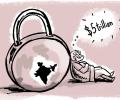
India might be heading towards a "serious livelihood crisis" as the situation seems to be worse this time for the working class amid the COVID crisis and local restrictions by states already add up to something close to a nationwide lockdown, according to noted economist Jean Dreze. In an interview to PTI, he also said the government's target to make India a $5 trillion economy by 2024-25 was never a "feasible target" and was just to pander to the "super-power ambitions" of the Indian elite. About the impact of the second wave of COVID on the Indian economy, the eminent economist said the situation today is not very different from what it was around this time last year as far as working people are concerned.
What is ailing India's Public Distribution System (PDS)? "Corruption" is the one and only answer to that question.

'I have seen, even in my village, people hanging pictures of Communist leaders -- Jyoti Basu, Joseph Stalin, Mao Zedong -- in their drawing rooms. Could we not hang pictures of Swami Vivekananda? '

Talking to reporters Khatkar Kalan, he also suggested that Pakistan's spy agency Inter-Services Intelligence will use farmers' unrest over the new farm laws and will try to foment trouble in the border state of Punjab.
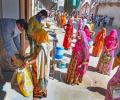
The government's food subsidy in the ongoing fiscal year is expected to be a little less than Rs 4 trillion.
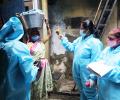
Officials said several witnesses were heard on the impact of the pandemic. They added that this was the longest meeting of the panel without a break so far.

Amid a surge in COVID-19 cases in the country, the Indian Medical Association has written to Prime Minister Narendra Modi suggesting that vaccination be allowed for all people above the age of 18 years.
The government is considering a ban on export of kerosene oil (jet kero) and aviation turbine fuel (ATF), which are similar to kerosene, to boost supplies of kerosene for public distribution system.

State-owned Indian Oil Corp (IOC) on Friday said international oil prices have been range-bound in the last few weeks, warranting no revision in retail petrol and diesel rates. While petrol price hasn't changed since September 22, diesel rates have been static from October 2.
A recent study shows that more than 100 million people are excluded from the public distribution system because the central government insists on using 2011 population figures to calculate state-wise PDS coverage, which effectively leaves out 100 million people, reports Sanjeeb Mukherjee.
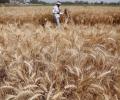
The surge in wheat export from India owing to the Ukraine crisis has once again demonstrated how farmers in states that have flexible marketing frameworks and low taxes benefit more from an emerging situation. The bulk of the wheat exported from India, trade and industry sources say, is being sourced at rates significantly higher than the state-mandated price of Rs 2,015 per quintal in Madhya Pradesh (MP), Uttar Pradesh (UP), and Gujarat - states which have low mandi taxes compared to Punjab and Haryana. This is not only benefiting farmers there but could also lead to significant savings for the states in procurement costs in the months to come.

'Welfare schemes are not a necessary evil, they are a necessary good.'
The findings of the report showed consumer spending falling for the first time in over four decades in 2017-18.
With a sub-normal monsoon looming, the government is worried about spiralling food inflation and its debilitating impact on the nascent economic recovery.
In the 2018 assembly polls, the Congress shocked the BJP by securing 30 of the 47 ST seats, proving that this vote bank has drifted away from the ruling party over some time. Sandeep Kumar reports.
A meaningful long-run strategy to eradicate poverty would do more than a top-down distributive model.
The IEO, which has been entrusted to assess public programmes, has found that 57 per cent of the subsidised foodgrains distributed in Delhi, do not reach the target group with close to 36 per cent siphoned off the supply chain.

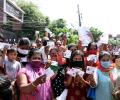
A large number of women from various states reached the sites of protest against the Centre's three farm laws that has been going on for over 50 days now.
Company to bring in initiatives like biometric transactions to improve efficiency.
All those who have been dismayed by the food security ordinance should thank Manmohan Singh and his colleagues for a neat optical trick, says T N Ninan.
 © 2026 Rediff.com - Advertise with us - Disclaimer - Privacy Policy - Sitemap - Feedback - About us - Terms of use - Grievances