
'The Opposition thinks since the ruling party is following Savarkar's Hindutva philosophy, they want to regain their lost political mileage (by attacking Savarkar).' 'By doing so, they think they will get their power back.'

Alka Mittal has been appointed interim chairman and managing director of Oil and Natural Gas Corporation (ONGC) - the first woman to head the country's largest oil and gas producer. Mittal replaces Subhash Kumar, another interim head who retired after reaching superannuation age on December 31. "The Appointments Committee of the Cabinet (ACC) has approved the proposal of the Ministry of Petroleum and Natural Gas for entrustment of additional charge of the post of chairman and managing director (CMD), ONGC to Alka Mittal, director (HR), ONGC for a period of six months with effect from January 1, 2022, or till the appointment of a regular incumbent to the post, or until further order, whichever is the earliest," the Department of Personnel and Training (DoPT) said in an order dated January 3, 2022.
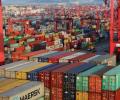
India's exports in January rose 25.28 per cent to $34.50 billion on account of healthy performance by mainly engineering, petroleum and gems and jewellery sectors, even as trade deficit widened to 17.43 billion, according to data released by the commerce ministry on Tuesday. Imports grew by 23.54 per cent to $51.93 billion during the month under review. Trade deficit, difference between imports and exports, stood at $14.50 bn in January 2021.
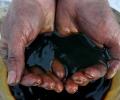
Notwithstanding the windfall tax placing a cap on profits, oil and gas producers like Oil India (OIL) and Oil and Natural Gas Corporation (ONGC) have done well in the October-December quarter (third quarter, or Q3) of 2022-23 (FY23). ONGC faces the drag of poor results from its subsidiary Hindustan Petroleum Corporation, and in comparative terms, OIL is better off. Standalone net sales in Q3FY23 stood at Rs 5,900 crore - up 57 per cent year-on-year (YoY), up 2 per cent quarter-on-quarter (QoQ).
The windfall taxes on domestic crude oil production and fuel exports will generate close to $12 billion (Rs 94,800 crore) for the government in the remainder of the current fiscal while trimming profits of firms such as Reliance Industries Ltd and ONGC, Moody's Investors Service said Tuesday. On July 1, the government imposed windfall gain taxes on the export of petrol, diesel and aviation turbine fuel (ATF), and on the domestic production of crude oil. It has also mandated exporters to meet the requirements of the domestic market first.
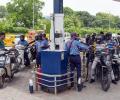
Petrol price on Monday was hiked by 30 paise a litre and diesel by 35 paise, taking the total increase in rates in the last one week to Rs 4-4.10 per litre. Petrol in Delhi will now cost Rs 99.41 per litre as against Rs 99.11 previously while diesel rates have gone up from Rs 90.42 per litre to Rs 90.77, according to a price notification of state fuel retailers. Rates have been increased across the country and vary from state to state depending upon the incidence of local taxation.

Women, men and children waiting in long queues to buy kerosene are a common sight in Colombo and other Sri Lankan cities after the nation's severe economic crisis cut off supplies of petroleum products to the island.
India's exports rose marginally by 1.62 per cent to $33.92 billion, while trade deficit more than doubled to $27.98 billion in August due to increased crude oil imports, commerce ministry data said on Wednesday. The revised data showed that imports rose by 37.28 per cent to $61.9 billion in August this year. The preliminary data released by the ministry on September 3 had shown a 1.15 per cent decline in exports to $33 billion in August.
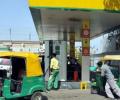
State-owned Indian Oil Corporation (IOC) and a joint venture of billionaire Gautam Adani's gas arm and Total of France -- Adani Total Gas Ltd -- have bid for maximum number of licenses to retail CNG to automobiles and piped cooking gas to households in the latest city gas bidding round.

Rajya Sabha proceedings were adjourned for the day on Monday amid protests by Opposition parties over their demand to revoke the suspension of 12 members of the House.

Finance Minister Nirmala Sitharaman on Thursday said India has ramped up the import of crude oil from Russia at discounted prices amid sanctions on Moscow as part of the country's inflation management. "In a situation where global prices were going beyond anyone's affordability, at that stage to take a very strong political decision, I respect the prime minister for his courage on this to get it from Russia because they are ready to give it to you at discount. And how speedily did we manage to do it," she said. India ramped up its import from Russia from about 2 per cent of the total shipment of petroleum products to 12-13 per cent in a couple of months as part of inflation management, she said at a seminar organised by economic think-tank Icrier.

Finance Minister Nirmala Sitharaman on Thursday said inflation management cannot be "singularly" left to the monetary policy as a majority of activities are outside its purview in the current context. Speaking at a seminar organised by economic think-tank Icrier, the finance minister said that both the fiscal policy and the monetary policy have to work together to contain inflation. Consumer price index (CPI) based inflation or retail inflation is ruling above the Reserve Bank's comfort level of 6 per cent since January.

India will kickstart on Tuesday a two-day multi-agency military exercise covering the country's 7,516 km-long coastline and exclusive economic zone with the twin aim of checking the preparedness of various agencies to deal with any eventualities and bolster overall maritime security, officials said.

Whether this remains under control in the coming months will depend on the future intensity and spread of the Russia-Ukraine war, and the effectiveness of the Indian government's response, points out A K Bhattacharya.
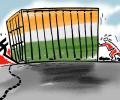
India's exports rose by 43 per cent to $35.65 billion in October while trade deficit widened to $19.73 billion during the month, according to the official data released on Monday. Imports soared by 62.51 per cent to $55.37 billion, widening the trade deficit. Export sectors which recorded positive growth during October include petroleum, coffee, engineering goods, cotton yarn/fabs./made-ups, gems and jewellery, chemicals plastic and linoleum and marine products, the data showed.
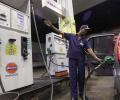
Petrol price on Sunday was hiked by 50 paise a litre and diesel by 55 paise, taking the total increase in rates since resumption of daily price revision less than a week back to Rs 3.70-3.75 per litre. Petrol in Delhi will now cost Rs 99.11 per litre as against Rs 98.61 previously while diesel rates have gone up from Rs 89.87 per litre to Rs 90.42, according to a price notification of state fuel retailers. Rates have been increased across the country and vary from state to state depending upon the incidence of local taxation.

Moitra brought two birthday caps in the House to press her argument that the businessman being most talked about had "topi-pehnau-ed" the government.

Acceleration in demand, together with marginal price hikes of about 2-3 per cent by cement companies in the October-December quarter (third quarter, or Q3) of 2022-23, may not be enough to cushion the impact of high input costs on the bottom line, reveal Bloomberg consensus estimates for the quarter. Year-on-year (YoY) net sales growth in Q3 will come in at nearly 7 per cent, shows Bloomberg data, while bottom-line growth will show a sharp decline of 25 per cent from a year ago. The earnings before interest, tax, depreciation, and amortisation (Ebitda) will likely decline by nearly 5 per cent versus a year ago, shows data.
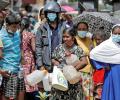
In what appears to be more trouble for President Gotabaya Rajapaksa and his elder brother Prime Minister Mahinda Rajapaksa's government, the main Opposition Samagi Jana Balawegaya party on Friday announced that it will move a no-confidence motion against the government if it fails to take steps to address the concerns of the public facing hardships due to the worst economic crisis in the island's history.
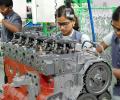
Cummins India will soon start producing fuel-agnostic engine systems at the Tata-Cummins plant in Phaltan in Satara district of Maharashtra, senior officials at Cummins India said. The firm will start limited production by the end of 2023 and mass production will likely begin by 2024, the officials said.

It was touted as a game changer but big-ticket privatisation has been a mixed bag as the government faces unanticipated challenges of lukewarm investor response, employee union agitation and legal hurdles. Prime Minister Narendra Modi's often-repeated statement 'the government has no business to be in business' guided the drawing up of an ambitious privatisation pipeline. While Air India sale succeeded, Bharat Petroleum Corporation Ltd (BPCL) divestment failed.

Corporate earnings grew in double digits during the April-June 2022 (Q1FY23) quarter but the momentum waned. Overall corporate earnings in the quarter were down sharply from their highs in FY22. The combined net profit of 2,981 listed companies across sectors in the Business Standard sample was up 22.4 per cent YoY to Rs 2.24 trillion in the June quarter, driven by a big jump in the earnings of banks, non-banking lenders, oil & producers, and FMCG companies. Also, earnings in the corresponding quarter a year ago were affected because of the second wave of the Covid pandemic, even though the numbers were a lot better than Q1FY21 when there was a nationwide lockdown.

Finance Minister Nirmala Sitharaman's Budget speech on Wednesday was marked by the usual thumping of benches by the ruling alliance members, but the loudest cheer was reserved for her announcement of income tax relief, which was welcomed by 'Modi, Modi' chants in Lok Sabha that also witnessed a few instances of protest by the Opposition.
Petrol and diesel price hikes are likely to resume after state elections get over next week to bridge the Rs 9 a litre gap created by international oil prices soaring past $100 a barrel. International crude oil prices shot above $110 a barrel for the first time since mid-2014 on fears that oil and gas supplies from energy giant Russia could be disrupted, either by the conflict in Ukraine or retaliatory western sanctions. The basket of crude oil India buys rose above $102 per barrel on March 1, the highest since August 2014, according to information from the Petroleum Planning and Analysis Cell (PPAC) of the oil ministry.
After a hiatus of nearly two decades, the government's programme to privatise state-owned firms restarted with the handing over of debt-laden national carrier Air India to the Tata Group. With the new owner shelling out Rs 18,000 crore for the buyout of the 'Maharaja', this would be the highest-ever amount garnered through privatisation, and is even more than the cumulative sum mopped up through strategic sales from 1999-00 to 2003-04. The government had in October last year inked the share purchase agreement with the Tata Group for sale of national carrier Air India for Rs 18,000 crore. Tatas would pay Rs 2,700 crore cash and take over Rs 15,300 crore of the airline's debt.

Overall, the record of the second term reveals a contradiction between the image and the reality. The image, especially on media and social media, is one of the man at the height of his power, and unstoppable. The reality on governance is someone who has found it difficult to get things implemented and unsure of what to do next, points out Aakar Patel.
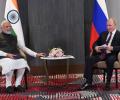
The phone conversation came days after it emerged that Modi will not be travelling to Russia for the annual India-Russia summit this year.
India's exports recorded a flat growth of 0.59 per cent to $31.99 billion in November, even as trade deficit widened to $23.89 billion during the month, according to the data released by the government on Thursday. Exports stood at $31.8 billion in November last year. Imports rose by 5.37 per cent to $55.88 billion in November as compared to $53.03 billion in the corresponding month a year ago, the data showed. During April-November 2022, exports rose by 11 per cent to $295.26 billion as against $265.77 billion in the same month last year.

Snapping the two-month easing trend, WPI inflation rose in August and remained in double-digit for the fifth consecutive month. In July 2021, WPI inflation stood at 11.16 per cent. In August 2020, WPI inflation was at 0.41 per cent. "The high rate of inflation in August 2021 is primarily due to rise in prices of non-food articles, mineral oils; crude petroleum and natural gas; manufactured products like basic metals; food products; textiles; chemicals and chemical products etc as compared the corresponding month of the previous year," the commerce and industry ministry said in a statement.

BJP leader Sushil Kumar Modi on Wednesday said it is not possible to bring petrol and diesel under the GST regime for the next eight to 10 years as it would cause an annual revenue loss of Rs 2 lakh crore to all states. Centre and states collectively collect over Rs 5 lakh crore tax on petroleum products, Modi told the Rajya Sabha while participating in a discussion on the Finance Bill 2021. The statement assumes significance in view of the rise in petrol price for the past over one year which even touched Rs 100 per litre in some states. In the first reduction in rates in over a year, petrol price on Wednesday was cut by 18 paise per litre and diesel by 17 paise a litre as international oil prices tumbled to the lowest since early February.

Privatisation of BPCL, which was dubbed India's biggest ever, has been stalled with just one bidder left in the fray after two others walked out over issues such as lack of clarity in fuel pricing, a top source said. The government had planned to sell its entire 52.98 per cent stake in Bharat Petroleum Corporation Ltd (BPCL) and invited Expression of Interest from bidders in March 2020. At least three bids came in by November 2020 but only one remains now after the others withdrew from the race.
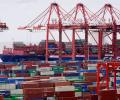
The country's exports for the first time crossed the $400 billion mark in a fiscal on healthy performance by sectors such as petroleum products, engineering, gems and jewellery, and chemicals, according to the commerce ministry's data released on Wednesday. The merchandise exports rose by by 37 per cent to $400.8 billion in 2021-22 until March 21 against $292 billion in 2020-21. Previously, the outbound shipments had touched a record of $330.07 billion in 2018-19.
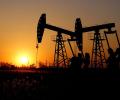
India plans to release about 5 million barrels of crude oil from its emergency stockpile in tandem with the US, Japan and other major economies to cool prices, a top government official said on Tuesday. India stores about 38 million barrels of crude oil in underground caverns at three locations on the east and west coast. Of this, about 5 million barrels will be released, starting as early as 7-10 days, the official, who wished not to be named said.

The biggest headwind to the consumption story in FY23 is a sharp decline in government subsidies on food, fertiliser and fuel, and overall decline in revenue expenditure net of interest payments. This, analysts say, will adversely impact purchasing power of households at the lower end of the income pyramid, translating into lower spending on consumer goods and services.

Amid record-high fuel prices, Finance Minister Nirmala Sitharaman on Monday said there is no proposal as of now to bring crude oil, petrol, diesel, jet fuel (ATF) and natural gas under the Goods and Services Tax (GST). When the GST was introduced on July 1, 2017, amalgamating over a dozen central and state levies, five commodities - crude oil, natural gas, petrol, diesel, and aviation turbine fuel (ATF) - were kept out of its purview given the revenue dependence of the central and state governments on this sector. This meant that the central government continued to levy excise duty on them while state governments charged VAT. These taxes, with excise duty, in particular, have been raised periodically.

The importance of China as India's top trading partner cannot be understated.

However, WPI inflation remained in double digit for the third consecutive month in July, mainly due to a low base of last year. WPI inflation was (-) 0.25 per cent, in July 2020. "The high rate of inflation in July 2021 is primarily due to low base effect and rise in prices of crude petroleum and natural gas; mineral oils; manufactured products like basic metals; food products; textiles; chemicals and chemical products etc as compared the corresponding month of the previous year," the commerce and industry ministry said in a statement.
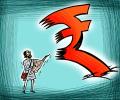
The Centre is staring at a combined shortfall of up to Rs 1 trillion in excise and Customs revenues in the current financial year (FY23) compared to the Budget estimates (BE), mainly because of duty cuts on edible oil and petroleum products. The government set a target of Rs 3.35 trillion for excise and Rs 2.13 trillion for Customs mop-up for FY23 while presenting the Budget in February. "As excise duty collection is mainly driven by diesel volumes, we might see a clear gap in the level budgeted for FY23, following the reduction in cesses on petrol and diesel in May. We are expecting somewhere between Rs 80,000 crore and Rs 1 trillion dip in excise and customs duty collections," a senior government official told Business Standard.

A group of 10 people, including women and children, arrived after getting stranded at fourth island here but were rescued and brought to the shore by the Indian Coast Guard.
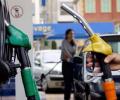
Officials from State-run refiners contend that savings from purchase of Russian oil are used to offset a part of the losses in revenues from selling transport fuels and LPG at State-set rates.
