
India's per capita income, a gauge for measuring living standard, is estimated to have gone up 11.7 per cent to Rs 5,729 per month in 2012-13 at currentprices, compared with Rs 5,130 in the previous fiscal.
The per capita income of Indians continued its climb up the ladder, increasing 11.1 per cent in 2004-05 to Rs 23,308 (at current prices) compared to Rs 20,989 in 2003-04.
Reflecting general rise in living standard, India's per capita income is estimated to grow above Rs 60,000 per annum or over Rs 5,000 per month, said the government data.

If Xi Jinping is dethroned in the future, the instrument for that may well be embedded within the PLA, notes former foreign secretary Shyam Saran.
Gross state domestic product of the city went up by 10.53 per cent.

The Gross National Income (GNI) at 2011-12 prices is now estimated at Rs 112.13 trillion as against Rs 112.14 trillion estimated earlier for 2015-16.
India has become the fourth largest economy in the world due to a strong economic growth but still has a low per capita income, the Economic Survey revealed.

The national per capita income in 2013-14 stood at Rs 87,748.

In the academic year 2024-2025, the IB had 258 authorised schools in India, up from 183 schools in 2019.
The per capita annual income in the national capital has increased to Rs. 2.01 lakh in 2012-13 compared to Rs 1.73 lakh in the previous fiscal, which is three times the national average and highest in the country.

The Indian government has expressed its disagreement with the IMF staff's 'baseline' assumption that the 50 per cent US tariffs on its goods exports 'would remain in place indefinitely', based on which the staff pegged the country's GDP growth at 6.6 per cent this year, and pared its 2026-27 projection by 20 basis points to 6.2 per cent.

The revised salaries of MPs are significantly lower than the salaries drawn by top bureaucrats in the country.
'When you compare Bihar's poverty from its earlier times, then there is a huge difference. Things have improved a lot. And migration has played an important role in reducing poverty.'

Per capita income is a crude indicator of the prosperity of a country.
India's per capita income is projected to grow by 17.3 per cent to Rs 54,527 in 2010-11 from Rs 46,492 in the year-ago period, according to the official data released on Monday.

India's per capita income, a gauge for assessing standard of living, for 2013-14 is up at Rs 6,699 per month for 2013-14 as against the earlier estimate of Rs 6,198.33 after the government updated the base year for measuring national accounts.

India's monthly per capita income, the measure of standard of living, is likely to be at Rs 7,378.17.

A string of welfare schemes and promises tests the state's budget, which is already heavily dependent on central support and spends little as capital outlay.
The US is likely to have per capita GDP of $57,455, about 20 times India's, indicative of how far India will stand in about a decade.
Reflecting growing prosperity, India's per capita income grew by 15.6 per cent to Rs 53,331 per annum in 2010-11, crossing the half-a-lakh rupees mark for the first time, according to government data.
Reflecting growing prosperity, India's per capita income grew by 15.6 per cent to Rs 53,331 per annum in 2010-11, crossing the half-a-lakh rupees mark for the first time, according to government data.

If he cannot do it this term by using his bureaucracy and experts from different fields, it will be a tragedy, asserts Ramesh Menon.
India's per capita income is projected to soar by 10.4 per cent to Rs 74,920 in 2013-14 as the country becomes a $1.7 trillion economy.
Addressing economists, investors and academicians in Washington, Basu said the fundamentals of the Indian economy are strong enough in the medium and long term to sustain a healthy growth rate of over 8 per cent.

An Indian would have got Rs 40,141 during 2008-09, if the country's wealth was equally distributed among its citizens, according to the revised estimates of the national income.
Population growth rate would be 1.5 per cent during the period 2007-12. "The next 10 years, India will register four major changes. The economic growth will accelerate, the technology will also grow and domestic industry will experience major liberalisation," Ahluwalia said after inaugurating the 22nd Indian Engineering Congress in Udaipur.

'We have 38 Dalits who are MLAs and ministers. But that does not mean the Dalits of Bihar are prospering.'

The average Indian worker must labour for an extraordinary 160 full working days to afford Apple's latest iPhone 17 Pro.

'Peninsular Indians could ask 'Why should we contribute half of India's tax revenues if we account for only a quarter of the seats in the Lok Sabha?'.' 'The rest of the country seems likely to counter that 'democracy means one vote per person irrespective of where that person resides in India'.' 'With no easy answers to this thorny debate, the south's economic ascendancy could end up creating a Hobson's choice.' A revealing excerpt from Nandita Rajhansa and Saurabh Mukherjea's book, Behold the Leviathan: The Unusual Rise of Modern India.

Bihar is now among the top 10 states in terms of investor base, surging past better-off states like Delhi, Haryana, and Punjab.

Uttar Pradesh, Gujarat and Odisha budgets maintain revenue surpluses despite welfare schemes while Rajasthan and West Bengal face high debt, fiscal deficits and low capital outlay.

Bharti Airtel sees opportunity in raising tariff for data services as it feels that rich are paying less and poor are not required to pay anymore, a senior official of the company said. During the company's earnings call for the first quarter of the current fiscal, Bharti Airtel vice-chairman and MD Gopal Vittal said that the company has written to the government for a relief on adjusted gross revenue and has demanded that it should be given benefit at par with other telecom operator, without naming Vodafone Idea.

The answer is to be found in the rise of the global south and in particular, the rise of China, explains Aakar Patel.
Each employee is generating more business than before -- driven by cost rationalisation, digital adoption, and better resource utilisation -- signalling a stronger foundation for sustainable growth and profitability.

On his 200th birth anniversary, Utkarsh Mishra traces the life, thought, and legacy of Dadabhai Naoroji, the Grand Old Man of India.

Siam argues that a 2040 ban could destabilise ongoing and future investments and threaten millions of jobs in the automotive value chain.
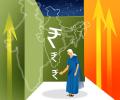
NITI Aayog member Arvind Virmani on Monday said India is set to become the fourth largest economy in the world by the end of 2025, an assertion which came days after NITI CEO BVR Subrahmanyam claimed India has already overtaken Japan to reach that spot. The International Monetary Fund (IMF), in its World Economic Outlook (WEO) report released in April had said that India is expected to be the fourth largest economy in the world with a GDP of $4.19 trillion in 2025, ahead of Japan.
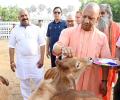
Uttar Pradesh Chief Minister Yogi Adityanath, known for his hardline Hindutva views and 'bulldozer justice' approach, has spoken out about his policies toward Muslims, the Waqf board, and his vision for India. He asserts that Muslims will receive a fair share of development in Uttar Pradesh, but not special concessions. He also criticizes the Waqf board for its alleged appropriation of government properties and calls for its reform. Adityanath defends his 'bulldozer justice' policy, claiming it is necessary for infrastructure development and removal of encroachments. He also discusses his vision for India, emphasizing the importance of Hindi as a national language and the need for unity across different linguistic groups.
 © 2026 Rediff.com - Advertise with us - Disclaimer - Privacy Policy - Sitemap - Feedback - About us - Terms of use - Grievances