
'It is a diamond which has a very long competitive history.'

The greatest progress on civil rights in the United States since Abraham Lincoln was under the Southern Democrat Lyndon Johnson, the past master of wheeling and dealing in Congress.

Modi took on the opposition parties, especially the Congress, saying it is the corrupt who are sleepless now.
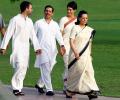
Indian law makes it clear that Sonia and Rahul are not related to Robert Vadra, nor is Sonia a relative of Pandit Nehru.

'Nehru's hegemonic politics has been responsible for many ills, which undoubtedly includes Kashmir'

Here was an Indian like you and me, who reached the country's highest office without compromising on his integrity or values. Here was a politician who was not a Muslim, or Tamil, or a boatman's son -- but an Indian president, who opened his office to all Indians, says Sriram Karri.

highlights of what Bharatiya Janata Party's prime ministerial candidate, Narendra Modi and senior leader L K Advani said at the Statue of Unity launch event
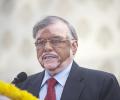
'Judging by the conduct of two governors of Kerala and one governor from Kerala, Congressmen treated Raj Bhavan as a transition point before taking a flight back into active politics.'
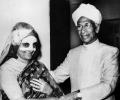
'She was once asked what the secret to political leadership was and she said it was the ability to like all kinds of people.' 'I don't think Rahul fundamentally likes people -- that's probably why he can't deal with them and it shows.' 'Sonia is a more talented political mobiliser than her son, but I think the decline of the Congress set in in 1969...'

'Muslims are depressed and disillusioned.' 'The safety valve is that we still have a multicultural mosaic in West Bengal, Tamil Nadu, Karnataka and Kerala.'

'A dangerous and false binary is now surfacing in Indian political discourse, which must be firmly rejected.' 'It is that we have to choose between freedom and development.' 'For us freedom is neither merely an instrument for development nor to be subordinated to development.' 'It is, as our founding fathers proclaimed early in our freedom struggle, 'our birthright' on which we shall never compromise.' 'Growth, wealth and development are fruits of democracy, not substitutes.' Dr Manmohan Singh's thoughts on democracy: A Must Read!
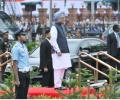
Amberish Kathewad Diwanji tweaks the prime minister's Red Fort speech.
'High denomination cash notes which was 1.4 lakh crores of Rs 500 and Rs 1,000 notes in 2004 became Rs 15.5 lakh crores in 2016.' 'If it had been allowed, by 2022, it would have been Rs 34 lakh crores, and that would have been the end of the Indian economy.' 'Demonetisation was a huge hit on the head of the economy, but without the hit, you could not U-turn the economy.'

Dr Raghuram Rajan's departure holds lessons for all, be it sections of the media, politicians or the people themselves. We need to learn how to value and retain talent. At the same time the talented must realise that talent alone does not ensure the top job, says Sanjeev Nayyar.

'If the Indian economy formalises, industrialises, urbanises and develops human capital, 10 lakh youngsters will join the labour force every month in the next 10 years.' 'It's not a bulb that will go off; it is a sunrise.'

It is unconscionable to choose between Sardar Patel, who united India physically, and Indira Gandhi, who gave meaning, content and pride to the unity of the nation and became a martyr at the altar of national unity, says Ambassador T P Sreenivasan.
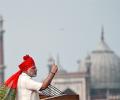
'Independence Day has been India's annual general meeting. For the most part, it has been a forgettable experience of ritual observances. Not so this year... Mr Modi instead presented what I call a moral balance sheet of India,' says Shreekant Sambrani.

Narendra Modi was both conciliatory and mocking towards the Opposition, particularly Congress, during his hour long reply to the debate on the motion of thanks to the President's address in the Upper House.

Has New Delhi internalised the truth that it does not matter, asks Saeed Naqvi. Such deafening silence from the government, principal opposition, even the pundits!

Narendra Modi's promise to allow states a bigger say in strategising and building foreign policy is unexceptionable, says TP Sreenivasan.

'Our policy seems to be to give away part of J&K, even though we are entitled to the entire state.' 'The Congress has done so, and the BJP is following the same policy.' 'No one is applying their mind to the legal position.' 'Kashmir is not a part of Pakistan under its own constitution.'

B S Gnanadesikan, who resigned as Tamil Nadu state Congress chief, tells Shobha Warrier/Rediff.com what is wrong with the party in the state.

'We don't know what the reasons were that we gave back the Haji Pir Pass which was strategically very important. Today the entire infiltration into Kashmir takes place from that area. If we had retained that post that we had captured, things could have been different.' 'A lesson we need to learn is if you start losing the gains of war at the negotiating table, they become a disincentive for future wars,' says Lieutenant General D B Shekatkar (retd), reviewing the lessons from the 1965 War.

Sardar Vallabhbhai Patel's sage advice remains as relevant today as it was during his lifetime, says Vivek Gumaste.

'We saw how vigorous democracy was when it dislodged authoritarianism under Indira Gandhi. We saw its vigour again when it voted Mr Modi out of humble origins as prime minister. It was Nehru who laid that foundation for India and what is worrying today is Modi's rather imperial style of functioning,' says writer Nayantara Sahgal.
.jpg)
We present Prime Minister Manmohan Singh's full speech as he addressed the country on the occasion of 66th Independence Day, from Red Fort, Delhi.
