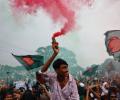
'Militants are taking over the administration. Fundamentalists have been released from jail.'

New Delhi -- which has had a disastrous neighbourhood policy that has alienated almost all the States with which it has a land or sea border -- seemed to be unwilling over the past years to even consider that its unquestioning support of Sheikh Hasina was painting it into a corner, points out Mihir S Sharma.
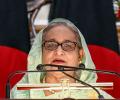
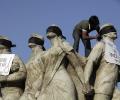
As news of Hasina's departure spread, hundreds broke into Hasina's residence, vandalising and looting the interiors, providing dramatic expression to the anti-government protests that have killed more than 100 people in the last two days. At the centre of people anger is the Hasina government's controversial quota system reserving 30 per cent jobs for families of veterans who fought the 1971 liberation war. With volatile crowds taking to the streets -- some clambering on Hasina's father and Bangladesh founder Sheikh Mujibur Rahman's statue and smashing it with hammers in a lasting image underscoring the fickleness of history -- Army chief General Waqar-uz-Zaman announced that the 76-year-old prime minister has resigned.

'The dominance of her party also meant that the institutions became lopsided -- whether it was the bureaucracy or the courts or the military.' 'She centralised power to the extent that you would see her representatives or her party office bearers having overly represented in these institutions.' 'That perhaps would have been the biggest blunder that she committed.'

The clashes broke out this morning when protesters attending a non-cooperation programme to demand the government's resignation faced opposition from the supporters of the Awami League, Chhatra League, and Jubo League activists.

At least four people, including two children, were killed and many injured in Dhaka on Friday when suspected arsonists set on fire a passenger train coming from Benapole, a port city bordering India, officials said, a day ahead of Bangladesh's general elections that have been boycotted by the main opposition Bangladesh Nationalist Party (BNP).

Sheikh Hasina was on Thursday sworn in as the prime minister of Bangladesh for the fifth term, days after her Awami League won an overwhelming majority in the general elections boycotted by the main opposition Bangladesh Nationalist Party (BNP) and its allies.
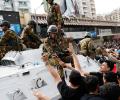
'At this moment you cannot give her asylum because if you do, then you are directing public anger against India.'

Bangladeshis on Sunday began voting in the general elections expected to be won by Prime Minister Sheikh Hasina in the absence of the main Opposition Bangladesh Nationalist Party (BNP) which is boycotting it.

The main Opposition BNP of former premier Khaleda Zia, 78, who is under house arrest, is boycotting the elections amidst violence.

Veteran politician and parliamentarian Abdul Hamid was on Wednesday sworn in as Bangladesh's 20th president. Hamid was administered the oath of office by acting Speaker Shawkat Ali during a ceremony at the Bangabhaban presidential palace, two days after he was elected unopposed to the post.
A high-level government committee has accused activists of ruling Awami League alongside main opposition Bangladesh Nationalist Party and fundamentalist Jamaat-e-Islami for the attack on Buddhist temples and localities in south-eastern Bangladesh last month, reports said on Friday.

A senior leader of Bangladesh's main opposition Bangladesh Nationalist Party has gone missing since Tuesday night, prompting the authorities to order a massive manhunt.
The nearly year-long trial of eight suspects at the International Crimes Tribunal in Bangladesh, who have been accused of war crimes during the 1971 war, may not have made headlines in India, but it is attracting huge international attention and further polarising the country's politics.
Bangladesh's main opposition Bangladesh Nationalist Party on Thursday called Prime Minister Manmohan Singh's Dhaka visit largely "a failure" due to "weak diplomacy" of the Hasina government, while the mainstream media said the deferring of the Teesta water-sharing pact dealt a "severe blow" to bilateral ties.
Ahead of Premier Sheikh Hasina's three-day visit to New Delhi next week, Bangladesh's main opposition BNP chief Khaleda Zia has warned her against inking any "unequal deal" with India and threatened to take to streets if the government "compromised" the country's interests.
Chinese Vice President Xi Jinping concluded a two-day visit to Bangladesh that included talks on improving defense ties and building a deepwater port, according to reports.

In the same case, her son Tarique Rahman and four others have been sentenced to 10 years in jail.

She had a narrow escape when several bombs exploded in a busy commercial area here minutes after her convoy passed through it.

Rahman, 50, was tried in absentia with the court declaring him a "fugitive". He now lives in London where he is believed to have sought asylum though the British authorities have declined to reveal his immigration status.
Several Bangladeshis are "anti-India" due to New Delhi's close ties with the ruling Awami League, a key advisor to opposition Bangladesh Nationalist Party chief Khaleda Zia has said while asking the Indian government to build relations with the people of Bangladesh and not with any political party.

"The government has identified the masterminds of the two attacks, they will be exposed to justice," Home Minister Asaduzzaman Khan said.
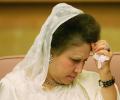
Bangladesh's Supreme Court on Wednesday upheld the death penalty for an influential opposition BNP leader Khaleda Zia for committing crimes against humanity.

Chakrabarty, who was hacked by three assailants in his head, neck and shoulders, raised an alarm, prompting local residents to grab one of the attackers while others fled.

The death toll in violence across Bangladesh, following dispute over electoral system, rose to six even as the country braced for a 60-hour opposition strike on Sunday, calling for a neutral caretaker government to oversee the next general elections.

Hasina, the president of the Awami League, won the 11th parliamentary elections with a landslide victory even as the Opposition rejected the "farcical" polls marred by violence that claimed 17 lives, making it one of the deadliest polls in the country's history.

Nizami now faces execution unless his case is reviewed by the court or he is granted clemency by the President.

The death toll in violence across Bangladesh triggered by the execution of a top Jamaat-e-Islami leader has risen to 21, prompting Prime Minister Sheikh Hasina to issue a stern warning saying, "We know how to control you."
Prime Minister Sheikh Hasina on Monday warned Bangladeshis against attacking the minority Hindu community, saying such assaults could have repercussions in neighbouring India.

Bangladesh's violence-plagued general elections, being boycotted by opposition Bangladesh Nationalist Party-led alliance, on Sunday witnessed low turn out in initial hours amid heavy security, as voters preferred to stay inside home fearing violence that has left six persons dead in last 12 hours.
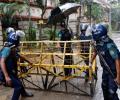
Bangladesh on Tuesday pressed anti-terrorism charges against several suspects and identified the fifth assailant in the country's worst terror attack as authorities intensified efforts to unravel the plot behind the brazen assault in which 22 people were slaughtered by Islamists.

Main opposition Bangladesh Nationalist Party chief Khaleda Zia on Monday rejected her arch-rival Prime Minister Sheikh Hasina's proposal for an all-party government to oversee Bangladesh's upcoming election and floated a formula for creating a neutral poll-time regime.

An "all-party" interim government headed by Prime Minister Sheikh Hasina was installed in Bangladesh on Monday to oversee the upcoming general elections despite boycott by the main opposition Bangladesh Nationalist Party which termed the move as "farce", heightening tension in the country.

A special Bangladeshi tribunal on Wednesday sentenced opposition Bangladesh Nationalist Party's 83-year-old leader Abdul Alim to jail until death for committing large-scale killings and other war crimes during the 1971 Liberation War against Pakistan.
'If a bloodbath of this nature can occur in a high security area like Gulshan, I shudder to think how vulnerable other parts of this country are.'
Bangladesh's main opposition Bangladesh Nationalist Party's three top women leaders were arrested on the second day of the 'democracy march' on Monday, as clashes erupted inside the supreme court premises between pro- and anti-government lawyers.
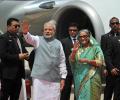
'When we have a terrorist outfit in a neighbouring nation, we need to do whatever we can to neutralise that threat,' says Ramananda Sengupta.
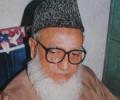
A 91-year-old top leader of the fundamentalist Jamaat-e-Islami was sentenced to 90 years in jail on Monday by a special Bangladeshi tribunal for masterminding atrocities during the 1971 war of independence against Pakistan.

Not many people in Bangladesh are talking about the Teesta issue.
 © 2026 Rediff.com - Advertise with us - Disclaimer - Privacy Policy - Sitemap - Feedback - About us - Terms of use - Grievances