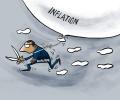
Wholesale price based inflation declined to a 3-month low of 1.89 per cent in November on cheaper food items, and experts predicted a 0.25 per cent interest rate cut by the RBI in the policy review in February. The Wholesale Price Index (WPI) based inflation was 2.36 per cent in October 2024. It was 0.39 per cent in November, last year. In August, 2024, it was 1.25 per cent.

Surging oil prices are unlikely to restrain the strong economic growth in India and China, Haruhiko Kuroda, president, Asian Development Bank said.

The Reserve Bank of India's (RBI's) caution on inflation, highlighted during the recent monetary policy meeting, may put investors' faith in fast moving consumer goods (FMCG) stocks to test, analysts said. They, however, believe FMCG stocks may ride through this near-term investor anxiety as related companies are, typically, well-equipped to handle inflation due to their pricing power and steady demand for essential goods.
The central bank is conducting a series of these meetings with individual banks as it prepares to announce the annual monetary and credit policy for the financial year 2011-12 on May 3.

Ahead of the Budget, the Survey made a case for gradual exit of stimulus provided to the industry.

Latest GDP growth numbers a one-off development and not the beginning of a trend, says CEA V Anantha Nageswaran.

Oil prices continued their rout on Tuesday with Brent crude and U.S. WTI both falling to their lowest in almost six years as a big OPEC producer stood by the group's decision not to cut output to tackle a glut in the market.
India's Petroleum Minister Mani Shankar Aiyar has predicted that the 'oil bubble' will burst soon.\n\n
Oil prices hit two-and-a-half-year highs in Asian trade on Friday as violence continued to wrack the Middle East and threatened to spread to other bigger oil producers in the region, analysts said.
As the oil moneybags get lighter, it will be increasingly difficult for Saudi Arabia and other Gulf states to continue to support incendiary radicals. And over time, there will be greater integration of Muslim life and culture into the "mainstream".

The November 5 US presidential elections, Federal Reserve interest rate decision, trading activity of foreign investors, and the upcoming quarterly earnings from domestic firms are the major triggers that would influence sentiments in the equity market this week, analysts said. In an eventful week ahead, a host of macroeconomic data announcements and global trends would also drive the markets, experts said. "The upcoming week is poised to be eventful on the global front.

The ongoing oil price decline is mainly a result of oversupply in the global market

Oil prices could reach $100 per barrel if there were "dramatic" developments in the Gulf or elsewhere, a leading oil official has said.

India's net oil import bill could widen to $101-104 billion in current fiscal from $96.1 billion in 2023-24 and any escalation in the Iran-Israel conflict could impart an upward pressure on the value of imports, ICRA said on Tuesday. The domestic rating agency said based on its analysis, lower value of Russian oil imports is estimated to have led to savings of $7.9 billion in 11 months (April-February) of 2023-24, up from $5.1 billion in 2022-23.

When oil prices are very high, cutting down the subsidy results in sharp increase in oil prices.

The Reserve Bank on Friday raised the inflation projection for current fiscal year to 4.8 per cent from 4.5 per cent with Governor Shaktikanta Das saying lingering food price pressures are likely to keep headline inflation elevated in the December quarter. Consumer price index (CPI)-based inflation increased sharply in September and October 2024 led by an unanticipated increase in food prices.

Global factors and FII activity will dictate trends in domestic equity markets this week while assembly poll results of Maharashtra and Jharkhand may impact stocks on Monday, say analysts. Stock markets witnessed a spirited recovery on Friday with benchmark Sensex and Nifty notching the best single-day gains in more than five months and offering relief after weeks of correction.

Leading industrialist, Mukesh Ambani,on Friday said the trend of rising energy prices is a matter of great concern and that it could rise further to three-digits going forward.
Communist Party India on Thursday asked the government and the public sector oil companies to share the burden of the surge in crude oil prices and expressed the desire to be consulted before any final decision on fuel pricing is taken.
Contrary to expectations, global oil prices, which have touched a 21-year high, are unlikely to fall substantially even if oil producer cartel OPEC raises production, industry officials said on Thursday.
The Reserve Bank of India on Thursday said that the economy had enough resilience to absorb rise in global oil prices and said it is keeping a close watch on inflation.

Oil and LNG prices are likely to shoot up if Iran is to block Strait of Hormuz, through which countries like India import crude oil from Saudi Arabia, Iraq and UAE, leading to a spike in inflation, analysts said on the Iran-Israel conflict. The Iran and Israel conflict has escalated over the last few days. Iran first launched drone and rocket attacks on Israel, which retaliated by firing a missile. Crude oil prices have hovered around USD 90 per barrel since the conflict.

US crude oil futures edged down on Tuesday after hitting an 8-week high of $82 a barrel on Monday.

Equity benchmark indices Sensex and Nifty settled lower for the sixth straight session on Monday due to heavy selling in bellwether stocks including HDFC Bank and Reliance Industries amid mixed trends in the global markets and outflow of foreign funds. Falling for the sixth consecutive session, the BSE Sensex tumbled 638.45 points or 0.78 per cent to settle at 81,050. During the day, it plummeted 962.39 points or 1.17 per cent to 80,726.06. The NSE Nifty slumped 218.85 points or 0.87 per cent to end at 24,795.75.

Financials were the top losers while oil shares also declined amid weak crude oil prices.

Macroeconomic data announcements, global trends and trading activity of foreign investors would be the major driving factors for the equity markets this week, according to analysts.
Fears of an economic slowdown in the US, and a consequent spread of the crisis to Europe and other parts of the world, resulted in oil prices falling over 12 per cent since Monday, the largest weekly fall since early 2004.
"The prime minister is thinking of having a meeting of all political leaders and it could take place in the second week of next month," sources in the government said. While the agriculture scenario was comfortable spiralling crude oil prices in the international market was causing a concern, they said. Crude oil reached $96 a barrel mark early this month. However, it has come a notch lower now.

Oil prices rose following Biden's suggestion that United States and Israeli officials were considering a possible Israeli strike on Iranian oil facilities, as reported by the Washington Post.


Quarterly earnings from corporates, global trends, and trading activity of foreign investors will guide market sentiment this week, analysts said, adding that benchmark indices may face volatile trends. "The upcoming release of Q2 results will be closely watched, providing insights into corporate performance. "Meanwhile, the escalating tensions between Israel and Iran introduce a significant geopolitical risk, potentially leading to increased oil prices and market volatility.
As it is, a great deal of oil is produced in countries with little to underpin their economies besides oil, so pricing the black stuff in an international currency makes sense, especially when that currency is that of the primary buyer of the oil concerned. It makes things simple for the buyer and lets the seller take its revenue in a major currency.

After a strong run in the midcap and smallcap indices, which surged 46 per cent and 43 per cent, respectively, on the National Stock Exchange (NSE) during Samvat 2080, analysts suggest that the rally in these segments may pause to catch its breath in Samvat 2081.

More than half of the total subsidy provisioning, amounting to 54 per cent, is going towards food subsidy, which is estimated at Rs 184,220 crore for 2019-20 - a 7.5 per cent increase over the revised estimates for 2018-19.

'If weak indicators persist, there is a risk that India could slip into a prolonged slowdown similar to the one experienced between 2014 and 2019,' warns Debashis Basu.

Global financial markets are wrong in hoping that the worst is over in geopolitical crises such as the Iran-Israel conflict and the Russia-Ukraine war, wrote Christopher Wood, global head of equity strategy at Jefferies, in a recent note to investors called 'GREED & fear'. While most investors and the media are focused on United States (US) Federal Reserve policy and the "endless chatter" of Fed governors, Wood believes the news flow in the financial sphere "pales into complete insignificance" compared with the "tectonic shifts" going on in geopolitics.

With an eye on the adverse fallout of rising oil prices, the Reserve Bank of India (RBI) on Monday said the government's subsidy bill for petroleum products and fertilisers might cross the projections for 2011-12 and put fiscal consolidation plans under strain.

Arab Gulf economies are set to benefit from large government spending programmes and high oil prices in the second half of the year, despite concerns over political turmoil in the Middle East and Europe's sovereign debt crisis, a senior bank official has said.
