
More than half of the total subsidy provisioning, amounting to 54 per cent, is going towards food subsidy, which is estimated at Rs 184,220 crore for 2019-20 - a 7.5 per cent increase over the revised estimates for 2018-19.

After a strong run in the midcap and smallcap indices, which surged 46 per cent and 43 per cent, respectively, on the National Stock Exchange (NSE) during Samvat 2080, analysts suggest that the rally in these segments may pause to catch its breath in Samvat 2081.

Global financial markets are wrong in hoping that the worst is over in geopolitical crises such as the Iran-Israel conflict and the Russia-Ukraine war, wrote Christopher Wood, global head of equity strategy at Jefferies, in a recent note to investors called 'GREED & fear'. While most investors and the media are focused on United States (US) Federal Reserve policy and the "endless chatter" of Fed governors, Wood believes the news flow in the financial sphere "pales into complete insignificance" compared with the "tectonic shifts" going on in geopolitics.

'If weak indicators persist, there is a risk that India could slip into a prolonged slowdown similar to the one experienced between 2014 and 2019,' warns Debashis Basu.

With an eye on the adverse fallout of rising oil prices, the Reserve Bank of India (RBI) on Monday said the government's subsidy bill for petroleum products and fertilisers might cross the projections for 2011-12 and put fiscal consolidation plans under strain.

Arab Gulf economies are set to benefit from large government spending programmes and high oil prices in the second half of the year, despite concerns over political turmoil in the Middle East and Europe's sovereign debt crisis, a senior bank official has said.

Palm oil prices are rising to record levels these days because China and India are stepping up purchases.

Demand has fallen significantly in the US, which accounts for around 30 per cent of crude oil consumption and meets 60 per cent of its demand through imports.
As far as US growth is concerned, he says that the first half of next year is expected to be better than the second half of this year.\n\n

From the Sensex basket, Larsen & Toubro, Bajaj Finance, Axis Bank, State Bank of India, UltraTech Cement, Wipro, ICICI Bank, Infosys, HCL Technologies and Asian Paints were the major gainers. NTPC, JSW Steel and HDFC Bank were the laggards.

Bank shares were the top gainer in early trades with Bank of Baroda up over 4%.
Volumes remain a concern because people still do not have confidence in the market.
Replying to questions on losses to Air India, civil aviation minister Praful Patel said the rally in international crude oil prices that touched $147 a barrel in July 2008, hit Indian carriers by Rs 10,000 crore (Rs 100 billion) in jet fuel bill. Air India loses are a result of high jet fuel prices and fall in air traffic following global economic slowdown, he said. "There are (also) systematic issues which need to be corrected."

Global trends, trading activity of foreign investors and domestic macroeconomic data announcements would dictate terms in the equity market in a holiday-shortened week ahead, analysts said. Equity markets would remain closed on Wednesday for Gandhi Jayanti. "Looking ahead, it will be interesting to monitor Foreign Institutional Investors (FIIs) and their flow into India.
Projecting that global oil prices would stabilise at around $30-35 and help ease pressures on consumers, Reliance Industries Chairman Mukesh Ambani on Wednesday sought deregulation of natural gas, terming it as an alternate fuel in the medium term.
There has been a dramatic decline in oil prices from the high of $147 a barrel in July, to less than a third of that today. However, it is too early to say if this is a fundamental change in the direction of oil prices, resulting from the announced cuts in production by the oil-exporting countries, or a blip in a falling market. The government seems to be assuming (or hoping that it is) the latter and is rushing ahead with its price cut plan.

According to a RBS report, 'the impact on India's current account deficit should be significant, cumulatively amounting to 1.9 per cent of GDP' provided for the full year FY14 prices for both oil and gold remain at current levels and aggregate volume gold demand remains stable.

Indian Oil Corporation (IOC) on Tuesday reported halving of its March quarter net profit largely because of losses in the petrochemical business and shrinking margin after it announced a pre-election fuel price cut despite rising input costs. The net profit of Rs 4,837.69 crore in January-March compared to Rs 10,058.69 crore a year back and Rs 8,063.39 crore in the preceding October-December quarter, according to a stock exchange filing by the company.
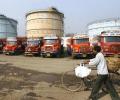
When oil prices collapse from $110 to $45, economic agents in India experience a large income windfall.
Expressing concern over the impact of rising crude oil prices on Indian economy, Prime Minister Manmohan Singh on Monday said it can have adverse consequences for the economy. "We cannot allow the subsidy bill to rise any further," Singh said and appealed to all the political parties to adopt a wider consensus on the pricing issue.

CAD, which is the difference between outflow and inflow of foreign currency, touched a historic high of 6.7 per cent in the third quarter.
The country's fiscal deficit, as a percentage of GDP, would be wiped out if the crude oil price, as measured with the Indian basket, touch $80 per barrel.

Oil prices dipped on Wednesday as the market prepared for a gradual increase of Iranian exports into an already oversupplied market from 2016.
The Indian industry wants the government adopt a multi-pronged approach to de-risk the country's oil needs by conserving energy, promoting alternative sources and building strategic reserves, a Federation of Indian Chamber of Commerce and Industry su

Macroeconomic data announcements, the last batch of Q1 earnings and global trends are the major factors that would influence trading sentiments in the equity market in a holiday-shortened week ahead, analysts said. Besides, trading activity of foreign investors would also be a crucial factor in dictating movement in the market. Equity markets would remain closed on Thursday for Independence Day.

India's fast-moving consumer goods (FMCG) sector grew 5.7 per cent by value and 4.1 per cent by volume in the July-September quarter driven by rural demand, consumer intelligence firm NielsenIQ said in its quarterly update on Thursday. Price-led growth stood at 1.5 per cent. According to NielsenIQ data, rural volume growth outpaced urban markets for the third straight quarter despite consumption softening in both regions.

Equity investors will track the trading activity of foreign investors, global trends and ongoing earnings results for further cues, and benchmark indices may continue to witness consolidation in a holiday-shortened week amid the monthly derivatives expiry, analysts said. Markets fell sharply last week amid massive foreign capital outflows and dismal Q2 earnings so far. Weakness in the markets might continue in the near term amid cautiousness among investors ahead of the US presidential election early next month, an expert said.
The threat of war in Iraq and fear of terrorism in the United States and Britain pushed oil prices to near two-year highs on Thursday, drove investors into the safety of bonds but battered stocks and the dollar.

Apart from the emotional value attached to buying gold, the yellow metal offers protection against inflation, interest rate spikes, currency and geopolitical risks, says Anamika Pareek.

It is a testament to some of the policies that were put in place to raise fuel-efficiency standards

State-owned fuel retailers are losing close to Rs 3 per litre on selling diesel while the profit on petrol has trimmed due to recent firming up in international oil prices, industry officials said detailing reasons for continuing to hold retail prices. Indian Oil Corporation (IOC), Bharat Petroleum Corporation Ltd (BPCL) and Hindustan Petroleum Corporation Ltd (HPCL), who control roughly 90 per cent of India's fuel market, 'voluntarily' have not changed petrol, diesel and cooking gas (LPG) prices for almost two years now, resulting in losses when input cost was higher and profits when raw material prices were lower.
India's large foreign exchange reserves can cushion a short-term jump in oil prices, but a long drawn conflict in Iraq could hurt the economy

Retail investors have become a force to reckon with in the last 10 years with their ownership of Indian equities rising 800 basis points, or 8 per cent, to 23.4 per cent during this period, suggests a recent note from Morgan Stanley. This number, Morgan Stanley said, is set to rise in the next few years as Indian households are still underinvested in equities. India's demographics, policy framework, investor education and modest positive real rates, it said, will fuel the 'equity cult' in India.
