
The Indian position on the Russia-Ukraine war and the unconditional treaty between China and Russia appear to have caused some ripples in India-US relations and led to a reappraisal of India's usefulness to the US in the eventuality of a conflict with China, notes Ambassador T P Sreenivasan.

Gokhale has said that China used its "close connections" with the Left parties in India to "build domestic opposition" to the Indo-US nuclear deal.

India on Monday signed a path-breaking broad-based agreement in the civil nuclear field with Russia, which will ensure transfer of technology and uninterrupted uranium fuel supplies to its nuclear reactors, and inked three pacts in the defence sector. The agreements were signed after talks between Prime Minister Manmohan Singh and Russian President Dmitry Medvedev at the Kremlin in Moscow, during which they discussed a whole range of issues.
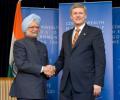
Canadian Prime Minister Stephen Harper and Indian Prime Minister Manmohan Singh on Saturday announced in Port of Spain that they had reached an agreement on the civilian nuclear agreement.

'You know why? Because they know they can't vet them, and they don't want Hamas in their neighbourhood'
India and Russia today signed an agreement on civil nuclear cooperation with Prime Minister Manmohan Singh describing it as a "new milestone" in bilateral relations.

The agreement will form the basis of wide-ranging bilateral cooperation from basic and applied research to full civil nuclear cooperation, including reactors, nuclear fuel supply, nuclear safety, radiation and environment protection and nuclear fuel cycle management, officials said. The nuclear agreement and the social security pacts were signed after the Summit meeting between Prime Minister Manmohan Singh and French President Nicholas Sarkozy at the Elysee Palace in Paris.
'The Indo-US nuclear agreement is a political deal masquerading as a technology treaty. The essence of the deal is politics, with technology and the energy it is supposed to bring simply a smokescreen. The aim is to redraw the global politico-strategic framework under the guise of providing technology, energy, and power. But like all power that is not earned, produced, there is a cost. And it is this cost that gets the goat of most Indians.'
Ahead of the United Progressive Alliance-Left meet on the India-United States nuclear agreement, the CPI has renewed its threat to withdraw support if the government moved ahead on the issue.To another question whether the Left would go with the Bharatiya Janata Party if they moved such a motion, he said, "We generally don't" go with the saffron party. If that happens, we will see at that time."
"We have changed laws in the US when we negotiated the 123 agreement. Both sides have agreed and it will move ahead," US Ambassador to India David Mulford said. The deal will help India meet its energy needs, he said.
The proposed India-United States nuclear agreement provides undefined India-specific safeguards and fails to explicitly state whether the US nuclear trade will terminate if India conducts a nuclear test.
The CPI-M general secretary on why his party opposes the India-US nuclear deal.
Menon clarified that there were no conditions attached with the deal.
'It is also a strategic decision to line up India against China,' Senator Hagel said.
Rice said in the next two months, Washington expects Pyongyang to shut down and seal the Yongbyon nuclear facility.
'Even China and Russia would not challenge the technology apartheid unless India was able to enhance its relationship with the United States.'
The newspaper said that, in trying to give India a special exemption, the US President was threatening the NPT's carrot-and-stick approach.
Until now, the state-run Chinese media had only made factual reporting on the Indo-US nuclear deal. However, Beijing seems to have given the go-ahead to People's Daily to attack the deal.
India and Japan are close to finalising a civil nuclear cooperation agreement, former Japanese prime minister Yukio Hatoyama said in New Delhi on Monday."India and Japan have come to a stage of concluding the nuclear cooperation agreement," said Hatoyama, a key leader of the ruling Democratic Party of Japan.He hoped India would uphold its unilateral moratorium on nuclear tests and underscored the sensitivity Japanese people attach to it.
India and South Korea have reached an agreement on civil nuclear cooperation.
Pakistan has gained atomic capabilities through "international deception" and "clandestine procurement" networks, eminent US lawmakers have said, while warning that the continuation of 'secretive' Sino-Pak nuclear ties is setting a wrong precedence for others.
Pakistan President Asif Ali Zardari will commence a high-level visit to China from July 6 during which the two countries will firm up a deal for supply of two new nuclear reactors to Islamabad.
It's highly unlikely that China will give up playing the Pakistan card vis-a-vis India anytime soon. Indian policy makers would be well advised to disabuse themselves of the notion of a Sino-Indian rapprochement. China doesn't do sentimentality in foreign policy, India should follow suit, writes Harsh V Pant.

The old Parliament building will now be known as 'Samvidhan Sadan', Lok Sabha Speaker Om Birla said on Tuesday as the functioning of Parliament shifted to its new building in New Delhi.
Crossing a significant milestone, the Indo-French civil nuclear agreement was unanimously adopted by the French Parliament, paving the way for companies to build nuclear power plants in India. The French National Assembly on Tuesday adopted a law authorising the ratification of the Cooperation Agreement between India and France on the Development of Peaceful Uses of Nuclear Energy, a French Embassy statement said. The French Senate had adopted the law on October 15.
During his first official visit to India, Canadian Prime Minister Stephen Harper indicated that he would like the two countries to sign the civilian nuclear agreement and the foreign protection promotion and investment agreement.Disappointed by the lackluster visit, Canadian journalists accompanying Harper are wondering why the two countries haven't signed the nuclear agreement so far, in spite of discussing such an agreement at length since a long time.
At scaling back Tehran's nuclear programme and relieving the Islamic Republic from the sanctions

'With Trump, the relationship was very transactional, whereas with President Biden it is very structured.'

The talks could be a last-ditch diplomatic effort to avert a military strike on Iranian nuclear installations and could also help President Barack Obama make the case that he is nearing a breakthrough in the decade-long effort by the world's major powers to curb Tehran's nuclear ambitions.
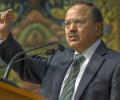
National Security Advisor Ajit Doval will hold crucial talks with the top US leadership, including his counterpart Jake Sullivan, on the first high-level dialogue on Initiative for Critical and Emerging Technologies (iCET).

Even as it gasped for breath, American insurance giant AIG was lobbying the United States Congress hard to get the Indo-US civil nuclear energy deal cleared, reports ProPublica.org.
Both countries have always supported the peaceful use of civil nuclear energy and an agreement in this connection is expected to be signed during the President's visit to China which began Tuesday, Ambassador Masood Khan said. The two countries will ink several agreements in the fields of technology, agriculture and minerals. They will also sign an investment protocol to their existing free trade agreement to boost investments in Pakistan, he told Geo News channel.
Dismissing the perception that Prime Minister Manmohan Singh and United Progressive Alliance Chairperson Sonia Gandhi have backtracked on the India-United States nuclear agreement, the Congress on Friday said that it has not changed its stand and everyone is adhering to the coalition dharma. "The Congress' stand is the same. However, at the same time, we have to abide by the consensus among our allies and coalition partners," Congress spokesperson Abhishek Singhvi said.
'We value our friendship with the Left, but not at the cost of the national interest. If this government goes, let it go'
The CPM on Monday decided to explore avenues to resolve its differences with the UPA government about the Indo-US nuclear agreement. the party stopped short of saying it would withdraw support if the govt goes ahead & operationalises the pact.
Can the nuclear deal become an election issue? Unfortunately not.
'If anybody in the US thinks that because we have an agreement or hold joint naval exercises, we will acknowledge their determination of whom we should deal with, then they are mistaken.'
The French move assumes significance as it comes close on the heels of conclusion of Indo-US civilian nuclear deal.
 © 2026 Rediff.com - Investor Information - Advertise with us - Disclaimer - Privacy Policy - Sitemap - Feedback - About us - Terms of use - Grievances