
These upcoming launches carry added significance in light of setbacks suffered in recent years.

Weighing 6,100 kg, the communication satellite would be the heaviest payload to be placed into the Low Earth Orbit (LEO) in LVM3 launch history from Indian soil.
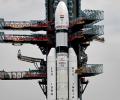
'The LVM3 rocket will orbit one Block 2 BlueBird satellite in Low Earth Orbit.'
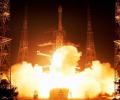
ISRO is part of an exclusive league which has forayed into the Moon and Sun.

The Indian Space Research Organisation (ISRO) has rescheduled the launch of PSLV-C59 to Thursday due to an "anomaly" detected in the PROBA-3 spacecraft. The launch was originally scheduled for Wednesday at 4.08 pm from the spaceport in Sriharikota. The anomaly was identified by scientists at the European Space Agency (ESA), who requested the rescheduling of the launch. The PROBA-3 mission, a joint project between ESA and ISRO, aims to study the Sun's corona using two spacecraft that will fly in formation. The launch will provide valuable insights for ISRO's future solar missions, including the Aditya-L1 mission which was launched in September 2023.

In a first-of-its-kind initiative involving precision-flying, Indian Space Research Organisation on Thursday successfully launched the Proba-3 mission onboard a PSLV-C59 rocket, a solar experiment undertaken by the European Space Agency.

The Indian Space Research Organisation (ISRO) successfully launched its third and final developmental flight of Small Satellite Launch Vehicle here on Friday whose payloads can be used in applications like satellite-based surveillance, disaster and environmental monitoring, fire detection, volcanic activity among others.
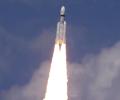
Currently, some of the rocket hardware for the human space programme has reached the Satish Dhawan Space Centre in Sriharikota and the integration of the crew module was going on at the Vikram Sarabhai Space Centre, Trivandrum, ISRO chairman S Somanath said.

'With India's growing capabilities in the space sector, this creates promising opportunities for enhanced collaboration and market access.'
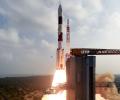
The Indian Space Research Organisation (ISRO) is all set to make its maiden commercial launch of 36 broadband communication satellites on board the space agency's heaviest rocket LVM3-M2, the countdown for which began early on Saturday at Sriharikota spaceport in Andhra Pradesh.

The primary satellite TeLEOS-2 is a synthetic aperture radar satellite developed under partnership between Defence Science and Technology Agency (DSTA) representing the Government of Singapore and ST Engineering.

Around 23 minutes after lift-off, the primary satellite got separated and it was followed by six other co-passenger satellites, which were deployed into the intended orbits sequentially, ISRO said.

The ISRO on Sunday scripted yet another history after its LVM3 rocket successfully placed 36 satellites of United Kingdom-based OneWeb group company into intended orbits.
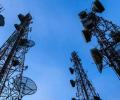
Spectrum allocation for satellite services came up as a dominant theme at the launch of 36 communication satellites by OneWeb, a Bharti group venture, here on Sunday. Following the launch, Bharti Enterprises chairman Sunil Mittal, in a conversation with a group of reporters, reiterated that spectrum auction did not make sense in the case of satellite services. "This (satellite services) is not competing with mobile services where you can justify the auction.

ISRO's first mission in 2023 and SSLV's sequel saw a strange coincidence--it was launched at 9.18 am, the same time its predecessor lifted off from the Satish Dhawan Space Centre here on August 7, 2022 but could not deliver due to orbit anomaly and flight path deviation.

Devas Multimedia has seized $87,457.47 cash that ISRO's commercial arm Antrix Corporation held in the US as it looked to enforce a $1.2 billion compensation it had won over a cancelled satellite deal, its lawyer said on Wednesday. Devas Multimedia America Inc had sought seizure of $145,000 but the actual recovery was $87,457.47 (a little less than Rs 70 lakh). This came after it secured a favourable order from the Eastern District Court of Virginia, Matthew D McGrill said.

The heaviest rocket of the Indian Space Research Organisation -- LVM3-M2/OneWeb India-1 -- blasted off from the Sriharikota spaceport on Sunday to place 36 broadband communication satellites into the Low Earth Orbit (LEO) for a UK-based customer.

CARTOSAT-3 is a third generation agile advanced satellite having high resolution imaging capability.
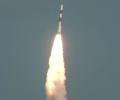
The launch marks a significant milestone for the space agency as it is the 50th flight of PSLV and the 75th vehicle mission from Sriharikota. The 628 kg satellite is meant for applications in various fields like agriculture, forestry and disaster management support. It would also serve military purposes.

This is the first mission by the Indian Speace Research Organisation this year.

The Indian Space Research Organisation has resolved to alight its lander on the lunar surface with Chandrayaan-3 in addition to a maiden solar expedition in 2020.
 © 2026 Rediff.com - Investor Information - Advertise with us - Disclaimer - Privacy Policy - Sitemap - Feedback - About us - Terms of use - Grievances