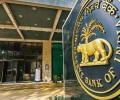
Prime Minister Narendra Modi will on Friday launch two schemes of the Reserve Bank of India (RBI) that may go a long way in changing how the household sector invests, and complains if anything goes wrong with their savings. These schemes - retail direct and an integrated ombudsman - will be launched by the Prime Minister virtually, in the presence of Finance Minister Nirmala Sitharaman. With the introduction of retail direct, a common man can directly take a position in government securities (G-Sec), considered to be the safest asset class a sovereign can offer.
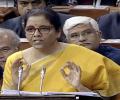
The revised estimated expenditure for FY20 has been pegged at Rs 26.99 lakh crore and receipts at Rs 19.32 lakh crore, she said.

Fintechs need to behave with responsibility and transparency. A lot of mis-selling has been happening. Other issues have been plaguing the fledgling industry -- high interest rates, even higher processing fees, harsh collection process and, most critically, data leakage leading to rampant frauds, points out Tamal Bandyopadhyay.

Only when we are part of the same family, which will happen down the line, then, of course, we will give them (PMC depositors) all the assurance and the comfort.'

You would find NBFCs more willing to lend even if you have a poor credit score, says Adhil Shetty

Permitting realty firms to tap ECBs, relaxing borrowing norms for non-banking finance companies, increasing the ECB limit 50 per cent to $750 million under the automatic route (that is, without central bank permission) and raising the price ceiling at which overseas loans can be raised are among proposals the committee is considering. For realty, the committee may relax norms only for integrated township projects, said a top finance ministry official.

'The people let off by the NBFCs have little bargaining power and willingly settle for a 20% to 25% cut in their existing salaries when hunting for new jobs.'

While the overall loan disbursements stood strong at 15 per cent YoY in Q2, pockets such as vehicle finance, loans to NBFCs, and business banking showed some weakness. A continued fall in these numbers may make it tough for AU SFB to defend its valuations under the current circumstances.

SBI will auction two non-performing accounts (NPAs) next month to recover dues of over Rs 313 crore, according to a notice by the lender. The two accounts to be put up for e-auction on August 6 are Bhadreshwar Vidyut Pvt Ltd (BVPL) with a loan outstanding of Rs 262.73 crore and GOL Offshore Ltd with Rs 50.75 crore dues. "In terms of the bank's policy on sale on financial assets, in line with the regulatory guidelines, we place these accounts for sale to ARCs/banks/NBFCs/FIs, on the terms and conditions indicated there against," SBI said in the notice. The reserve price for the auction of Bhadreshwar Vidyut is set at Rs 100.12 crore and for GOL Offshore at Rs 51 crore.

Experts say a combination of improving asset quality and NBFCs' weak balance-sheets bodes well for both corporate and retail banks.

'Valuations are very attractive, and most companies are cash-rich with strong dividend yields.'

Nomura analysts said the Reserve Bank of India and the government would need to segregate the potential solvency issue at DHFL from liquidity issues at other larger wholesale NBFCs and HFCs.

'This is the first time we will see how SIP investors react to market correction.'

The Union Cabinet on Wednesday approved additional funding of up to Rs 3 lakh crore at a concessional rate of 9.25 per cent through the Emergency Credit Line Guarantee Scheme (ECLGS) for the MSME sector hit hard by the coronavirus crisis. The ECLGS was the second-biggest component of Rs 21 lakh crore comprehensive package announced by Finance Minister Nirmala Sitharaman last week.

'As valuations of large-caps appeared to be out of whack, investors started lapping up quality mid-caps and small-caps, which were available at relatively comfortable valuations.'

Titan was the top loser in the Sensex pack, shedding over 4 per cent, followed by IndusInd Bank, Reliance Industries, Axis Bank, Kotak Bank, ONGC, ITC and ICICI Bank. NSE Nifty closed 3.05 points higher at 14,634.15.

'One of the ways to do that is to ensure that NBFCs have got liquidity.' 'If we don't do that, this mood of gloom will continue.' NBFCs need to be provided with liquidity if they have to start lending.

'Common sense says if one can afford, servicing the loans during this period is a better bet than postponing it by three months,' says Tamal Bandyopadhyay.

The disruptions caused by COVID-19 have more severely impacted small and mid-sized corporates, including NBFCs and MFIs, in terms of access to liquidity.

'It is critical that the Covid curve does not have a fat tail and the chain is broken quickly.'

A few days back, Finance Minister Nirmala Sitharaman urged the start-up community and public to deal in cryptocurrency with caution because everything that was floating around was not currency. In the first week of August, the country's top nine crypto exchange platforms were summoned by the Directorate of Enforcement (ED) in Hyderabad. The exchanges were questioned for money laundering, especially over a number of Indian non-banking financial companies and their fintech partners for predatory lending practices in violation of the Reserve Bank of India (RBI) guidelines and by using tele-callers who misuse personal data and use abusive language to extort high interest rates from the loan takers.

Payments startup BharatPe on Tuesday said it has terminated several employees and vendors as well as filed criminal cases against them for misconduct besides deciding to claw back former founder Ashneer Grover's restricted shares in the firm. The steps have been taken by the company's board following a detailed corporate governance review against the backdrop of alleged lapses and misdoings during the tenure of Grover as managing director. IPO-hopeful BharatPe, which allows shop owners to make digital payments through QR codes, has implemented a new code of conduct for senior management and employees and brought in a comprehensive vendor procurement policy to avoid a repeat of alleged lapses that happened when Grover was managing director.

Stocks such as ICICI Bank, Axis Bank, State Bank of India, Bank of Baroda and HDFC Bank are among the top banking picks of analysts for 2017. A decline in cost of funds and treasury gains are expected to help stabilise their net interest margins

'The selling in India may emerge as soon as the RBI reverses its interest rate stance.'

The meeting will review the current global and domestic economic situation and financial stability issues, including those concerning banking and NBFCs.

Here are the highlights of the monetary policy announced by RBI governor Shaktikanta Das on Friday.

With the Reserve Bank of India's (RBI) extended deadline coming to an end, there will be no automatic recurring payment for various services including recharge and utility bill as the additional factor of authentication (AFA) will become mandatory from Friday. On December 4, RBI had directed all banks including RRBs, NBFCs, and payment gateways that the processing of recurring transactions (domestic or cross-border) using cards or Prepaid Payment Instruments (PPIs) or Unified Payments Interface (UPI) under arrangements/practices not compliant with AFA would not be continued beyond March 31, 2021. As part of risk mitigation measures, RBI announced this step to bolster safety and security of card transactions.

It may be a 'no-go' for banking licences to large industrial houses.

India will require a total investment of $10.1 trillion to achieve net-zero emissions by 2070, while the nation could face a shortfall of $3.5 trillion, a study by CEEW Centre for Energy Finance (CEEW-CEF) said. At the recently concluded COP26, Prime Minister Narendra Modi announced India's aim to achieve net-zero emissions by 2070. "India would need cumulative investments of $10.1 trillion to achieve net-zero emissions by 2070, according to an independent study released today by the CEEW Centre for Energy Finance (CEEW-CEF)," a statement said.

Reliance-Google's new smartphone has got mixed reviews from analysts and brokerages. The phone pricing is seen unattractive for low-end customers and bundled offers are being viewed as non-disruptive. While this could slow the pace of adoption, it could set the stage for tariff hikes in the industry, feel analysts.

With a loan book of $268 billion, India's retail banking is now ahead of Russia, Malaysia and Mexico but behind China, Brazil and Thailand

The RBI has this year cut interest rates by 110 basis points in four instalments but banks have passed only a part of it to borrowers. Before the last reduction earlier this month of 35 basis points, the bank on an average had passed only 29 basis points out of 75 basis points cut affected during 2019.

'Indian non-bank lenders stand exposed to a deteriorating credit quality environment.' 'Such a deterioration could put at risk the value of NCDs purchased by the mutual funds and expose investors in bond and liquid funds to a risk of capital loss.'

Credit to priority sectors as well as small and medium industries will be discussed to find ways to accelerate economic growth.

For now, the concerns over bad loans have taken a back seat; a bigger challenge for the banking community is credit growth, explains Tamal Bandyopadhyay.

Penalty must act as a deterrent. If it is too low, it could encourage the regulated entities to lap up penalty instead of complying with the norms, suggests Tamal Bandyopadhyay.
Private equity players said their research had shown that the PE share after COVID-19 could go up to 8-10 per cent.

Reserve Bank of India (RBI) deputy governor M Rajeshwar Rao on Wednesday defended the central bank's decision of not allowing industrial houses to float banks, and said more deliberations are needed before RBI changes its stance on this issue agreed back in 2001. An internal working group (IWG) of the RBI had recommended allowing industrial groups into banking, but late last month the RBI said it kept on hold the two recommendations of allowing industrial houses and large non-banks to float banks. However, RBI had accepted 21 of the 33 recommendations of the group that submitted its report a year ago.

It can be an useful tool in achieving the objective of Pradhan Mantri's Jan Dhan Yojana
 © 2026 Rediff.com - Investor Information - Advertise with us - Disclaimer - Privacy Policy - Sitemap - Feedback - About us - Terms of use - Grievances