
The Indian economy is rapidly normalising towards pre-pandemic activity levels, even as uncertainty exists about coronavirus mutations and repeated infection waves, industrialist Kumar Mangalam Birla said on Wednesday. Vaccination is picking up pace, which would improve India's resilience against a potential third wave, the chairman of Aditya Birla Group said while virtually addressing shareholders at the AGM of group firm UltraTech Cement Ltd. Moreover, various steps taken by the RBI and the government have helped in containing the economic disruptions of the pandemic, Birla added.

Finance Minister Nirmala Sitharaman on Tuesday said monetisation of Central Public Sector Enterprises (CPSE) assets is based on the principle of value creation for the government and investors and would bring about a paradigm shift in infrastructure augmentation and maintenance. Chairing the National Workshop with the states/UTs on Asset Monetisation organised by Niti Aayog, the minister sought the collaboration of states for the holistic development of infrastructure. She said India can become a $5 trillion economy, while striking the right balance between fiscal imperatives and socio-economic welfare, through active collaboration between the public and private sector.

Industry players believe the new DFI model will be initially risk capital, which will then be used to mobilise additional resources from development agencies such as World Bank.

The government will press ahead with the sale of public sector companies that have been approved by the Cabinet, Finance Minister Nirmala Sitharaman said on Thursday. Highlighting that FDI flow into India is much higher compared to other emerging economies, she said India's strong macroeconomic fundamentals, ability to do reforms and a stable government help attract long-term foreign funds into Indian businesses.
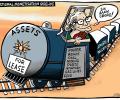
'This will have a multiplier effect in generating more jobs.'
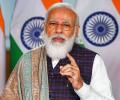
Modi said his government is carrying out "holistic reforms".

Expressing commitment to augment the country's infrastructure, Finance Minister Nirmala Sitharaman on Monday proposed to significantly enhance capital expenditure to Rs 5.54 lakh crore in the next fiscal, besides creating institutional structures and giving a big thrust to monetizing assets to achieve the goals of the National Infrastructure Pipeline (NIP). Sitharaman said NIP, that was launched in December 2019 with 6,835 projects, has now been expanded to 7,400 projects and around 217 projects worth Rs 1.10 lakh crore under some key infrastructure ministries have been completed. "For 2021-22, I propose a sharp increase in capital expenditure and thus have provided Rs 5.54 lakh crores which is 34.5% more than the BE of 2020-21," the finance minister said.

Terming investment in infrastructure "quintessential" to boost growth, the Economic Survey on Friday said post unlocking of the economy, infra sectors are poised for growth and construction of roads is expected to return to the high pace attained before COVID-19. The infrastructure sector will be the key to overall economic growth and macroeconomic stability, the Survey said emphasising that the year after the crisis (2021-22) will require sustained and calibrated measures to facilitate the process of economic recovery and enable the economy to get back on its long-term growth trajectory. "Basic infrastructure facilities in the country provide the foundation of growth. In the absence of adequate infrastructure, the economy operates at a suboptimal level and remains distant from its potential and frontier growth trajectory.

Asserting that the self reliant India programme will help revive the global economy, Prime Minister Narendra Modi on Thursday told global business community that his government aims to transform the country through access, inclusion and empowerment while also ensuring complete data security. Addressing the World Economic Forum's online Davos Agenda Summit, where he also interacted with global business leaders, Modi also said India offers a predictable and friendly environment from tax regime to FDI norms. He said Aatmanirbhar Bharat movement is committed to global good and global supply chain while the country's digital profile has been completely transformed.

Prime Minister Narendra Modi on Wednesday said the government has no business to be in business and his administration is committed to privatising all PSUs barring the bare minimum in four strategic sectors. "It is government's duty to support enterprises and businesses. But it is not essential that it should own and run enterprises," he said. Modi also said the Centre's policy is to either monetise or modernise public sector enterprises, with the intent that the government has "no business to be in business".

While most experts suggest the government loosen its purse strings and not worry about the fiscal deficit in a pandemic impacted year, it will be a tightrope walk for the government to increase spending without going overboard.

Finance Minister Nirmala Sitharaman on Tuesday unveiled a Rs 39.45 lakh crore Budget with a view to fire up the key engines of the economy to sustain a world-beating recovery from the pandemic. This was Sitharaman's fourth Budget. While the taxpayers were left in the lurch, once again, was she able to cheer Corporate India?

The government has been waiting for the expansion by the private sector, Finance Minister Nirmala Sitharaman said while reminding India Inc of various measures including corporate tax rate cut, policy consistency, ease of doing business, among others to facilitate investment.
The infrastructure spending target for 2020-25 was revised because of additional and amended data provided by central ministries, state governments since the release of the summary NIP Report in December 2019 when it was pegged at Rs 100 trillion.
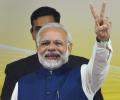
The document, shared by the prime minister on the occasion of the first anniversary of his second term on his Twitter account and web portal, detailed the steps taken by his government for the progress and development of the country. The document is divided into 15 heads ranging from ease of doing business, ease of living, to eliminating corruption and the country's fight against coronavirus.

But it is disappointing to note that Sitharaman's third Union Budget continues to promote a few problematic ideas, observes A K Bhattacharya.

For development finance institution to succeed now, the government must stand like a rock behind it and be patient.

The immediate need is to put more money in the hands of agriculture-based and rural households to improve their purchasing power, says S Mahendra Dev.
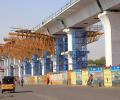
Investment in infrastructure was necessary for the economy, as power shortages, inadequate transport and poor connectivity affect overall growth performance, as per the Economic Survey 2019-20 tabled in Parliament by Union Finance and Corporate Affairs Minister Nirmala Sitharaman. "To achieve GDP of USD 5 trillion by 2024-25, India needs to spend about USD 1.4 trillion (Rs 100 lakh crore) over these years on infrastructure so that a lack of infrastructure does not become a constraint to growth," it said.

The Budget emphasises on capacity building and empowerment of marginalised sections of society including farmers.

As India emerges from the COVID-19 crisis, the ninth budget under the Modi government, including an interim one, is widely expected to focus on boosting spending on job creation and rural development, generous allocations for development schemes, putting more money in the hands of the average taxpayer and easing rules to attract foreign investments.
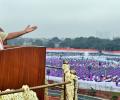
He made a reference to the clash between Indian and Chinese troops in Ladakh's Galwan Valley in June this year. "What our jawans can do, what the country can do, the world has seen in Ladakh," he said.

Here's the full text of President Ram Nath Kovind's customary address to the joining sitting of Parliament on the first day of the budget session.
 © 2026 Rediff.com - Investor Information - Advertise with us - Disclaimer - Privacy Policy - Sitemap - Feedback - About us - Terms of use - Grievances