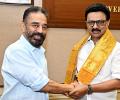
Where does Kamal Haasan stand on the issue of imposition of Hindi in the south? "I stand with Punjab. I stand with Karnataka. I stand with Andhra," is his quick reply.
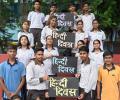
Fadnavis questioned the people's perception of Indian languages and English.
Initially, we will look to take a small batch of a few hundred students, with a plan to increase this to 5,000 students in the next five years, and eventually 10,000 by 2036.'

An amended government order issued on Tuesday said Hindi will "generally" be the third language, instead of being mandatory, but gave an option to opt out if 20 students per grade in a school express the desire to study any Indian language other than Hindi.
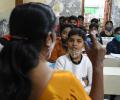
The Maharashtra government has reversed its decision to make Hindi a mandatory third language in schools after facing widespread opposition. The move comes after the state's language consultation committee urged the Chief Minister to revoke the decision. The government will now issue a revised order making Hindi learning voluntary. The decision had been met with criticism from various quarters, including opposition parties and the Maharashtra Navnirman Sena, which had called for a protest against the move.
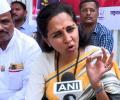
NCP (SP) leader Supriya Sule has criticized the Maharashtra government's decision to make Hindi a mandatory third language in schools, stating that it will not tolerate any undermining of the Marathi language. Sule also criticized the state's implementation of the National Education Policy (NEP) 2020, expressing concerns about its potential impact on students and teachers. She also questioned the appointment of a retired bureaucrat as the chief economic advisor to the chief minister and criticized the state's performance in areas like fiscal deficit management and the Jal Jeevan Mission.
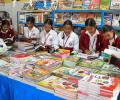
The National Council of Educational Research and Training (NCERT) has removed all references to the Mughals and Delhi Sultanate from its class 7 textbooks. The new textbooks, released this week, have been designed in line with the new National Education Policy (NEP) and the National Curriculum Framework for School Education (NCFSE) 2023, which emphasize incorporating Indian traditions, philosophies, knowledge systems, and local context into school education. The textbooks now include new chapters on ancient Indian dynasties, sacred geography, and government initiatives like Make in India and Beti Bachao, Beti Padhao. The revamp has been met with criticism from opposition parties who equate it with "saffronisation."
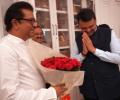
Maharashtra Navnirman Sena (MNS) president Raj Thackeray has slammed the state government's decision to make Hindi a mandatory third language in schools from Classes 1 to 5, calling it an attempt to "Hindi-fy" the state. Thackeray has vowed to oppose the decision vehemently and ensure it is not implemented. The move is part of the new curriculum implementation under the National Education Policy (NEP) 2020, which mandates a three-language formula for classes 1 to 5. Thackeray argues that Hindi is not a national language but a state language and its imposition undermines the principle of linguistic regionalization. He also questioned why Hindi is being forced on Maharashtra but not in southern states. The Opposition Congress has also criticized the move, calling it an imposition of Hindi and a threat to Marathi sentiment. The state government, however, defended its decision, stating that Hindi is a means of communication in the entire country and that Marathi is already compulsory.

'The time has come to have a relook at the Constitution as every document has a shelf life.'
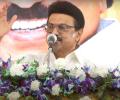
"Permitting students to discontinue studies is akin to asking them not to study," Stalin said, addressing an event organised by the Parents-Teachers Association in Cuddalore.

The DMK government in Tamil Nadu has sparked controversy by replacing the Indian Rupee symbol with a Tamil letter in the logo for its 2025-26 budget. The move has drawn criticism from the state BJP, which accused the ruling party of being "stupid." The development comes amidst the ongoing language row between the Centre and Tamil Nadu, with the latter alleging Hindi imposition by the Union government.

'Why should children, who are already burdened with so many subjects, be over-burdened with three languages?'

A parliamentary panel has criticized the Indian government for withholding funds from states that have not agreed to implement the PM SHRI schools scheme, calling the reasoning behind the decision "not factual or justified." The panel has recommended the immediate release of pending funds to states like Kerala, Tamil Nadu, and West Bengal, which have been significantly impacted by the delays.
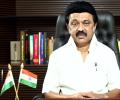
Tamil Nadu Chief Minister and DMK president M K Stalin announced that his party will file a case in the Supreme Court against the Waqf Bill passed in the Lok Sabha. The opposition AIADMK expressed solidarity with the DMK's stance, while the BJP members staged a walkout from the Assembly in protest. The CM argued that the amendment was passed at the behest of a few allies despite opposition from majority parties and that it is an attack on the Constitution and religious harmony. The DMK claims the bill threatens the autonomy of the Waqf Board and the Muslim minority population.
'The vast majority of BJP supporters in Tamil Nadu can't speak any language other than Tamil.' 'When rural Tamil Nadu can't speak any other language than Tamil, how are they going to convince them that they have to learn Hindi?'
Tamil Nadu Chief Minister M K Stalin has reiterated the state's opposition to Hindi imposition by the Centre, calling it a 'mask' for Sanskrit. He also claimed that the National Education Policy (NEP) is being used to promote Sanskrit in many states, and that the Centre is trying to do away with languages like Tamil and impose Sanskrit. Stalin's statement comes amid growing concerns over the alleged imposition of Hindi in non-Hindi speaking states.
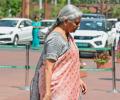
The resilience of the economy and strength of domestic demand will continue to make India an engine of growth amid the rapidly evolving global trade landscape as a result of US tariffs, Finance Minister Nirmala Sitharaman said in London on Tuesday.
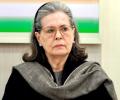
Noting that these three Cs haunt Indian education today, the Congress Parliamentary Party chairperson said in an article that this "carnage" of India's public education system must end.
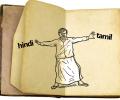
The three-language formula proposed in the National Education Policy 2020, is at the centre of the political row between the Dravida Munnetra Kazhagam-led Tamil Nadu government and the central government.
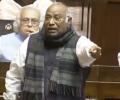
The Rajya Sabha witnessed an uproar on Tuesday over an unparliamentary remark by Leader of Opposition Mallikarjun Kharge, who apologized to the Chair while clarifying that it was meant for the government that was "trying to create a regional divide" in the country. The controversy stemmed from a statement by Education Minister Dharmendra Pradhan, who slammed the Tamil Nadu government for its stand on the three-language policy under the National Education Policy (NEP). Kharge's use of a Hindi expression, deemed unparliamentary, sparked outrage from the treasury benches. He subsequently apologized for the remark, stating it was directed at the government's policies and not the Chair.
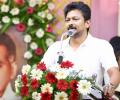
Whether or not today's protest against NEP escalates into a full-fledged struggle across the state remained in the hands of the Prime Minister Narendra Modi-led BJP government, he said.

A students' organization in Madhya Pradesh has demanded an inquiry after a woman, recently selected in the government service in the disabled quota, was seen dancing in a viral social media video. The woman, however, denied any irregularity in her appointment, claiming that she suffers from 45 percent disability due to bone-related problems. She stated that she is able to walk and even dance for short periods due to implants from surgery following a serious hip injury.
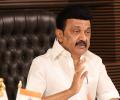
Tamil Nadu Chief Minister and DMK president M K Stalin said on Wednesday that the DMK will not oppose Hindi if it is not "imposed" on Tamil Nadu, stating that forcing the language on Tamils amounts to playing with their self-respect. Stalin's remarks come amidst an intense language row in the state, with the DMK alleging that the BJP-led NDA government at the Centre was trying to impose Hindi through the three-language formula in the National Education Policy (NEP), a charge denied by the union government.
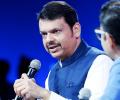
Maharashtra Chief Minister Devendra Fadnavis on Thursday asserted that Marathi is the language of Mumbai and Maharashtra and anyone who lives here should learn and speak it. Fadnavis was speaking in the state assembly after Shiv Sena (UBT) MLA Bhaskar Jadhav said the government should clarify its stand on senior Rashtriya Swayamsevak Sangh (RSS) leader Suresh Bhaiyyaji Joshi's comments that a person coming to Mumbai may not necessarily learn Marathi.

'If delimitation is not handled well by the Centre, the southern states are certainly going to challenge it.'
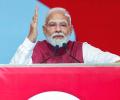
Prime Minister Narendra Modi asserted that his "vocal for local" campaign is bearing fruit as Indian products are going global and making their presence felt across the world. He said that India was becoming the land of infinite innovations, finding affordable solutions and offering them to the world. The prime minister also highlighted the country's rising defense products, electronics, automobile sector, and the success of superfoods, Ayush products, and yoga. He said India should be presented to the world as it is, without any bias. Modi said that the country was now emerging as a manufacturing hub and a "factory of the world." He added that India was creating solutions that were affordable, accessible, and adaptable, and offering them to the world without gatekeeping.
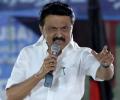
Tamil Nadu Chief Minister M K Stalin on Tuesday warned of "another language war" amid the ongoing Hindi imposition row, stating that the state is "ready" for it. He also expressed concerns about the potential loss of Lok Sabha seats due to the proposed delimitation process, which he believes will disadvantage states that have successfully implemented population control measures. Stalin has called for an all-party meeting on March 5 to discuss the issue, urging unity across political lines to address the perceived threat to Tamil Nadu's representation in Parliament.
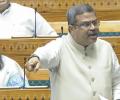
The DMK protested in the Lok Sabha after Union Education Minister Dharmendra Pradhan criticized the Tamil Nadu government for refusing to implement the National Education Policy (NEP) and accused them of "politics." Pradhan alleged that the state had initially agreed to the PM SHRI scheme but later backed out. The DMK, however, asserted that they have issues with the NEP and the three-language formula, and cannot accept it in full. The protests disrupted House proceedings, leading to an adjournment. The DMK members were angered by Pradhan's accusations, demanding the release of funds allocated for education in the state.

'The southern states will have no voice.' 'Political parties in future need to focus only on one region, the northern region, to win the general election.'
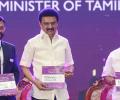
Tamil Nadu is set to protest against the National Education Policy (NEP) on February 18, with the ruling DMK and its allies announcing a demonstration. The state government has been at odds with the Centre over the implementation of the NEP and the three-language formula proposed in the policy. Union Education Minister Dharmendra Pradhan dismissed the state's opposition as "politics" and asserted that the Centre is committed to implementing the NEP across the country. The DMK, however, accused the Centre of encroaching on the state's rights and using the office of the Governor to push the NEP.
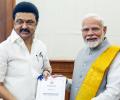
With its age-old fascination for education, southern states have done better than the North. Start-ups, IT hubs, and industry majors setting up shop have changed the face of the South. Nearly 79% of global offices set up by international conglomerates in India are in the South. Almost 46% of tech unicorns are from the South. The GDP per person in the South is 4.2 times higher than the North. None of these indicators can be ignored by any central government, whatever the political compulsions, notes Ramesh Menon.
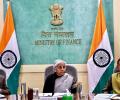
The Budget assumes significance as it comes on the back of lower-than-expected growth numbers during the second quarter and geopolitical uncertainty.

If the DMK is able to sustain the momentum until the assembly polls, the AIADMK especially and the PMK and possibly the infant TVK too would find it hard to sign up with the BJP, explains N Sathiya Moorthy.

The Indian government has scrapped the 'no-detention policy' for classes 5 and 8 in schools it governs. This means that students in these classes who do not pass the year-end exams will be allowed to fail. The decision comes after the amendment to the Right to Education Act (RTE) in 2019, which has already led to 18 states and union territories doing away with the 'no-detention policy' for the two classes. The new policy will be implemented in over 3,000 schools run by the central government, including Kendriya Vidyalayas, Navaodyala Vidyalayas, and Sainik Schools.
'Patients under the scheme may ultimately have to go to private hospitals.'

He also pointed out the high sums earned by the coaching centres leading to the commercialisation of education.

The paper said that the taxation proposal needs to be accompanied by explicit redistributive policies to support the poor, lower castes, and middle classes.

'Your activities are not in the interest of the nation. Being a public institution, TISS cannot permit or tolerate its students indulging in such activities which are anti-national and bring a bad name to the nation. Hence all such activities fall under the category of serious criminal offence'

Here is an explainer on the functioning of the seven-year-old body.

Explore, engage, participate and excel in as many co-curricular activities and hackathons as possible to improve your self-confidence, communication skills and overall personality, advises rediffGURU Chocko Valliappa.
 © 2026 Rediff.com - Advertise with us - Disclaimer - Privacy Policy - Sitemap - Feedback - About us - Terms of use - Grievances