
The recent tragedy confirms the view of humanitarian aid as a political weapon

Stepping up relief and rescue operations in quake-hit Nepal, India on Sunday deployed over two dozen aircraft and choppers along with nearly 1000 trained personnel and said the situation in the Himalayan nation was "very, very serious".

Poor land-use planning, indiscriminate approvals of building plans and the absence of disaster-risk assessment in urban design have resulted in what experts term concentrated concretization, predisposing cities to disaster risks

The Seismological department said that the quake measured 6.8 on the Richter scale and lasted for about two minutes.

The temples committee has already posted a request to devotees on its website to contribute towards the rebuilding.
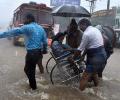
In a minor relief for residents of flood-hit Chennai, the rains have stayed away for the last few hours.

'If a major earthquake of the kind that hit Nepal hits us in Delhi, 35 per cent of our homes would be destroyed.'

Indian cities will go down like a pack of cards if hit by a powerful earthquake, seismologists tell Rashme Sehgal.

Rescue and relief operations continued in full swing in Chennai with over a hundred people taken to safety by teams of Army, IAF and NDRF, including a seven-month pregnant woman who was airlifted on Thursday from one of the worst-affected areas in the flooded city.

The stage on which the Jammu and Kashmir flood disaster played out is littered with protagonists, most of whom did not receive the attention they deserve, says Ajai Shukla
The successful effort to combat Cyclone Phailin threatens to put disaster mitigation, and a fundamental overhaul of how disaster management in India is structured, on the back-burner, says Anand Sarkar.

Uttarakhand was a tragedy that none of us will forget. As experts analysed the tragedy, it became clear that the disaster was more man made. The intergovernmental panel on climate change in its Assessment Report 5 states that human influence on the climate system is clear and this is evident from the increasing greenhouse gas concentrations in the atmosphere, positive radiative forcing, observed warming, and understanding of the climate system.
.jpg)
By the end of 2020, India will lay 32,737 km across the length and breadth of the country. It needs to lay down and comply with strict safety standards especially since some of these pipes will go through areas of dense habitation, says Rashme Sehgal.

Scientists at the India Meteorological Department warn that not only has India turned hotter in the last two decades, but that heat waves are projected to become more intense, have longer durations and greater frequency, thereby resulting in more deaths.
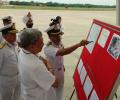
'Other countries go out on a limb to save even a single life.' 'What to talk of civilian accidents and disasters, even our military does not have a priority for Combat Search and Rescue,' says Group Captain P I Muralidharan (retd).

Rains will continue to batter Tamil Nadu for the next seven days and the next 48 hours are "very crucial", the IMD has said.
 © 2026 Rediff.com - Investor Information - Advertise with us - Disclaimer - Privacy Policy - Sitemap - Feedback - About us - Terms of use - Grievances