
Congress MP Manish Tewari has introduced a bill in Lok Sabha that seeks to allow parliamentarians to take an independent line in voting on bills and motions other than those affecting the government's stability in a bid to free them from "whip-driven tyranny" and promote "good lawmaking".
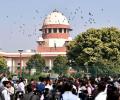
The Supreme Court of India has ruled that no timelines can be imposed on governors and the president to grant assent to bills passed by state assemblies, clarifying the extent of their powers under Article 200 of the Constitution.

The Supreme Court has questioned the practice of Governors withholding assent to bills indefinitely, stating that it renders the constitutional provision of 'as soon as possible' meaningless.

The Centre has argued before the Supreme Court that state governments cannot use writ jurisdiction to challenge the actions of the President and Governor regarding bills passed by state assemblies, particularly concerning fundamental rights violations. The President seeks the Supreme Court's opinion on whether states can file writ petitions under Article 32 and the scope of Article 361.

BJP-ruled states argued in the Supreme Court that governors and the President have autonomy in assenting to bills passed by state assemblies, asserting that courts cannot mandate assent.

The Supreme Court has ruled that a Governor cannot send bills to the President for consideration if the state assembly has already cleared them for a second time. The court was questioning the Centre over the powers of the Governor when it comes to granting assent to bills.
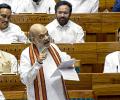
'This type of comprehensive legislation has never been introduced before in Parliament's history.' 'A bill that simultaneously affects ministers, chief ministers, and the prime minister represents completely uncharted Constitutional territory.' 'Throughout our nation's legislative history, the established policy has consistently held that public office holders should face punishment only after receiving conviction from a competent court of law. Without this safeguard, we risk systematic destabilisation, and our federal structure would face complete collapse.' 'Any central government could potentially deploy this legislation against state governments they oppose politically. This represents the most frightening prospect and dangerous possibility that these bills create.'

Hours after Congress leader Manish Tewari on Thursday said the government might get the Digital Data Protection Bill classified as a money bill, Union IT Minister Ashwini Vaishnaw refuted the charge and termed it a "normal bill".
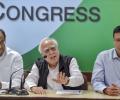
Sibal said the party will certainly move the court if amendments in the Aadhaar Act to be brought after this verdict are not brought in Rajya Sabha for discussion.
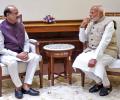
The Speaker is the final authority to take a call on cases of defection. Although this may not be an immediate concern now, but its occurrence in the future cannot be ruled out considering the volatile nature of politics, points out Rup Narayan Das.

The Bill could be introduced in Lok Sabha very soon.

The Aadhaar Bill passed during Budget session last month, overruling amendments moved in Rajya Sabha.

Might use it to counter Opposition campaign on land issue.

The Centre needs to have dialogue with the Opposition instead of letting politics come in the way; it needs to stoop to conquer, says Aditi Phadnis.

Today even those who support Prime Minister Modi feel there is a certain sense of listlessness in this government. What is it intending to achieve? This is not easy to say, notes Aakar Patel.
The apex court had permitted only voluntary use of Aadhaar for welfare programmes including MGNREGA, all pension schemes, provident fund and Pradhan Mantri Jan Dhan Yojna.

He said the Aadhaar programme violated informational privacy, self-determination and data protection.

States are apprehensive of losing their rights to raise revenue during emergencies.

Aadhaar is a creation of the previous Congress-led government.

Black money Bill: Govt may widen disclosure window to 3-6 months.

Companies were consulting law firms and consultants to understand the Bill.

The governments of Tamil Nadu and Punjab have moved the Supreme Court alleging delay by the state governors in giving assent to bills passed by the respective state assemblies.

Khan said when any ordinance or Bill comes before him, he applies his mind to ascertain whether it is constitutionally and legally sound.

The state government said these bills had been pending with the governor for as long as about two years and his action "subverted" the functioning of the state legislature, rendering its very existence "ineffective and otiose".

Compliance window for those with undisclosed income abroad to come clean by paying 30 per cent tax and 30 per cent penalty
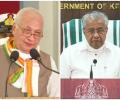
The Kerala government has moved the Supreme Court claiming that Governor Arif Mohammed Khan was delaying giving his assent to bills passed by the state assembly, which was "defeating the rights of the people".

he Punjab government had also sought a judicial declaration that the assembly session held on June 19 and 20 was "legal and that the business transacted by the House is valid".
The bench said if the governor decides to withhold assent to a bill, then he has to return the bill to the legislature for reconsideration.

The Opposition parties need to spell out how exactly they will protect the citizen from government excess, asserts T N Ninan.

The government on Thursday tabled the Digital Personal Data Protection Bill 2023 in the Lok Sabha with an aim to protect the privacy of Indian citizens, while proposing a penalty of up to Rs 250 crore on entities for misusing or failing to protect digital data of individuals.
The Supreme Court has dismissed a batch of pleas seeking review of its 2018 verdict upholding the Centre's flagship Aadhaar scheme as constitutionally valid but striking down some of its provisions, including its linking with bank accounts, mobile phones and school admissions.
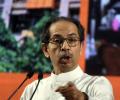
The Supreme Court on Thursday reserved its verdict on a batch of cross-petitions of Uddhav Thackeray and CM Eknath Shinde factions pertaining to the Maharashtra political crisis.

The Lower House of Parliament took up the Demands for Grants and Appropriation Bills after two adjournments as the ruling and Opposition MPs engaged in a matching duet over demands for an apology by Rahul Gandhi and the Adani issue.

The Supreme Court on Thursday refused to grant any interim relief and stay the Life Insurance Corporation (LIC) IPO share allotment on a batch of pleas filed by some policy holders. A bench of Justices DY Chandrachud, Surya Kant and PS Narasimha said that the court should be reluctant to grant any interim relief in matters of commercial investments and IPO. "We are not inclined to grant any interim relief", the bench said as it issued notice to the Centre and LIC on the batch of pleas seeking their response within eight weeks.

The Bill could be referred to the Parliamentary Committee for scrutiny
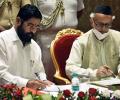
Calling for a trust vote merely on the ground of differences between MLAs of a ruling party can topple an elected government, the Supreme Court observed on Wednesday, adding that the governor of a state cannot lend his office to effectuate a particular result.

History would not see the institution kindly if it continues to avoid, as appears to be the case, hearing and deciding some of the most pressing issues of our time, asserts Aakar Patel.

The amendment of around 40 central statutes makes the Finance Bill, 2017 unique

Talking to reporters in Islamabad, he said the Opposition has laid all of their cards, but the no-confidence motion against him would not be successful.
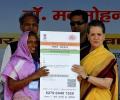
The Congress and the Left parties might move court to challenge LS speaker's ruling on Aadhaar as money Bill.
 © 2026 Rediff.com - Investor Information - Advertise with us - Disclaimer - Privacy Policy - Sitemap - Feedback - About us - Terms of use - Grievances