
The power failure comes at a time when the state is reeling under power deficit.

It rained in the periphery of Delhi -- Aligarh in Uttar Pradesh and Karnal in Haryana -- but clouds hovered over the national capital, without giving any relief from the heat.

The country saw 645 events of heavy rainfall and 168 events of very heavy rainfall in November, the highest in the month in five years, the India meteorological department said on Wednesday.

Heavy rain threatens to play spoilsport when India face New Zealand in their next World Cup game at Trent Bridge on Thursday.

Showers through much of the day restricted the chances of the two teams getting onto the field and, after several inspections, the umpires called off play at 4:10 p.m. (1510 GMT).

Kashmir remained cut off from rest of the country for the fourth consecutive day on Wednesday as the arterial Jammu-Srinagar national highway and the Mughal road remained closed, while air traffic was suspended due to heavy snowfall across the valley.

The snowfall started during the night at most places and early in the morning at few places, the officials said. They said while some areas in north Kashmir received light snowfall, most areas in central and south Kashmir experienced moderate snowfall.

The warmest six years have all been since 2015, with 2016, 2019 and 2020 being the top three. The differences in average global temperatures among the three warmest years are indistinguishably small. The average global temperature in 2020 was about 14.9C, 1.2 ( 0.1) C above the pre-industrial (1850-1900) level.

The system moved north-northeastwards at 20 kmph in the last six hours and is over west-central Bay of Bengal, 90 km from Gopalpur, 120 km from Puri and 210 km from Paradip, the weather office said in its 11.30 am bulletin.

The weather department said its latest model analysis had indicated that the moist easterly winds in the lower level from the Bay of Bengal would spread to northwest India, covering Punjab and Haryana by July 10, leading to the advancement of monsoon and an increase in rainfall activity over the region, including Delhi, from July 10 onwards.

The minimum temperature across the Kashmir Valley and Ladakh Union Territory stayed several degrees below the freezing point, intensifying the cold wave in some areas in the region, an official of the Meteorological Department said. He said Srinagar city recorded the low of minus 6.2 degrees Celsius last night, down from minus 5.8 degree Celsius the previous night.

Normally, monsoon reaches Delhi by June 27. It covers the entire country by July 8. Last year, the wind system had reached Delhi on June 25 and covered the entire country by June 29.

Very light rains and thundershowers occurred at isolated places in Uttar Pradesh though, and a fresh warning of heavy showers was issued in Himachal Pradesh as the India Meteorological Department (IMD) said heavy to very heavy rainfall is likely in several parts of the country, including the northern region, over the next six-seven days.

In Uttar Pradesh, the death toll due to lightning strikes rose to 42.

The deep depression in Bay of Bengal that crossed the coast close to Kakinada in East Godavari district on Tuesday morning left a trail of devastation as it brought with it a massive downpour in several districts of Andhra Pradesh.

Maharashtra Anti-Terrorism Squad (ATS) on Tuesday said suspended police officer Sachin Waze was a prime accused in the Mansukh Hiran murder case, adding it will approach the special National Investigation Agency court in Mumbai to get his custody.

The latest rains since Saturday evening led to lakes and other water bodies overflowing and triggering flooding of several low-lying areas, including places affected last week, in Hyderabad and on the outskirts.

The IMD said heatwave conditions are likely to continue over the northern plains, and central and southern parts of the country for two more days and abate gradually.

Rain may play spoilsport in the third and final T20 international between India and Australia with the weather forecast indicating possibility of light to moderate rain, in Hyderabad, on Friday.

Manchester could experience patchy drizzle later in the night.

The southwest monsoon is likely to hit the Kerala coast around June 1, well within its normal date of arrival, the India Meteorological Department (IMD) said.
Media reports said that the earthquake occurred at around 11.36 am, and added that residents of the region rushed out of their homes on feeling the tremors.

'Southwest Monsoon has advanced into remaining parts of Rajasthan, Haryana and Punjab and thus it has covered the entire country today, the 26th June 2020,' the IMD said in its special Daily Weather Report.

Isolated heavy rainfall is also very likely over north Konkan region during the same period, it said.
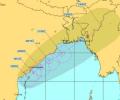
Heavy rainfall coupled with gusty surface wind is likely to pound some parts of Odisha as the deep depression over west-central Bay of Bengal intensified into a cyclonic storm 'ROANU' on Thursday.

The state government has declared a holiday on Wednesday and Thursday for all private institutions, offices, non-essential services within Outer Ring Road here in view of rains.

England has been blanketed in snow, plunging Britain's transport network into chaos with crashed cars, grounded planes and cancelled trains. Police forces and highway agencies across the United Kingdom have urged people not to travel unless 'absolutely necessary' as they deal with surging calls, while all trains have been suspended out of London Euston.

The state disaster management authorities informed that the three member committees set up at district level confirmed that all these deaths were occurred due to sun stroke and heat wave related problems.

The third and final Twenty20 International between India and Australia was called off without a ball being bowled because of a wet outfield in Hyderabad, on Friday.
Hitting hard at global warming sceptics, powerful United States lawmakers have accused them of 'engaging in a policy of distraction' by promoting hacked e-mails which claimed that scientists had exaggerated the crisis and asserted that the world is getting hotter faster.
The cold wave conditions are likely to intensify across the Kashmir Valley as the weather is expected to remain dry for another week.

Rain and thundershower lashed many places in Ganjam, Khurda, Puri, Cuttack, Jagatsinghpur, and Balasore in Odisha, disrupting normal life, the weatherman said.
Kashmir Valley had its second heaviest snowfall on Wednesday bringing life to a grinding halt.

Bangladesh on Wednesday launched a massive evacuation campaign as weathermen warned that cyclonic storm Mahasen had moved further towards the coast.
With a wind speed of up to kilometres per hour while heading east-northeastward, the cyclone hit the Barisal-Chittagong region, sending impacts across the country.
The Kashmir valley is in for the heaviest snowfall of the season. The snowfall which began on Thursday evening after rains during the day is set to continue for the night and Friday as per the local MET office.
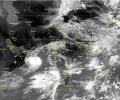
Cyclonic storm Ashobaa is expected to intensify further into a severe cyclonic storm and then move northwestwards during next 24 hours.
Icy winds are blowing from the hills in northern parts of the country due to snowfall and they are causing the dip in the temperature, the Met Office said. Cold wave conditions have been declared as the temperature drop is five degrees below normal.

Over 80 cattle lost their lives and over 600 houses were damaged in rain-related incidents.

The all-time low recorded in the month of December in Srinagar is minus 12.8 degrees Celsius on December 13, 1934.
 © 2026 Rediff.com - Investor Information - Advertise with us - Disclaimer - Privacy Policy - Sitemap - Feedback - About us - Terms of use - Grievances