
Veteran Communist leader Madhav Kumar Nepal was on Saturday elected unopposed as the prime minister of Nepal, bringing to an end the nearly three-week long political crisis in the country. The 56-year-old Communist Party of Nepal (Unified Marxist Leninist) leader, who claims to have the support of 351 lawmakers in the 601-member Constituent Assembly, was the only candidate to have filed the nomination for the top post. The Maoists boycotted the voting process.

Madhav, the chairman of the Communist Party of Nepal-Unified Socialist, was present in a special court to present his arguments relating to the land misappropriation case.

Earlier in the day, rich tributes were paid to Yechury at the Communist Party of India (Marxist) headquarters at the AKG Bhavan here, where his mortal remains were brought from his residence in the morning.
Nepal's Prime Minister Madhav Kumar Nepal is on a five-day visit to India.
India plotting our downfall, say Nepalese Maoists
Nepal's coalition cabinet headed by Prime Minister Madhav Kumar Nepal has scrapped the erstwhile Maoists-led government's controversial decision to remove the army chief Geneeral Rookmangud Katawal. The cabinet in its meeting on Thursday nullified the Maoists-led government's decision.
Slamming Maoist leader Prachanda for alleging Indian interference in Nepal's affairs, premier Madhav Kumar Nepal has said his charges expose the "bias" of an "unpredictable" person against the neighbouring country.

India's youngest Everest summiteer Arjun Vajpayee was to receive a medal from President of Nepal Ram Baran Yadav at function on Saturday, but instead recieved his medal from Nepal's minister of tourism & civil aviation, Sharat Singh Bhandari.
Nepali Maoists have launched an anti-India propaganda in Nepalganj town in Banke division of southern Nepal, about 30 km across the Indo-Nepal border from Bahraich. The campaign sims at provoking India and also throwing Nepal Prime Minister Madhav Kumar Nepal out of power.
Prime Minister Manmohan Singh on Thursday emphasised the need for all political parties in Nepal to sink their differences and come together to push the peace process as he met his Nepalese counterpart Madhav Kumar Nepal.
Nepal attaches 'great importance' to its relations with India which are based on mutual respect, goodwill, understanding and cooperation, Prime Minister Madhav Kumar Nepal has said.
Nepal political parties on Friday night agreed to extend the term of Constituent Assembly by one year as part of a crucial deal under which Prime Minister Madhav Kumar Nepal agreed to step down.
One wonders whether the Communists in India are still at their old game: ostensibly nurturing democracy (in Nepal) but in reality waiting for the right moment and the right circumstances to launch an armed bloody revolution in India via Nepal with the backing of China.
In a major breakthrough, Nepal's ruling coalition partners on Saturday sorted out the vexed issue of portfolio distribution and power sharing after they 'tentatively agreed to a deal' to give the 20-day-old Communist Party of Nepal-Unified Marxist Leninist government a "full shape" by Sunday.
On the eve of his maiden official visit to New Delhi, Premier Madhav Kumar Nepal affirmed on Monday that his country would not allow its soil to be used against India and sought the giant neighbour's cooperation in the fields of infrastructure development and power generation.
Madhav Kumar Nepal was sworn-in on Monday as the Prime Minister of Nepal along with two cabinet ministers, capping the three-week long political crisis in the country that eased Maoists out of power after a confrontation with the army.
Former deputy prime minister has jail term extended by three months.
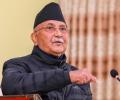
The decision to remove Oli from the party's general membership was taken at the Standing Committee meeting of the faction led by former prime ministers Prachanda and Madhav Kumar Nepal after Oli failed to produce explanation to his recent moves as sought by party leadership, sources said.

The 75-year-old veteran politician and Nepali Congress President took the oath of office and secrecy from President Bidya Devi Bhandari during a swearing-in ceremony which was delayed by over two hours.
A five-member Constitutional Bench of the Supreme Court led by Chief Justice Cholendra Shumsher Rana issued the verdict stating that President Bhandari's decision to dissolve the lower house upon a recommendation of Prime Minister K P Sharma Oli was an unconstitutional act, delivering a major blow to the veteran Communist leader who was preparing for snap polls.
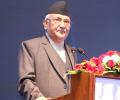
Nepal's political crisis deepened on Friday as both embattled Prime Minister K P Sharma Oli and the Opposition parties staked a claim for the formation of a new government by submitting letters comprising signatures of lawmakers to President Bidya Devi Bhandari.

President Bidya Devi Bhandari administered the oath of office and secrecy to Oli, 69, at a ceremony at Shital Niwas, after he was reappointed to the post on Thursday night as the Opposition parties failed to secure majority seats in Parliament to form a new government.
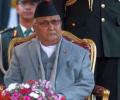
'The Prime Minister's remarks that India was conspiring to remove him was neither politically correct, nor diplomatically appropriate,'
The move comes as the intra-party feud reached climax in the ruling NCP which has been witnessing months long tussle between two factions, one led by 68-year-old Oli and Party's chairman and another led by 66-year-old 'Prachanda', also the executive chair of the party and former premier.
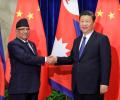
Nepal plunged into a political crisis last Sunday after Oli, known for his pro-Beijing leanings, in a surprise move, recommended dissolving the 275-member House, amidst a tussle for power with former prime minister Pushpa Kamal Dahal 'Prachanda'.

It alleged that the decision by India to 'derail the summit' effectively 'contradicts' Prime Minister Narendra Modi's own call to fight against poverty in the region.

'By treating Nepali politicians as shabby buffoons to be pampered one day and collared another day, India badly exposed itself.' 'A belief got entrenched in the Nepalese mind that we are a dangerous neighbour,' observes Ambassador M K Bhadrakumar.

Communist leader Vidya Devi Bhandari was on Wednesday elected as Nepal's first woman President by the parliament, weeks after it adopted a new landmark Constitution that declared the country a secular state.

'This allows opportunities for (Chinese) entry into the domestic politics of Nepal, something that is also encouraged by Nepali politicians's willingness to play the China card (vis-a-vis India).'

For India to endorse Nepal's Buddhist conference will be like sipping from a poisoned chalice, warns former RA&W official Jayadeva Ranade.
 © 2026 Rediff.com - Advertise with us - Disclaimer - Privacy Policy - Sitemap - Feedback - About us - Terms of use - Grievances