
The GoM is likely to submit an interim report to the Council on pruning the list of items that at present do not attract the levy.

Crypto exchanges have been asked to furnish details this month itself.

The finance ministry is looking at rationalising long-term capital gains tax structure by bringing parity between similar asset classes and revising the base year for computing indexation benefit to make it more relevant, an official said on Friday. Currently, shares held for more than one year attract a 10 per cent tax on long-term capital gains. Gains arising from sale of immovable property and unlisted shares held for more than 2 years and debt instruments and jewellery held for over 3 years attract 20 per cent long term capital gains tax.

The US launched an investigation, focusing on whether the tax in India and other countries discriminated against American companies, were retroactive, and reflected unreasonable tax policy.
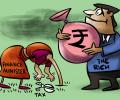
The Central Board of Direct Taxes (CBDT) has proposed a new common income-tax return (ITR), with greater focus on disclosing income from virtual digital assets or crypto assets and foreign equity and debt instruments held by resident Indians. For non-resident Indians, the draft ITR seeks exhaustive details ranging from nature of business, permanent establishment (PE), business connection, whether the entity has significant economic presence (SEP) in India, along with the number of users in India. The ITR protocol for NRIs could widen the scope of the SEP principle that was introduced in the Finance Bill 2018-19, and the explicitly defined 'business connection' to include provision of download of data or software, if aggregate payments from such transactions exceed a prescribed amount, or if a multinational's interaction is with a prescribed number of users.

Late on Thursday, chief proctor Rajnish Kumar Mishra issued a notification saying the document on rules and discipline of JNU students is withdrawn, citing administrative reasons.
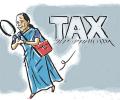
The Central Board of Direct Taxes (CBDT) has extended various tax returns filing deadlines till December 31 this year but it will continue to levy interest on delayed payments made after July 31, the original due date. Officials say tax payment has to be done through net banking, and the assessee doesn't need to use the e-filing portal, which has been facing glitches. So, taxpayers have to bear the interest payment liability of 1 per cent per month on the outstanding tax for those who filed a return after July 31.

Hitting out at Prime Minister Narendra Modi over the issue of tax cuts on petroleum products, Tamil Nadu Chief Minister M K Stalin on Thursday said people were aware of the fact behind the issue and pointed out at his government effecting a Rs 3 a litre cut on petrol earlier.

India's climate change goals are turning combustible. On the one hand, a protracted dispute between the government and manufacturers over subsidies threatens to slow the pace of electric vehicle (EV) sales. On the other hand, repeated assertions by different arms of the government over banning sales of new fossil fuel-fired vehicles have queered the pitch for energy investments. Before we address the issue of the recommended diesel vehicle ban in the recent report on energy transition, issued months before the next round of global climate talks begin in Dubai in November, let's look at what's at stake.

The government said that far from targeting any US entity, the purpose was to ensure fairness, healthy competition, and to exercise the ability of governments to tax businesses having a nexus with the Indian market through digital operations.


The levy of retrospective tax on the UK's Cairn Energy Plc is a tale of bizarre twists and turns that saw its attached shares being sold in May 2018 amid the passing of the baton from a full-time finance minister to interim one and the talks at the highest level to resolve the dispute, to claims that levy of back taxes was a result of an investigation into Panama Papers leak. The government late last month refunded about Rs 7,900 crore it had collected from selling residual shares of the British firm in its erstwhile India unit, seizing dividend and withholding tax refunds, to settle an eight-year-old dispute that had tarred the country's reputation as an investment destination. But, this did not come about easily. For seven years, the establishment vehemently justified in courts and outside seeking of Rs 10,247 crore in back taxes plus interest and penalty from a firm that gave India its biggest onshore oil discovery.

Sebi on Tuesday sent a notice to 7 entities, including Malvinder and Shivinder Mohan Singh, asking them to pay Rs 48.15 crore within 15 days in a fund diversion case of Religare Finvest. Sebi also warned of attachment of assets and bank accounts, if they fail to make the payment. The notice came after the entities failed to pay the fine imposed on them by the Securities and Exchange Board of India (Sebi).

The finance ministry is looking at a reworked proposal from mobile device makers on how to fight the rampant and growing smuggling of very high end phones. The proposal suggests reducing the basic customs duty (BCD) on phones which have a CIF (cost, insurance and freight or price at landing in the port) value of over Rs 35,000-Rs 40,000. The retail value of these phones is upwards of Rs 70,000.

US short seller Hindenburg Research has rejected Adani Group's charge that its report was an attack on India, saying a "fraud" cannot be obfuscated by nationalism or a bloated response that ignored response to key allegations. Commenting on the 413-page response Adani Group released late on Sunday evening in response to its report, Hindenburg said it believed India was a vibrant democracy and an emerging superpower with an exciting future and it was Adani Group which was holding it back through "systematic loot". Hindenburg stood by its last week's report that said its two-year investigation found Adani Group "engaged in a brazen stock manipulation and accounting fraud scheme over the course of decades".

The government intends to continue with the top GST slab of 28 per cent for luxury and sin goods, but is open to discuss narrowing down the three slabs of 5, 12 and 18 per cent into two, Revenue Secretary Tarun Bajaj said on Monday. Addressing the industry leaders, Bajaj said the rate rationalisation exercise of the GST Council is a result of introspection of GST, five years after its rollout, and the policymakers do not have a "fetish" to raise the tax rates to the revenue-neutral level of 15.5 per cent. On the industry demand for bringing petroleum products under GST net, he said since fuel constitutes a larger part of their revenues, both the Centre and states have some apprehension.

The 47th GST Council meeting that is currently underway is slated to discuss a host of issues, including a mechanism for compensating states for revenue loss, tax rate tweaks in some items and relaxed registration norms for small online suppliers. Further, the meeting of the Council, chaired by the Union Finance Minister Nirmala Sitharaman and comprising state counterparts, will also clear levying the highest tax of 28 per cent on online games, casinos and horse racing, besides, measures to curb tax evasion, especially devising ways to tackle high-risk taxpayers in GST. "The meeting is being chaired by Hon'ble Union Minister of Finance @nsitharaman and many important decisions are expected to be taken at the meet," PIB Chandigarh tweeted.

Cars and two-wheelers attract 28% GST and a cess in the range of 3-22%, taking the effective tax rate to up to 50%.

Come January and the government is empowered to send its recovery officials to your premises to collect GST without notice, if your tax liability shown in the requisite form is less than what invoices, mentioned in the outward supply form, should draw. The relevant provision in the Finance Act, 2021, will come into effect from January 1, 2022, according to a gazette notification issued on Tuesday. Under the GST system, there are two kinds of returns that a company is required to file monthly if its turnover is over Rs 5 crore annually. These are form GSTR-1 and GSTR-3B.

'I think my first obsessive, possessive and only half-requited -- as we would joke -- 'love' was Ivan. I saw him first slouching down the corridor of St Stephen's College nearly 50 years ago and was instantly smitten (as was everyone else around him).'

Policies to break down the business group format are far more likely to be effective, argues Simon Commander.

Suppose you had bought a television set that came with a one-year warranty. It breaks down two years after purchase. You can't react emotionally and say that such an expensive set should last for at least five-six years.

A nurse working at actor Sonam Kapoor Ahuja's Delhi residence was arrested along with her husband for allegedly stealing cash and jewellery worth Rs 2.4 crore in February.

It will also be new Revenue Secretary Sanjay Malhotra's first GST Council meeting. He will take charge after the incumbent Tarun Bajaj retires on November 30.

The government on Thursday proposed to tighten the norms for taxation of cryptocurrencies by disallowing set off of any losses with gains from other virtual digital assets. As per the amendments to the Finance Bill, 2022, circulated among the Lok Sabha members, the ministry proposes to remove the word 'other' from section relating to set off of losses from gains in virtual digital assets. This would mean that loss from the transfer of virtual digital assets (VDA) will not be allowed to be set off against the income arising from the transfer of another VDA.

Airports levy charges such as FTC, infrastructure charge, and into-plane charges on sale of jet fuel. The levy is passed through to airlines, pushing up costs.

Meanwhile, US President Joe Biden condemned Russia's annexation of Ukrainian territory on Friday.

Going through the credit report regularly will make you aware of a number of issues. One is identity theft.

Finance Minister Nirmala Sitharaman in her fifth Union Budget made five major announcements for the income tax assesse. She announced no changes in the old tax regime and confined her relief measures to the new tax regime. There have been no changes under the old tax regime.
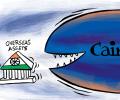
Faced with prospect of its assets across the globe being seized just like Pakistan and Venezuela, the government decided to scrap retrospective taxation but the international embarrassment could have been avoided had 'attached' shares of Britain's Cairn Energy Plc not been sold, according to tax and legal experts. On Thursday, the government introduced a Bill in Parliament to scrap the tax rule that gave the tax department power to go 50 years back and slap capital gains levies wherever ownership had changed hands overseas but business assets were in India. The 2012 legislation was used to levy a cumulative of Rs 1.10 lakh crore of tax on 17 entities, including UK telecom giant Vodafone, but substantial punitive action was taken only in the case of Cairn.

Amid record-high fuel prices, Finance Minister Nirmala Sitharaman on Monday said there is no proposal as of now to bring crude oil, petrol, diesel, jet fuel (ATF) and natural gas under the Goods and Services Tax (GST). When the GST was introduced on July 1, 2017, amalgamating over a dozen central and state levies, five commodities - crude oil, natural gas, petrol, diesel, and aviation turbine fuel (ATF) - were kept out of its purview given the revenue dependence of the central and state governments on this sector. This meant that the central government continued to levy excise duty on them while state governments charged VAT. These taxes, with excise duty, in particular, have been raised periodically.
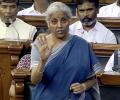
India is facing no risk of recession or stagflation as macroeconomic fundamentals of the economy are strong, Finance Minister Nirmala Sitharaman said on Monday. Replying to a debate on price rise in the Lok Sabha, she said the GST collection and Purchasing Managers' Index (PMI) are indicating that the Indian economy is getting more robust. The GST collection rose 28 per cent to touch the second-highest level of Rs 1.49 lakh crore in July. GST, introduced in July 2017, touched a record high of Rs 1.68 lakh crore in April 2022.

The group has called for a retaliatory tariff action against India, if New Delhi does not roll back the 'unilateral and discriminatory' equalisation levy or Google Tax.
Net direct tax collection in the April-June quarter of the current fiscal rose by 41 per cent to Rs 3,54,569.74 crore, Minister of State for Finance Pankaj Chaudhary informed the Lok Sabha. During the April-June period of 2021-22, the government had collected a net direct tax of Rs 2,50,881.08 crore. At the same time, net indirect tax collection including Goods and Services Tax (GST) and custom duty increased by 9.4 per cent to Rs 3,44,056 crore as against Rs 3,14,476 crore in the first quarter of the previous fiscal, he said in a written reply.

Currently, domestic supplies and commercial imports of vaccines attract a 5 per cent Goods and Services Tax, while COVID drugs and oxygen concentrators attract a 12 per cent levy.
