
Gautam Adani's alleged proximity to Narendra Modi may dent the latter's self-styled image of incorruptibility, points out Kanika Datta.

Talking to PTI Amarjeet Kaur, General Secretary of All India Trade Union Congress (AITUC), said, "The two-day nationwide strike by the joint forum of central trade unions has begun this morning". About the impact of the agitation, she said that the entire coal belt (mining area) is affected in Jharkhand, Chhattisgarh and Madhya Pradesh. She also said that there is a good response in industrial areas of Assam, Haryana, Delhi, West Bengal, Telangana, Kerala, Tamil Nadu, Karnataka, Bihar, Punjab, Rajasthan, Goa, Andhra Pradesh and Odisha. The AITUC official noted that the banks and insurance sectors are affected all over India, while steel and oil sectors are also seeing partial impact due to the strike. Kaur said that she has got preliminary reports that markets are closed in Odisha.

A survey, with over 3,700 respondents across digital platforms, found that transparent taxation has been one of the most significant initiatives of the government followed by the production-linked incentives (PLI) scheme, equalisation levy and new labour codes.

None of the issues which have been continuously raised by the central trade unions, including unemployment, minimum wages, social security and 14-point charter of demands, were addressed by the minister.

A joint forum of central trade unions has given a call for a nationwide strike on March 28 and 29, to protest against government policies affecting workers, farmers, and people. The Joint Platform of central trade unions held a meeting in Delhi on March 22, 2022, to take stock of the preparations in various states and sectors for the proposed two-day all India strike on 28-29 March 2022 against "the anti-worker, anti-farmer, anti-people and anti-national policies" of the central government, a statement said. The statement said that roadways, transport workers and electricity workers have decided to join the strike in spite of the impending threat of ESMA (Haryana and Chandigarh, respectively). Financial sectors, including banking and insurance, are joining the strike, it stated.

India's time use survey for January-December 2019 had found that an average person in urban areas spends 485 (eight hours and five minutes) minutes on employment and related activities.

If retrenched workers are unable to reskill within a fixed period of time, they will have to return the money given to them by the government. Moreover, they may be asked to pay back an interest on the sum transferred.

ndependent of the political fallout, which Stalin has sought to arrest through the withdrawal of the measures as fast as they were introduced, there are concerns about the way those decisions came to be taken, without adequate application of mind, not in official terms but in political and electoral contexts, points out N Sathiya Moorthy.
The ten central trade unions have demanded a cash transfer of Rs 7,500 a month to all families that do not pay income tax, free ration of 10 kg per head in a month to all the needy, expansion of the Mahatma Gandhi National Rural Employment scheme to cover more days of job, withdrawal of labour codes and farm bills, halt on privatisation, universal pension coverage and withdrawal of "draconian" circular on forced premature retirement of government officials.

For large numbers of employees in the government system, the month-end salary cheque is no longer guaranteed. So the days of the government and State-owned enterprises wanting to be ideal employers are over, observes T N Ninan.

According to reports, public transport and banking services remain partly disrupted for the second day in some states.

The new definition under the Code of Wages, 2019, includes three components: basic pay, dearness allowance and retention payment.

The challenges before the coming Budget are more daunting than those in 2021, reveals A K Bhattacharya.
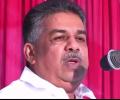
Kerala Minister Saji Cheriyan on Tuesday landed in trouble for his harsh remarks against the Constitution, triggering a huge political row in the state with the opposition demanding for his sacking, but the Left leader later expressed regret and claimed news reports in this connection were 'distorted'.

Ailing telecom operator Vodafone Idea has flagged the industry's "unsustainable financial duress" in its latest annual report and hoped that the government would provide the necessary support to address "all structural issues" faced by the sector. In the chairman's letter to shareholders, Himanshu Kapania cited persistent challenges in the operating environment, amid "unsustainable pricing" and "hyper-competition" during FY21. Kapania expressed hope that government will support efforts to generate reasonable returns on massive investments.

A joint forum of central trade unions has given a call for a nationwide strike on March 28 and 29 to protest against the government policies affecting workers, farmers, and people.

Given the many policy areas where the Centre and the states have not been seeing eye to eye in the last few years, it is time the Modi government convenes a meeting of the Inter-State Council, recommends A K Bhattacharya.

While all indicators pointed to economy drastically slowing down due to lack of demand, the government continued to steer its policies in the name of 'ease of doing business', aggravating widespread impoverishment and deepening the crisis further, the unions alleged.
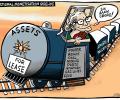
But use of that word -- privatisation -- is not encouraged. This seems to be a classic case of reforms through subtle signals, observes A K Bhattacharya.

Till such time that a new governance framework comes into being, the progress of reforms in health, education, land, labour, electricity and agriculture could remain fraught with problems, agitations and delays, observes A K Bhattacharya.
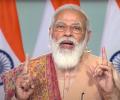
Prime Minister Narendra Modi on Wednesday said that the country's economic growth is picking up pace again and the domestic industry needs to enhance its risk-taking appetite. Noting the recent reforms taken by the government, the Prime Minister said that bringing reforms is a matter of conviction for his government, which is ready to take all risks in the national interest. "We have taken bold decisions. Reforms continued even during pandemic. "The government is doing reforms not out of compulsion but out of conviction," he said while addressing the CII's annual meeting.

Tikait says PM Modi was supporter of MSP law when he was CM

The employment situation remains dire. Whatever can be done to promote greater low-skill employment should be pursued aggressively, advises former chief economic adviser Shankar Acharya.

'There will always be a challenge to maintain a fine balance to ensure that the growth keeps happening and inflation is contained.'

'The government is sincerely working on employment generation. Unfortunately, they are depending on these people from Harvard. Their wrong policies are killing jobs. The government has to come out of the Western framework on which they depend upon a lot.'

The recent protests by employees of Urban Company and the case of a a Zomato delivery executive who died in a road accident point to the severely straitened condition of gig workers during the ongoing Covid-19 pandemic. Budget 2021 had promised several measures to help the cause of gig economy workers, but most of them are yet to see the light of day. Even after a year, the country's gig workers continue to be without any social security cover or a minimum wage guarantee. "In Budget 2021, finance minister Nirmala Sitharaman had announced that the government is looking toward including migrant and gig workers for social security benefits," says Srinivas Kotni, managing partner, Lexport, a consulting firm. Parliament had passed the Code on Wages in 2019 and Code on Industrial Relations, Social Security and Occupational Safety, Health and Working Conditions in 2020.

Labour Minister Santosh Gangwar said, the purpose of labour reforms is to provide a transparent system to suit the changed business environment.

Besides low interest rates, a reduction in active Covid cases and strong high-frequency macro data have lifted the sentiment of both corporate India and the stock markets.

The norms, say industry experts, are not sufficient to weed out fly-by-night contractors.

Sitharaman said the Bill has proposed giving a legal framework for fixed-term employment through which contract workers serving a fixed-tenure will get equal statutory social security benefits as regular workers in the same unit.

The promise of a less suspicious government is surprising. What about the disconnect between the new business stance and earlier push to dictate the narrative in politics and public life, wonders T N Ninan.

The Modi government's defeat on farm laws underlines the perils of governing an entire continent-sized, diverse and federal nation like the chief minister of a state, observes Shekhar Gupta.

There is talk of a fresh approach to a new labour code as well as reforming land acquisition laws in such a way as to be politically.

The move will help industries in pushing authorities for exemption under various labour laws at a micro-level, along with demanding changes to bring greater flexibility in their operations related to retrenchment, safety standards, and collective bargaining.
Strengthening the portfolios of the home minister and the finance minister is a message that should not be missed, points out A K Bhattacharya.
However, the government has enacted an important change to the fixed-term employment framework that may help companies in handing out contractual jobs to its existing permanent workforce.

The government further defended its move to introduce fixed-term employment, insisting that the present system of hiring workers through contractors is exploitative.

'In the real economy, the scars of the pandemic will continue to define 2021.' 'It is still hard to tell the effect on unemployment, migrant workers, poverty, and the informal sector of the lockdown and of the pandemic,' observes Mihir S Sharma.

Some of the violations that will lead to community service include failure to pay social security contribution of workers, maintain records, furnish information to inspectors, pay gratuity to workers, provide crche facility and medical pay, and retrenching women workers during maternity leave.

Adapting to the new hybrid normal of remote and office work, cautiously optimistic corporate are looking to hire more people and provide better appraisals in the new year as they step out of the pandemic-ravaged 2020. The coronavirus pandemic emerged as the biggest inflection point for the Indian job landscape. For the corporates, work-from-home and remote workers became the new normal and for the professionals, online learning and digital skills took centrestage.
 © 2026 Rediff.com - Advertise with us - Disclaimer - Privacy Policy - Sitemap - Feedback - About us - Terms of use - Grievances