
A Bengaluru court on Thursday issued a non-bailable arrest warrant against Yediyurappa in the case registered against him under the POCSO Act on March 14 this year.

While dismissing a public interest litigation that challenged the sanctity of the oath taken by members of the legislative assembly in the name of certain persons instead of as mandated in the Constitution, the high court has said that Buddha, Basaveshwara and Ambedkar are considered as divine incarnations which is the same meaning the Constitution employs to denote 'God'.

The CID, probing charges against Yediyurappa of sexually assaulting a minor girl, has alleged in the chargesheet that he and three other accused paid money to the alleged victim and her mother to buy their silence.
Justice Krishna S Dixit, presiding over a single judge bench, issued notice to the parties concerned and paused the ongoing investigation.
Microblogging site Twitter (now X Corp) has approached the high court of Karnataka against the earlier order of a single judge bench which had dismissed its petition challenging the Centre's blocking orders.

Masood Manna, who is known to Shifa, claimed in a tweet that a mob of 150 people attacked Saif.

Expressing anguish, the high court of Karnataka has termed the incident of a woman being paraded naked in a village in Belagavi district as an "extraordinary case" and said "it will have extraordinary treatment at our hands".

A bench headed by Chief Justice N V Ramana said the high court is seized of the case and should be allowed to continue with the hearing and decide it.

The Karnataka high court on Thursday observed that the maturity level of some internet users is not up to the mark and they may believe in anything they come across.

The hijab protests began on February 4 at the Government Girls PU college in Udupi district in Karnataka when some students alleged that they had been barred from attending classes.

The high court of Karnataka has orally warned Facebook (Meta) that it may order its operations in India to be shut down if it does not cooperate with police investigation over a fake profile.

The Ameer-E-Shariat Karnataka, Maulana Sagir Ahmad Khan Rashadi, has called for a state-wide bandh on Thursday over the verdict of the high court ruling that the hijab was not essential to the practice of Islam.

The Bench, constituted on February 9 and comprising the Chief Justice, Justice Krishna S Dixit and Justice Jaibunnisa M Khazi, heard on a day-to-day basis over the last two weeks a batch of petitions filed by some girls seeking permission to wear the hijab in educational institutions where a uniform has been prescribed.

"We are making it very clear that whether a degree college or a PU college, if a uniform has been prescribed, that has to be followed so long as the matter is pending before the court," Chief Justice Ritu Raj Awasthi told advocate Mohammed Tahir who is the counsel for one of the petitioners seeking permission to wear hijab in the classrooms.

Chief Minister Basavaraj Bommai on Thursday said that schools in the state will reopen on Monday for classes up to Class X.

"We will pass an order. Let the schools-colleges start. But till the matter is resolved, no student should insist on wearing religious dress," the CJ said.

He will be holding a meeting with Ministers of Education and Home departments and officials later in the day aimed at taking certain measures to restore cordial and peaceful atmosphere and discipline at educational institutions.
The Government First Grade College at Uppinangady on Wednesday suspended six students for a week, after the principal held a meeting with faculty members in this connection.
Stating that the issue has been closed after the syndicate meeting at Mangalore University, he asked students to focus on education instead of getting into such issues.

In view of the high court verdict, the Kalaburagi district administration has imposed Section 144 effective from 8 pm Monday till 6 am on March 19.

"The way the hijab imbroglio unfolded gives scope for the argument that some 'unseen hands' are at work to engineer social unrest and disharmony. Much is not necessary to specify," the three-judge bench headed by Chief Justice Ritu Raj Awasthi said in the order.

According to the lawyers appearing for the petitioner girls from Udupi district, the matter pertaining to hijab case has been listed for Tuesday as serial No. 1 and the court may spell out the operative part of the verdict from 10.30 am onwards.

The single-judge bench of Justice Krishna S Dixit which dictated the operative portion of the judgement also imposed a cost of Rs 50 lakh on Twitter and ordered it to be paid to the Karnataka State Legal Services Authority within 45 days.
Senior counsel S S Naganand, representing the Government PU College for Girls, its principal and a teacher, on Wednesday told the full bench, comprising Chief Justice Ritu Raj Awasthi, Justice J M Khazi and Justice Krishna S Dixit, that the hijab row was started by some students owing allegiance to CFI.
"This court requests the students and the public to maintain peace and tranquility. This court has full faith in the wisdom and virtue of public at large and hopes that the same would be put to practice," the single bench of Justice Krishna S Dixit said.

The Karnataka high court on Friday said it has called for a report from the state government on the role of radical organisations behind the hijab controversy in the state.

Condemning the incident, Bommai said, "Being in favour of community is not secularism, that is communalism. I condemn this, we all should stand together. The government will condemn this."

The Karnataka high court, which dismissed a batch of petitions by some Muslim girls from Udupi seeking permission to wear the hijab inside classrooms of educational institutions, framed the entire case in the form of four questions and answered them accordingly.

The Muslim Rashtriya Manch, the Rashtriya Swayamsevak Sangh's Muslim wing, has backed the burqa-clad student who was heckled by youth shouting 'Jai Shri Ram' slogans at a Karnataka college, saying 'purdah' is a part of Indian culture.
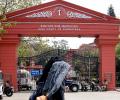
The Karnataka high court, which dismissed the batch of petitions by some Muslim girl students from Udupi seeking permission to wear the hijab inside classrooms, said there was no material placed on record to prima facie show that wearing the headscarf was an essential religious practice.
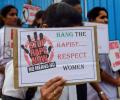
The court also found it difficult to believe at this stage that the complainant was subjected to rape on the false promise of marriage 'in the given circumstances of the case'.
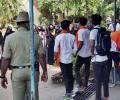
In its interim order issued by the three-judge full bench led by Chief Justice Ritu Raj Awasthi, the court also made it clear that the order was confined to such of the institutions wherein the College Development Committees have prescribed the student dress code or uniform.

Quoting verses from Surah Al Bakra in Qur'an, Justice Krishna S Dixit said a pious Muslim owes a moral and religious duty to provide subsistence to his destitute ex-wife.
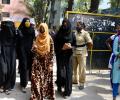
Karnataka has told the high court that its order dated February 5 did not ban the headscarf but only delegated the powers to decide the school uniform to the college development committees.

The single judge of the Karnataka high court hearing the case related to the 'hijab' ban in school-college campuses referred the matter to Chief Justice Ritu Raj Awasthi on Wednesday with a view that the CJ may decide on constituting a larger bench to look into the case.
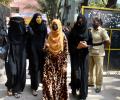
"This is our stand that hijab is not an essential religious practice. There was a statement by Dr B R Ambedkar in the Constituent Assembly where he said 'let us keep the religious instructions outside educational institutions'," Karnataka Advocate General Prabhuling Navadgi told the full bench of the high court, which is hearing the hijab case.
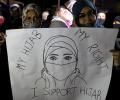
The appeal contended that the high court has sought to curtail the fundamental right of Muslim student women by not allowing them to wear the hijab.
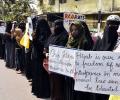
The Karnataka high court on Tuesday dismissed petitions filed by a section of Muslim students from the Government Pre-University Girls College in Udupi, seeking permission to wear the hijab inside the classroom.

The hijab-row triggered protests in Karnataka spread across the state on Tuesday, with campuses witnessing 'conflict-like' situations marked by stone-pelting incidents, use of force by police and the Muslim girls standing their ground for wearing the headscarves, prompting calls for peace and calm both by the government and the high court, which is now looking into the students' plea for their right to their hijab.
 © 2026 Rediff.com - Investor Information - Advertise with us - Disclaimer - Privacy Policy - Sitemap - Feedback - About us - Terms of use - Grievances