
All the three issues raised by China at the Modi-Xi meeting are either intractable or peripheral to the bilateral relations and suggest conventional methods to placate the other side without yielding much, says Srikanth Kondapalli.

The panel was set up to suggest ways to reform India's monetary policy.

'Pakistan thinks it is winning this low intensity conflict.' 'It is a serious observation. Half the battle is convincing your adversary that he cannot make headway.' 'A lot depends on how the internal professional management of the army and the handling of situations that are bound to rise sooner than later in his command, are done.'

Here comes the moment of truth. Modi prides himself on offering an "incorruptible" government. Will he dilute the Prevention of Corruption (Amendment) Bill to coax the administration's fealty and compromise his self-image?

The finance ministry has put out a revised draft in public domain.

The ability and quality of implementation of development initiatives remains India's Achilles' heel.

The 2015 World Bank group's Doing Business index ranked India at 142, down from 140, which it was the year before.

Within two weeks of the speech, the prime minister flagged off the Pradhan Mantri Jan Dhan Yojana, and the day was marked by announcing its outcome on the very first day of its implementation.
.jpg)
Both India and China have demonstrated levels of maturity in diffusing tensions and ensuring that the border remains by and large incident free, says Seema Mustafa

'I live in a privileged city, I have a privileged life, I was in a car.' 'If it can happen here, then there is literally no hope for women in rural India or smaller cities.' 'If more women think we can help ourselves, we can survive, and men would be a lot more hesitant to try something like this.'

'I can tell you, Mr Chairman, from personal experience that there is nothing sadder than witnessing a close one, a loved one with mental illness at close quarters.' 'I have lived with a victim of mental illness. Like many in that condition, very often such people are in a state of denial.'

'The "Hollandisation" of British policy may not bring the expected gains as the future may show,' says Claude Arpi.

Will China's new military reforms endanger Xi Jinping's rule?

Moshe's laughter rings in the home of the Rosenbergs, his maternal grandparents in Afula, Israel. Abhishek Mande Bhot listens in.
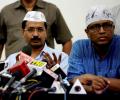
Swaraj Samvad has moved on to be a nationwide agenda, says group convenor Professor Anand Kumar.

'I felt like a used and discarded rag.' 'The pro-dialogue constituency has shrunk in the valley.' Academician and author Dr Radha Kumar was among the three interlocutors which the Manmohan Singh-led UPA government appointed on Kashmir in October 2010, speaks of how the panel report was never acted upon.
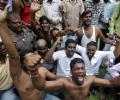
After many years of struggle and strife, Telangana has come to pass. Many lives have been lost and property destroyed because various governments at the Centre have had no defined policies for creating new states. There has to be a better way of "delivering" a state -- not by fasts, by threats or by violence unleashed by a "rent-a-crowd" but by a logical, democratic way of meeting the will of the people. Not the will of an egotistical leader who wants to establish one more political dynasty -- or one who equates state with caste.
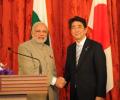
India and Japan are natural partners at sea, and Narendra Modi's recent visit underlined the need to keep the association going

'We have made no effort in recent years to build a national opinion on Kashmir amongst political parties.' 'At least we should speak as one country.' 'It has been a failure of our foreign policy that we have not been able to convince world opinion that something needs to be done about Pakistan.'

Orissa learnt its lessons from previous cyclones, particularly the 1999 super cyclone, whereas Uttarakhand has failed to do so from any of the previous natural calamities that hit the state, says Dinesh C Sharma.
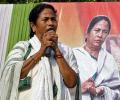
'In this election -- her first major one since wresting power from the Left -- Mamata has proved that she has simply maintained the Left's systemic status quo by ensuring that she implements the CPI-M method of election and result 'management', says Dr Anirban Ganguly.
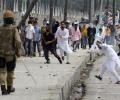
'The so-called separatists are representatives of Pakistan. They get paid from Islamabad for propagating that country's policy and conniving in her ploy of accession of Kashmir to Pakistan.'

'After more than 20 years of understanding, nothing much seems to have been achieved. What the two countries have been trying to do is to manage the recurrence of border incursions. The two sides must address the disease, and not the symptom of the disease,' says Rup Narayan Das.

The BDCA is yet another dose of insidious placebos administered on the people of India by their own government that has been in perpetual denial over the steady incremental loss of strategic Indian territory, says R N Ravi

Since many of Modi's urban policies were initiated in Ahmedabad, the city may act as a template to examine what can be expected in a country that is witnessing the biggest migration from rural to urban areas in the world

Imagine being a part of a country, but being discriminated against by the majority community and atrocities being committed against you by the state. This is the deplorable conditions that the Rohingyas of Myanmar live in where they are cut off from their livelihoods and sources of income, unable to access markets, hospitals and schools, and have little or no access to relief aid. In order to understand the situation and the genesis of the tragedy unfolding, Rediff.com's Archana Masih speaks to Ambassador Vijay Nambiar, the United Nations' Chef de Cabinet (Chief of Staff), who had served a long stint with the UN in New York on the issue.

Born and abandoned in Mumbai, reborn in Sweden, Erika Sandberg says she is Indian on the outside but feels Swedish on the inside. Vaihayasi Pande Daniel narrates her tale.

'Our story was really made after we saw what was happening in Punjab.' 'Earlier it was 'drug film, cool thriller, hipster movie.' Then we went to Punjab and we said, "Boss!"'

'Foreign policy-making cannot be shifted out of Delhi and the regional satraps, who do not have a national perspective, should not be allowed to dominate foreign policy. But regional inputs should be integral to foreign policy-making at every step of the way,' says Ambassador T P Sreenivasan.

'As the first leaders of their respective countries born after Indian Independence and the Chinese Liberation, Modi and Xi would be expected to have the ability to overcome the traditional mindsets and the hierarchical nature of their official/bureaucratic establishments,' say Alka Acharya and Jabin T Jacob.

In a recent lecture, RBI governor Raghuram Rajan dished out some frank advice -- don't get into 'jugaad', instead try for the long haul. Only that will sustain in the long-run.

Narendra Modi's promise to allow states a bigger say in strategising and building foreign policy is unexceptionable, says TP Sreenivasan.

India and China on Wednesday signed in all nine agreements, including the Border Defence Cooperation Agreement and one on strengthening cooperation on trans-border rivers, after restricted and delegation-level talks that lasted over two hours as Prime Minister Manmohan Singh and Premier Li Keqiang met for the second time this year for talks which the Indian leader described as "fruitful and productive".
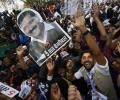
'I think the AAP is still in transition from being a movement to a political party so there is a mix of people who form the party. So there is somewhat of a overlapping and commonality of purpose.' 'Look at the way the government and party is functioning, not a single woman minister in the cabinet, or no woman member in the political affairs committee, it is all very tactical now.' 'After the 'sting' I decided to step back. I realised that my moral basis has been questioned by Kejriwal, it is truly despicable. He is around 15 years younger to me, I was aghast by his words.' AAP 'rebel' Prof Anand Kumar speaks of what went wrong with the party in the last few days in this interview with Upasna Pandey.

'What hurts people most is dynastic impulses and corruption under a family-ruled Congress party -- and Nehru has borne the brunt of it... I cannot be blinded by how the Nehru family has functioned but just as Gandhi can't be judged by his descendents, why should Nehru?' asks political scientist Ashutosh Varshney.
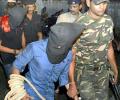
'Counter terrorism does not appear to be good guys fighting the bad ones; it is about people being picked up, detained and charged with crimes they did not commit.'

Those who know Shiv Shankar Menon will vouch that he did lots of things, substantial in the immediate neighbourhood and widespread in South Asia, but without making things public. Twenty per cent of Menon's job was visible, while 80 per cemt of his job was not known to the public, says Sheela Bhatt/Rediff.com

J Sandhya, member, Child Rights Commission, speaks to Shobha Warrier about the recent incident where more than five hundred poor children from Jharkhand, Bihar and West Bengal were being sent to Kerala orphanages, and why children's rights need to be protected with vigour.

'Modi's campaign has been strikingly devoid of anti-Muslim rhetoric. After the kutta pilla incident, it has been several months since he said something horrible about the Muslims of India. It is the result of democratic constraints. He has to make compromises... He's trying to reinvent himself. He will politically hurt himself if 2002 becomes the definition of Mr Modi again', says political scientist Ashutosh Varshney.
 © 2026 Rediff.com - Investor Information - Advertise with us - Disclaimer - Privacy Policy - Sitemap - Feedback - About us - Terms of use - Grievances