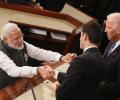
The maiden bilateral meeting between President Joe Biden and Prime Minister Narendra Modi on Friday will further strengthen the US-India strategic ties and allow the leaders to discuss the situation in Afghanistan and how the two countries can work together to fight terrorism, a senior White House official has said.

For the first time, the MiG-29K fighter aircraft undertook night landing on indigenously-built aircraft carrier INS Vikrant, a feat described by the Indian Navy as a 'historic milestone'.
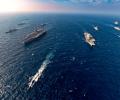
"Relevant countries should abandon the obsolete Cold War mentality and narrow-minded geopolitical rivalry concept and view correctly and respect people's aspiration in the region and do more things conducive to regional solidarity and cooperation," Chinese foreign ministry spokesman Zhao Lijian said.
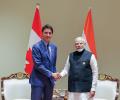
'They are too connected for the relationship to completely sour.' 'It will be difficult to mend this relationship, but it will start with full and clear evidence on the issue in question.'

China, the Ukraine crisis and Quad will dominate the discussions, observes Dr Rajaram Panda.
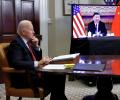
Washington is signalling to Delhi that it can rely on American support in any great game vis-a-vis China. Delhi shouldn't fall into the trap, argues Ambassador M K Bhadrakumar.
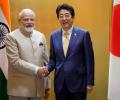
With the signing of the pact, the Quad grouping of India, Japan, Australia and the US is set to gain more heft now, notes Dr Rajaram Panda.
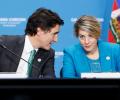
'The Americans want to have a good relationship with India. They see it as a counterweight to China. And also American businesses are all trying to get out of China and go to India and Vietnam as well, but India largely.'

Foreign Secretary Harsh Vardhan Shringla has met top Biden administration officials, including Secretary of State Antony Blinken and Deputy Secretary Wendy Sherman, and held substantive discussions with them on the strategic bilateral ties and regional and global issues like the current situation in Afghanistan after the Taliban seized Kabul.
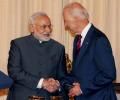
The two leaders agreed to work closely to further advance the India-US Comprehensive Global Strategic Partnership, built on shared values and common interests, it added.
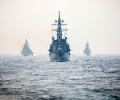
Aircraft carriers of India, the United States, Japan and Australia are set to take part in the second phase of Exercise Malabar that is scheduled to take place from November 17 to 20 in the Indian Ocean region, the Navy said on Monday.

Chief of Defence Staff Gen Bipin Rawat on Wednesday asserted that any possible terrorist activity flowing out of Taliban-controlled Afghanistan and finding its way into India will be firmly dealt with, and suggested that the Quad nations should boost cooperation in the global war on terrorism.
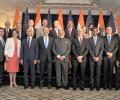
Prime Minister Narendra D Modi's itinerary for his June 21-24 US visit could include an address to a fledgling business advocacy group, the US-India Strategic Partnership Forum.

The navies of India, the US, Japan and Australia on Tuesday held a series of complex manoeuvres in the Bay of Bengal, kick-starting the four-day-long first phase of the Malabar naval exercise, seen as a prelude to future military cooperation among the member nations of the Quad or Quadrilateral Coalition.

Navy said the landing demonstrated India's capability to design, develop, construct and operate indigenous aircraft carrier with indigenous fighter aircraft.
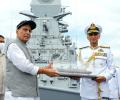
Taking a dig at China, Defence Minister Rajnath Singh on Sunday said 'some irresponsible nations' with their narrow partisan interests and hegemonic tendencies are coming up with wrong definitions of the UN Convention on the Law of the Sea.
Kurt Campbell, the White House Asia Coordinator, said that in his view India is the most important bilateral relationship for the United States in the 21st century.

Weeks before Canada made an explosive allegation implicating Indian officials in the killing of Sikh separatist leader Hardeep Singh Nijjar, Canadian officials sought public condemnation of the murder from their allies, including the United States, but were met with reluctance, The Washington Post reported.

In an interview with Larry O'Connor, Pompeo said in his meetings with his counterparts from Japan, India and Australia, they began to develop a set of understandings and policies that can jointly take these countries to work to present a true resistance to the threats that the Chinese Communist Party poses to each of these nations.

External Affairs Minister S Jaishankar has said India faces a 'very complicated challenge' from China, and the Narendra Modi government has taken steps to ensure no attempts are made to change the status quo in the border areas unilaterally.
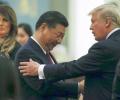
'While many Chinese policy makers dismiss the political, economic and technological component of US-India relations, they express caution on the defence-related ties which also happens to be a major driver in US-India relations,' explains China expert Srikanth Kondapalli.
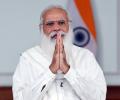
The main elements of the programme are bilateral meetings with the US leadership, participation in the Quad Leaders' Summit, address at the UN General Assembly and business interactions.
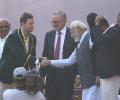
Prime Minister Narendra Modi and his Australian counterpart Anthony Albanese will hold extensive talks on Friday with a focus on boosting overall bilateral ties in areas of trade and investment, defence and critical minerals.

'The future of BRICS is under stress as Chinese attempts to expand the platform are being resisted by India and Brazil.' 'Beijing is focused on a quick expansion with the aim of giving the platform a distinctly anti-Western orientation, which New Delhi and Brasilia seem to have no interest in,' notes Harsh V Pant.

A healthy growth in India's services segments has helped the country's total exports and imports of goods and services to cross the $800 billion mark during the first half of 2023, despite a slowdown in global demand, think tank GTRI said in a report on Monday. According to the analysis of the Global Trade Research Initiative (GTRI), exports of goods and services rose by 1.5 per cent to $385.4 billion during January-June this year, as against $379.5 billion in January-June 2022. Imports, however, dipped by 5.9 per cent to $415.5 billion during the six months of this year, as against $441.7 billion in January-June 2022.
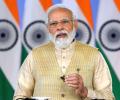
Modi emphasised the need to return to a path of dialogue and diplomacy in dealing with the Ukraine crisis.

Modi will also meet Chinese President Xi on the sidelines of the summit. It would be their fourth meeting in last seven months.

Shringla said India will continue to work towards the reformed United Nations during its stint as a non-permanent member of the UN Security Council.

'In light of the events in Israel, Foreign Minister Cohen decided to cut short his diplomatic visit to India and return to Israel after the meeting with Indian Prime Minister Narendra Modi that will take place today'
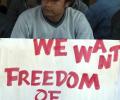
'This includes increasing restrictions on freedom of expression and the detention of human rights activists and journalists'

The bilateral and Quad summits, in which Prime Minister Modi played a significant role, has sent the right message to China, observes Ambassador T P Sreenivasan.

According to the Biden-Harris Transition, 'the president-elect noted that he looks forward to working closely with the prime minister on shared global challenges, including containing COVID-19 and defending against future health crises, tackling the threat of climate change, launching the global economic recovery, strengthening democracy at home and abroad, and maintaining a secure and prosperous Indo-Pacific region'.
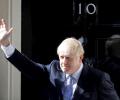
UK Prime Minister Boris Johnson was supposed to be the chief guest at Republic Day, but due to the surge in COVID-19 cases in the UK and the spread of a new strain, he cancelled his visit. Johnson is scheduled to visit India in April.

Ahead of the Quad summit on Friday, China said exchanges and cooperation between countries should contribute to mutual understanding rather than "targeting" a third party and refrain from "pursuing exclusive blocs".

In a post on X, Modi said, "Happy to have welcomed @POTUS @JoeBiden to 7, Lok Kalyan Marg. Our meeting was very productive."

It is understood that India's border row with China figured in the talks between Foreign Secretary Harsh Vardhan Shringla and US Under Secretary of State for Political Affairs David Hale though there was no mention of it in the press statements issued by the two sides.
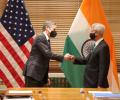
'We know that our Indian partners are committed to that rules-based international order. There are any number of tenets in that order. One of them is that borders cannot be redrawn by force'

Prime Minister Narendra Modi held talks with US President Joe Biden at the White House on Thursday to discuss a wide range of issues of mutual and global interests, aimed at further boosting the Indo-US strategic relations in areas like defence, space, clean energy and critical technologies.

'Countries around the world are like passengers aboard the same ship. For the ship to navigate the storm and sail toward a bright future, all passengers must pull together'

After his wide-ranging talks with Modi on the second and final day of his India visit, Johnson said the new defence and security partnership will enable India to strengthen its domestic defence industry as well as help the two countries protect vital shared interests in the Indo-Pacific.
